

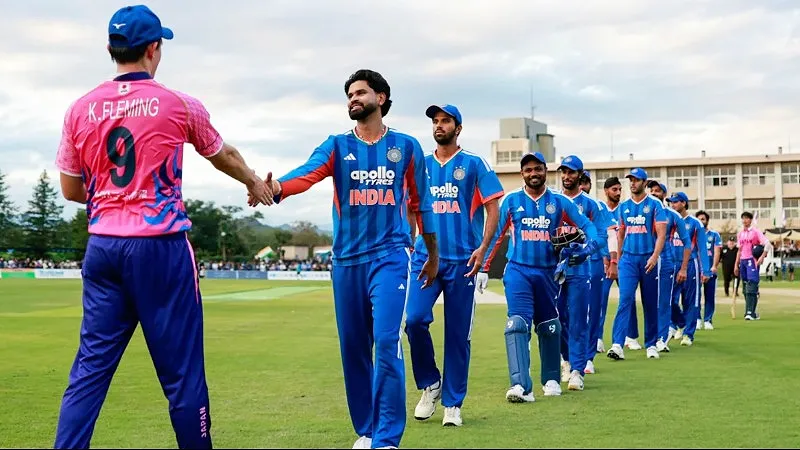

The structure is the bigger threat because India walks straight into a one-off quarter-final with no tournament cricket behind them. Their likely opponent will already have two competitive games under its belt. Seeding looks like a reward on paper, but in Aichi-Nagoya it removes every safety net. Every other risk on this trip flows from that design. One flat afternoon on 28 September ends the gold defence, and the squad heading there is already absorbing two late, unplanned injury changes.
Asian Games 2026 cricket format India
The men’s event runs from 24 September to 3 October with 10 teams. Six of them play a single round-robin between 24 and 26 September: Afghanistan, Japan and Nepal in Group A, with Hong Kong, China, Malaysia and Oman in Group B.
Only the top two from each group advance. India, Pakistan, Sri Lanka and Bangladesh are seeded directly into the last eight without playing a group game.
India meet the Group A runner-up on 28 September, the same day Pakistan face the Group B runner-up. Sri Lanka take on the Group A winner on 29 September, and Bangladesh face the Group B winner to complete the round.
Team | Seeded or Qualifier | Group Matches Before QF | QF Opponent | QF Date |
|---|---|---|---|---|
India | Seeded | 0 | Group A runner-up | 28 Sep |
Pakistan | Seeded | 0 | Group B runner-up | 28 Sep |
Sri Lanka | Seeded | 0 | Group A winner | 29 Sep |
Bangladesh | Seeded | 0 | Group B winner | 29 Sep |
Afghanistan, Japan, Nepal | Qualifier (Group A) | 2 each | Seeded team (if top 2) | 28-29 Sep |
Hong Kong, Malaysia, Oman | Qualifier (Group B) | 2 each | Seeded team (if top 2) | 28-29 Sep |
One Knockout Tie, Zero Warm-Up
That leaves the title defence resting on a single elimination match with nothing competitive at the event beforehand. The only recent outing was a one-off T20I against Japan on 22 September, useful but nowhere near tournament pressure.
Lose that quarter-final and the campaign is over in one afternoon, however strong the squad looks on paper. There’s no group-stage cushion to absorb an off day. If two or three frontline batters misfire at once, there’s no second chance to put it right. One inspired spell from an underdog bowler would be enough.
Group A Sides Arrive Match-Sharp
Compare that with the side most likely to line up opposite India on 28 September. Whoever finishes second in Group A will have played two round-robin matches in the three days before the quarter-final, settling batting orders, bowling plans and fielding roles in real conditions.
Afghanistan look the likeliest pace-setters in that group. They reached the final in both earlier editions that used this format, 2010 and 2014, as underdogs, and they knocked out Pakistan in the 2023 semi-final. Any side with two games of rhythm can hurt a seeded team walking in cold. Rhythm often matters more than rankings in a single game.
The Hangzhou Washout Gold Proved Little
The 2023 gold in Hangzhou gets quoted as proof of dominance, yet the final was never finished. India won the toss, bowled first, and held Afghanistan to 112 for 5 in 18.2 overs before rain ended play for good. It’s hard to read much into it.
Gold was awarded on the higher ICC T20I ranking under the washout rule, not on a result. It remains their only final at these Games, and they didn’t have to win it on the field. That’s one weather-assisted data point, not evidence of a team that knows how to win a straight knockout decider here.
Iyer’s Depleted Squad Faces the Trap
Shreyas Iyer leads the side, but not at full strength. Pacer Harshit Rana was ruled out with a rectus femoris strain and replaced by Yash Thakur, while spinner Varun Chakaravarthy went down with a side strain and made way for Vipraj Nigam.
So a ring-rusty group is also absorbing two late changes before a knockout-only campaign. The women’s team showed how lopsided these mismatches can look when they thrashed Japan in a five-over quarter-final on the way to gold. The men get exactly one shot at a day like that, against opponents who have already had two, and that imbalance is the real danger built into the Asian Games 2026 cricket format India must survive.
Is a single knockout game a fair way to decide a seeded team’s fate, or should the top four play group cricket too? Tell us in the comments.
Frequently Asked Questions (FAQs)
How does Asian Games men’s cricket work?
Ten men’s teams compete between 24 September and 3 October. Six play a single round-robin in two groups of three, and the top two from each group join India, Pakistan, Sri Lanka and Bangladesh in the quarter-finals.
When does India play their first cricket match in Aichi-Nagoya?
India’s men open their campaign in the quarter-final on 28 September. They face the Group A runner-up, with the semi-final on 1 October and both medal matches scheduled for 3 October.
Who is India’s captain at the Asian Games?
Shreyas Iyer captains India’s men’s team in Aichi-Nagoya. Tilak Varma is his vice-captain, while Harmanpreet Kaur led the women’s side that has already won the gold medal at this edition.
Why does India start at the quarter-finals?
India received a direct bye as one of the four highest-ranked teams in the competition. The seeding for India, Pakistan, Sri Lanka and Bangladesh was based on ICC T20I rankings at the time of the draw.
Who won the cricket gold medal at the 2023 Asian Games?
India won the men’s gold after the final in Hangzhou was abandoned due to rain. Afghanistan had reached 112 for 5, and the title was decided on India’s higher ICC T20I ranking.