

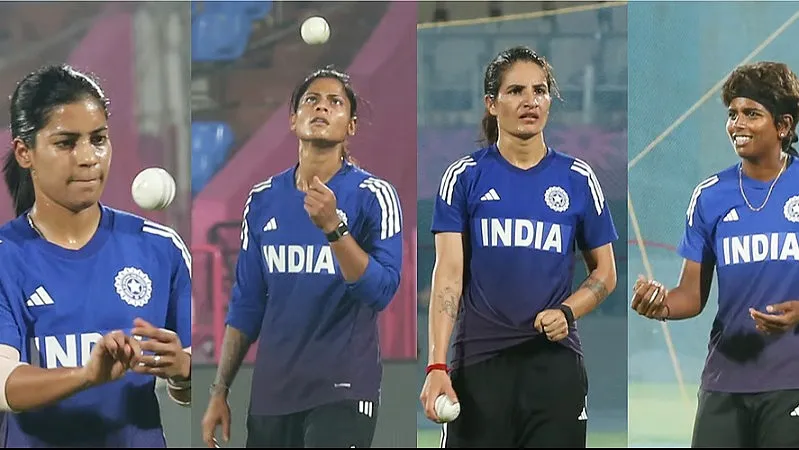

It isn’t the batting order or the captaincy record. Three failed campaigns in 2026, against South Africa, England, and at the T20 World Cup, all collapsed in the same passage of play: the closing five overs with the ball in hand. India conceded more runs per over at the death than any semi-finalist at the World Cup and lost twice inside the last five overs of a chase. Heading into Dubai, fixing that pattern matters more than any batting fix being debated publicly.
A Rocky Run Before Reaching Dubai
The 2026 T20I calendar has been turbulent. South Africa won 4-1, with Laura Wolvaardt averaging over 82 across the series while India’s attack leaked runs at the death. England beat India in two of three T20Is, Arundhati Reddy conceding 23 to 24 runs in one death spell in Bristol.
The T20 World Cup confirmed the trend. India conceded 7.43 runs per over across the tournament, worse than any of the four semi-finalists, and lost to South Africa and Australia inside their last five overs. It was a group-stage exit for the second straight World Cup, Dubai now the first chance to reverse it.
India Women Death Overs Bowling Asia Cup 2026
At the World Cup, the pace unit claimed only five wickets in total, the joint-lowest return in the tournament. Nandani Sharma was the best of them, three wickets at an economy of 8.69, yet she was left out against Australia. Arundhati Reddy and Kranti Gaud went wicketless throughout, and the same pace combination was never fielded twice.
The Australia game exposed the problem starkly. Three bowlers conceded above 10 an over as Ellyse Perry, 56, and Ashleigh Gardner, 53 not out, added a match-winning stand to complete a six-wicket chase of 171. Against South Africa, the attack folded against Marizanne Kapp’s unbeaten 81, with three catches off her dropped. Coach Amol Muzumdar later acknowledged the bowling group was inexperienced, spinners taking roughly 87.5 percent of India’s wickets across the tournament.
The Attack Carrying Hopes Into Dubai
The Asia Cup pace attack is unchanged from the World Cup: Renuka Singh Thakur, Arundhati Reddy, Kranti Gaud, and Nandani Sharma. Renuka remains the senior threat but has managed workload and injury concerns through the year. Arundhati has 45 T20I wickets and can bowl a yorker under pressure, though her economy has hovered near eight. Kranti Gaud, just 22, brings raw pace but a limited sample.
Deepti Sharma is the wild card, her five-wicket haul against Pakistan at the World Cup proof she still has bite, but she is a spinner rather than a genuine death-overs option. India need at least one pacer to claim three or more wickets in the back five overs of a knockout match, and in Dubai’s dew, where the ball skids through, spin becomes harder to trust late in an innings.
Sri Lanka And Pakistan Set A High Bar
India remain seven-time Asia Cup champions and the most successful side in the competition’s history, but they lost the 2024 final to Sri Lanka by eight wickets, undone by Harshitha Samarawickrama’s finishing in the closing overs. Defending champions Sri Lanka arrive in Dubai again led by Chamari Athapaththu, who struck 115 runs against Bangladesh at a strike rate of 122.34 and took four wickets at an economy of 5.50 in the same series.
Pakistan have their own death-overs weapon in Eyman Fatima, unbeaten on 79 off 43 balls against Zimbabwe. Both rivals now carry finishers capable of punishing exactly the bowling that failed India three times already this year.
The Stakes For Harmanpreet And The Coaching Staff
The timing raises the pressure further. With the Asian Games following in September, another death-overs collapse in Dubai would put Harmanpreet Kaur’s captaincy and Muzumdar’s methods under scrutiny, neither can afford. A second straight Asia Cup final exit would confirm the problem from South Africa, England, and the World Cup was never fixed.
That is why India women’s death-overs bowling in the Asia Cup 2026 remains the story to watch above every other subplot in the tournament. Everything else- the batting order, the captaincy debate, the team composition- is secondary until the bowlers prove they can hold a total in overs 16 through 20.
Can Renuka and this pace attack finally close out a knockout game, or does India’s Asia Cup defence come down to the death overs again? Tell us your prediction in the comments.
Frequently Asked Questions (FAQs)
Why does India keep losing close T20Is late in the innings?
Their pace bowlers have been expensive and wicketless when it matters most. At the T20 World Cup, their seamers took only five wickets in the entire tournament, the joint-lowest total among all sides.
Who bowls the death overs for India at the Asia Cup?
Renuka Singh Thakur leads a group that also includes Arundhati Reddy, Kranti Gaud, and Nandani Sharma. Deepti Sharma and Radha Yadav offer spin cover, though Deepti is not considered a genuine finishing-overs option.
How successful has India been at the Women’s Asia Cup historically?
India have won the title three times and remain the most successful side in the competition. They were beaten in the 2024 final by Sri Lanka, losing by eight wickets in Dambulla.
Which knockout defeat exposed India’s bowling problems this year?
The T20 World Cup loss to Australia was the clearest example. India conceded 172 for 4 in 19 overs after posting 170 for 4, with two bowlers wicketless as Perry and Gardner added a match-sealing stand.
When does the Women’s T20 Asia Cup 2026 get underway?
The tournament runs from August 28 to September 13 in Dubai. All matches are staged at the Dubai International Cricket Stadium, with the final on September 13.