

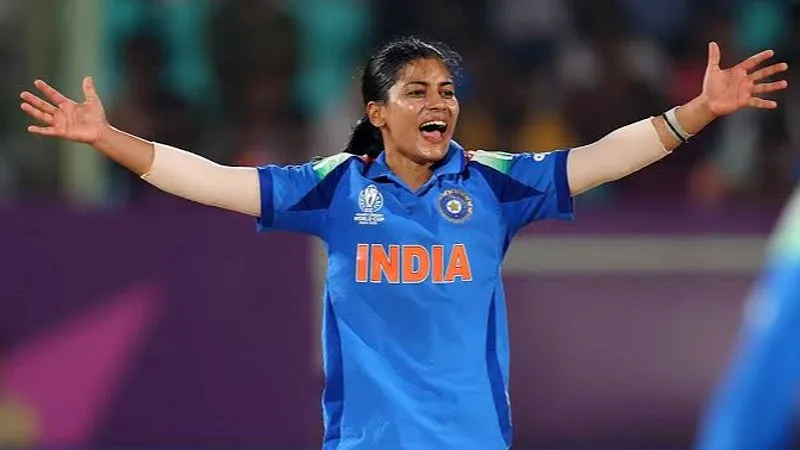

Amanjot Kaur never bowled a ball at this tournament, never faced a delivery, never appeared at Lord’s. Her back injury in February removed her from selection entirely, and the reigning ODI world champions spent five group games trying to compensate for it. They won three, lost the one that mattered, and finished third in Group 1. Every specific gap head coach Amol Muzumdar pointed to after the exit traces back to the same moment her name was scratched from the squad.
The Injury That Derailed the Squad
Amanjot suffered a back injury after India’s series against Australia in February and was ruled out for four to five months. The squad didn’t simply lose a player; it lost a role no single replacement could fill.
Kashvee Gautam was named to fill the gap, then picked up a knee injury herself. India used three players to cover one position: seamer Nandani Sharma, spin all-rounder Radha Yadav, and power-hitter Bharti Fulmali. Chief selector Amita Sharma said Amanjot had been strengthening all three departments at once, and Harmanpreet Kaur described her as the hardest player in the squad to replace. A mid-tournament injury to off-spinner Shreyanka Patil stretched the unit further.
India Women’s T20 World Cup 2026 exit reasons: Amanjot Kaur
The pace bowling numbers are unambiguous. India fielded a different seam combination in every match. Nandani Sharma took three wickets at 8.69, the best return among the seamers. Arundhati Reddy and Kranti Gaud went wicketless. Renuka Singh Thakur barely got a game until the Australia decider.
Spinners carried the entire burden: 29 of India’s 34 wickets came from spin, accounting for 85.3% of the total haul. The team’s overall economy of 7.43 was worse than every semi-finalist: Australia managed 6.21, South Africa 6.93, England 7.23, West Indies 7.36.
Bowling Category | Wickets | Economy | Tournament Context | % of Total |
Spin (combined) | 29 | Not separately reported | Carried the attack all 5 games | 85.3% |
Pace (combined) | 5 | Not separately reported | Best: Nandani Sharma, 3 wkts | 14.7% |
Nandani Sharma | 3 | 8.69 | Best-performing seamer; sat out vs Australia | 8.8% |
Arundhati Reddy / Kranti Gaud | 0 | Not found | Wicketless through the tournament | 0% |
Team Overall | 34 | 7.43 | Worse than all 4 semi-finalists (6.21-7.36) | 100% |
Perry, Gardner and the Bowling Rotation Problem
Chasing 171, Australia were 68 for 3 inside ten overs. Then Ellyse Perry and Ashleigh Gardner added an unbroken 100 for the fourth wicket, the highest successful chase in Women’s T20 World Cup history, and overs 13 to 18 produced 81 runs as the required rate fell from 10.33 to 2.50.
The over-by-over breakdown: 17 off Radha Yadav in the 13th, 16 off Sree Charani in the 15th, 17 off Renuka Singh Thakur in the 17th. India had no answer. Harmanpreet turned to part-time batter Shafali Verma to try to break the partnership. An experienced medium-pacer with international caps would have been the obvious choice; India simply didn’t have one.
A Middle Order Without Its Best Finisher
The middle-order collapses weren’t a one-off. India lost three for 14 against Pakistan, three for six against the Netherlands, three for 29 against South Africa. Results disguised how regularly the batting unit lost shape before those games were decided.
Against Australia, it couldn’t be papered over. Harmanpreet’s 56 off 27 balls, built on three consecutive sixes off Sophie Molineux, stood apart from everything else the middle order produced. No one else matched that finishing pace, and the No. 5 spot between Yastika Bhatia and Bharti Fulmali was never settled. Amanjot’s best knock internationally was an unbeaten 63 off 40 balls; that acceleration was exactly what India kept needing when Harmanpreet wasn’t batting.
The Loss That Was Decided Before June
Muzumdar noted India could have used 10 to 15 more runs and that the powerplay never quite worked for them. He stopped short of naming any single tactical call.
But the squad arrived already missing its most complete all-round option. The pace attack had no reliable sixth bowling option, and the No. 5 spot was never settled. When assessing the India Women’s T20 World Cup 2026 exit reasons, Amanjot Kaur provides the clearest thread connecting each failure, running all the way back to a February injury before a single World Cup ball was bowled.
Drop your take in the comments: could India have reached the semi-finals with a fit Amanjot Kaur, or was the squad depth always going to be exposed at this level?
FAQs
Why did India Women fail to reach the T20 World Cup 2026 semi-finals?
India finished third in Group 1 with three wins from five, behind Australia and South Africa. A six-wicket defeat to Australia at Lord’s on June 28 ended their campaign.
How many wickets did India’s pace bowlers take at Women’s T20 World Cup 2026?
India’s seamers took just 5 of 34 tournament wickets, with Nandani Sharma top-scoring on three at 8.69 economy. Arundhati Reddy and Kranti Gaud were wicketless across all five group games.
What injury kept Amanjot Kaur out of the 2026 Women’s T20 World Cup?
Amanjot sustained a back injury after India’s Australia series in February 2026 and was ruled out for four to five months. She missed squad selection, leaving India without a replacement.
How did Perry and Gardner turn the game in the Australia chase?
Perry and Gardner put on 100 unbroken for the fourth wicket with Australia needing 103 from the last ten overs. Overs 13 to 18 produced 81 runs, cutting the required rate from 10.33 to 2.50.
What did Harmanpreet Kaur score against Australia at Lord’s?
Harmanpreet Kaur hit 56 off 27 balls, including three consecutive sixes off Sophie Molineux in the final over. Her innings helped India reach 170, but Australia chased it down with six wickets to spare.