

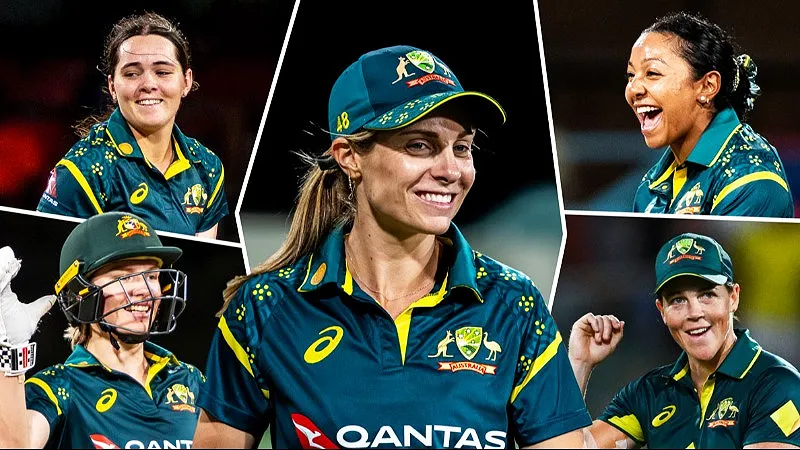

Australia’s decision to pick Lucy Hamilton over Darcie Brown is not a like-for-like swap between two pace bowlers. It is a structural argument about how to win in England. Seven venues in June and July on English soil, four of them historically favouring turn and variation over raw carry, and Australia has responded by building an attack that bowls from five different angles with no duplication. The Lucy Hamilton selection is the clearest signal of that intent, but the full picture only makes sense when you read the whole squad.
English Conditions: Raw Pace Loses Value
The ICC Women’s T20 World Cup 2026 runs from June 12 to July 5 across seven venues, including Edgbaston, Old Trafford, Headingley, the Rose Bowl, Bristol County Ground, The Oval, and Lord’s. Australia plays two group games at Old Trafford and Lord’s, historically among the slower, drier squares in England, where the ball doesn’t carry as consistently, and bouncers lose their sting. Lateral movement rewards control and angle over raw speed.
This is the condition set that makes Brown’s omission logical and Hamilton’s inclusion deliberate. National selector Shawn Flegler confirmed “raw pace expected to be less effective” in English conditions, and that single phrase explains the entire selection framework, not just one decision.
Hamilton vs Brown: The Left-Arm Difference
Brown has taken 34 wickets in 41 T20Is at an economy of 6.64, but was wicketless in her last four appearances, three against West Indies and one against New Zealand in early 2026. Flegler confirmed selectors had been trying to develop her into a frontline powerplay bowler for two years without success. With six right-arm pace options already in the mix, adding a seventh addressed nothing.
Hamilton’s T20I debut produced 1/11. In the WBBL, she became the youngest player in competition history to take a five-wicket haul, returning 5/8 against Melbourne Stars and removing Meg Lanning and Annabel Sutherland. She took five wickets at an average of 10.8 at the 2023 U19 Women’s T20 World Cup. The left-arm angle she creates from around the wicket against right-handers is unavailable to any right-arm seamer in this squad.
Australia Women T20WC 2026 Squad
The table below maps every bowling option and the arm angle each provides. The key arithmetic: Australia now carries two left-arm options, Molineux’s orthodox spin and Hamilton’s pace, against a predominantly right-handed world. Every other seam option in the squad is right-arm. Brown would have added a sixth right-arm pace bowler.
Player | Role | T20I Economy | Recent Wickets / Note | Arm |
Sophie Molineux | Left-arm spin / Capt | 6.11 | 19 (15 T20Is) | Left-arm |
Ashleigh Gardner | Off-spin / All-rounder | 6.50 | 41 T20I career | Right-arm |
Alana King | Leg-spin | 5.50* | 5 in WI series | Right-arm |
Georgia Wareham | Leg-spin / All-rounder | 7.10 | 6 in 2024-25 | Right-arm |
Megan Schutt | Right-arm pace | 6.80 | T20I spearhead | Right-arm |
Kim Garth | Right-arm fast-medium | 7.20 | T20I regular | Right-arm |
Lucy Hamilton | Left-arm pace | 5.50 | 1/11 (1 T20I) | Left-arm |
Darcie Brown | Right-arm pace (omitted) | 7.50 | 0 last 4 T20Is | Right-arm |
Four Spinners Built for England
Four specialist spinners in a T20 World Cup squad sounds like excess. In England in June, it’s a plan. Molineux has taken 19 wickets in 15 T20Is at an economy of 6.11. King was the player of the series against West Indies in March 2026, five wickets at an average of 11, economy 5.5. Wareham was Australia’s leading wicket-taker in the 2024-25 Women’s Ashes T20Is with six scalps. Gardner’s off-spin rounds out a quartet that attacks from four distinct spin angles.
Old Trafford, one of Australia’s group-stage venues, is historically among the driest, turn-friendly surfaces in England. Combined with Hamilton’s left-arm pace, Australia now bowls from five different angles: left-arm spin, off-spin, two leg-spinners, and left-arm pace, with no duplication across the attack.
India and South Africa: The Payoff
Australia plays South Africa at Old Trafford on June 13 and India at Lord’s on June 28, both venues that suit the bowling attack they’ve built for this tournament.
India’s right-handed top order of Smriti Mandhana, Shafali Verma, and Harmanpreet Kaur faces both Molineux’s left-arm orthodox and Hamilton’s left-arm seam, attacking the same corridor from different angles. Two leg-spinners in Wareham and King compound the variation. India has faced pace-heavy attacks repeatedly; this configuration is less familiar.
South Africa has reached back-to-back Women’s T20 World Cup finals in 2023 and 2024, finishing runners-up both times, a batting-heavy side with a pace-reliant attack. On English surfaces in June, left-arm angles and four-spinner variation represent the match-up they’ve had the least exposure to. This Australia Women T20WC 2026 squad isn’t the best 15 players available; it’s a purpose-built response to a specific venue set, and Group 1’s two strongest opponents are precisely the sides it was designed to beat.
Does Australia’s five-angle attack make them the most tactically prepared side at this tournament, or are England and India better suited to home conditions? Vote below.
FAQs
Why was Darcie Brown left out of Australia’s T20WC squad?
Brown was wicketless in her last four T20Is and added a redundant sixth right-arm pace option to a squad that needed variety. Selectors had spent two years trying to develop her into a powerplay bowler without success.
Who is Lucy Hamilton and why was she selected?
Hamilton is a 20-year-old left-arm fast bowler who became the youngest WBBL player to take a five-wicket haul (5/8 vs Melbourne Stars). Her left-arm angle into right-handers fills a gap no right-arm seamer in the squad can cover.
Who does Australia play in the WT20WC 2026 group stage?
Australia face South Africa (Old Trafford, June 13), Bangladesh (Headingley, June 17), Netherlands (Rose Bowl, June 20), Pakistan (Headingley, June 23), and India (Lord’s, June 28). The top two from each group advance to the semi-finals at The Oval.