

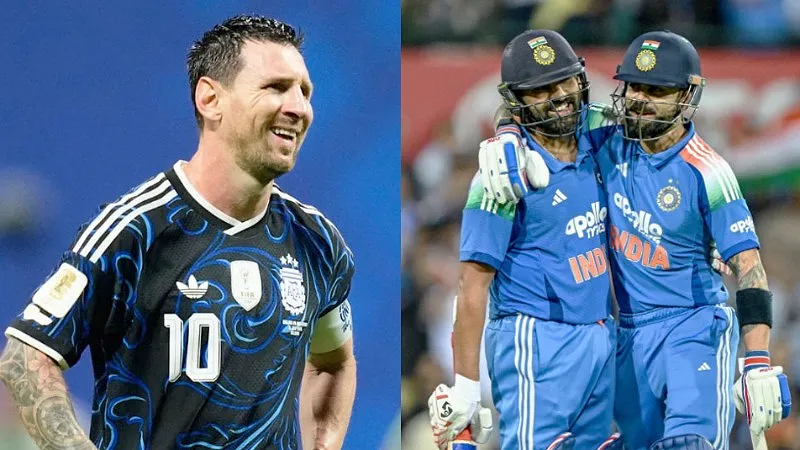

It hinges on South Africa because Kaif isn’t making a nostalgia argument; he’s making a conditions argument. Bouncy, seaming pitches at venues India rarely sees domestically demand a technique that Kohli has already proven, and Rohit has not, at least not consistently. Speaking on Cricbuzz after Rohit’s twin failures against England, Kaif framed the entire case around what the 2027 tournament will actually ask of India’s batting lineup. The Messi comparison is about experience solving one narrow problem: helping a young side under Shubman Gill survive conditions it has barely encountered.
Kaif’s Case Built Around One Tournament
Kaif didn’t frame this as a farewell tribute or a case for reputation. His argument was specific to one tournament: the 2027 ODI World Cup, co-hosted by South Africa, Zimbabwe and Namibia, arriving with pitches unlike anything India’s batters see at home. He predicted a difficult tournament with genuinely bouncy surfaces, and said plainly that India will need both senior batters there regardless of who holds the captaincy.
That last point matters. Shubman Gill has already been confirmed as ODI captain, so Kaif isn’t lobbying for Kohli or Rohit to lead anything. He’s positioning them as specialists brought in for a specific job. That distinction changes how the conversation should be read entirely, since nobody is asking India to reverse Gill’s promotion.
Kohli Rohit India ODI 2027 South Africa
The framework Kaif used borrows directly from football. When younger players can finish games, he argued, experienced heads know how to guide them and manufacture chances, exactly the role Messi still plays for Argentina. Applied to India, that means Kohli and Rohit aren’t there to outscore Jaiswal or Suryakumar; they’re there to structure a lineup around them. It isn’t about winning every match personally. It’s about experience absorbing pressure so a young batting order doesn’t have to face unfamiliar conditions completely alone for the first time on the biggest stage available.
Pace And Bounce No Subcontinent Pitch Offers
South Africa’s pitches at Centurion, Johannesburg and Cape Town carry, seam and bounce in ways Indian surfaces simply don’t replicate. Kohli’s numbers there back up the argument directly: a 76.38 average across 20 matches, including 558 runs on the 2018 tour alone, the kind of output that proves technique holds up under genuine pace.
Rohit’s record in the same conditions has historically been far more modest, with just one century to show on South African soil. Gill, at this stage, has barely been tested there at all. None of that is his fault; it’s simply a gap in the resume that experience elsewhere cannot fill.
Player | ODI Average in SA | Centuries in SA | Matches in SA |
|---|---|---|---|
Virat Kohli | 76.38 | 3 | 20 |
Rohit Sharma | 16.63 | 1 | 14 |
Shubman Gill | Limited exposure | 0 | Under 5 |
Gill’s Inexperience Raises The Stakes Further
Gill is 25 and has faced very little top-level South African pace and carry in his career so far. Build a batting order around him with Jaiswal, Suryakumar and other newer names, and the entire top six is essentially walking into a learning curve at the worst possible moment, a World Cup. Kohli and Rohit, whatever their current form suggests, have already sat that exam and passed it.
That’s the whole of Kaif’s argument in one sentence: experience that has already been tested under these exact conditions is not something you discard lightly, even amid retirement speculation that BCCI officials have themselves pushed back on. BCCI secretary Devajit Saikia publicly denied any retirement decision had been made, keeping both names firmly in the frame for now.
Testing Whether The Messi Parallel Holds
The football parallel is useful, but it isn’t perfect. Messi’s value to Argentina comes partly from presence and goal threat even in quiet matches; a cricketer has to actually score the runs; there’s no equivalent of simply occupying space effectively. That’s where Kaif’s comparison holds up best for Kohli, whose South Africa numbers do the talking, and holds up less cleanly for Rohit, whose case leans more on winning ICC tournaments in 2023 and 2024 than on a strong personal average in these specific conditions.
Form over the next year will decide plenty, but conditions rarely change. Even accounting for that gap, the Kohli Rohit India ODI 2027 South Africa debate isn’t going away before the squad is picked.
Does Kohli’s South Africa record make him undroppable for 2027, or is Kaif overrating what two veterans can offer a team building around Gill? Tell us where you land in the comments.
Frequently Asked Questions (FAQs)
Why does Mohammad Kaif compare Kohli and Rohit to Messi?
He says their experience guides India’s younger players the way Messi guides Argentina. Kaif argues both veterans help a young batting order under Shubman Gill cope with unfamiliar South African conditions in 2027.
Where is the 2027 ODI World Cup being held?
South Africa, Zimbabwe and Namibia will co-host the tournament. South Africa’s pace-friendly venues, including Centurion, Johannesburg and Cape Town, offer conditions very different from what India’s batters see at home.
What makes South African pitches different from subcontinent pitches?
They offer far more bounce, seam movement and pace. Tracks at Centurion, Johannesburg and Cape Town rarely resemble the slower, drier surfaces found across India and much of the subcontinent.
Are Kohli and Rohit guaranteed a place in India’s 2027 World Cup squad?
No, neither player’s spot is guaranteed. Rohit’s retirement was speculated after his poor England ODI form, a claim BCCI secretary Devajit Saikia publicly denied, leaving selection to hinge on form.
Who is India’s ODI captain heading into the 2027 World Cup?
Shubman Gill is India’s ODI captain. Kaif argues Gill’s youth and limited South African exposure make Kohli and Rohit’s experience essential alongside him at the tournament.