

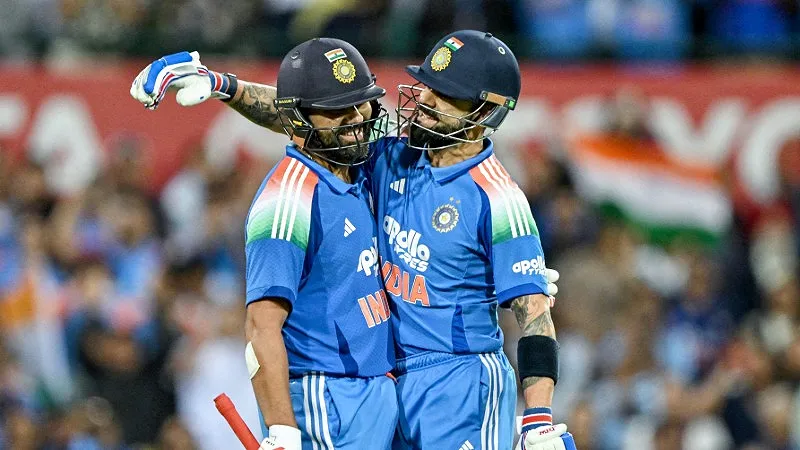

Kohli needs one big innings. Rohit needs a three-match heist. Both stand a genuine chance of erasing Rahul Dravid’s all-time bilateral ODI runs mark for an Indian batter in England, a tally that has stood since 2011. Arriving at Edgbaston as red-ball retirees now fully focused on the fifty-over game, the pair open India’s three-match series with contrasting math in front of them. One man is close enough to touch history in a single afternoon. The other needs something historic across all three games.
Sharma’s Bilateral Numbers Set the Bar
Rohit Sharma’s bilateral ODI record against England on English soil reads 410 runs from 10 matches at an average of 58.57. Two centuries sit inside that tally, the highest an unbeaten 137. That knock alone tells you what he’s capable of on these pitches.
Getting past Dravid’s mark means finding 239 more runs in only three matches, working out to roughly 80 per innings across the series. It’s a big ask by any measure, but not an impossible one for Rohit at this ground. His Edgbaston average sits at 89.4, exactly the kind of number a chase like this needs, and the series opener is being played right there. That average alone explains why this opener could turn into exactly the platform he needs, sooner rather than across all three games.
Kohli Rohit England ODI 2026 runs record
Kohli’s bilateral numbers in England read 581 runs from 16 matches at 38.73, one century worth 107 and four fifties built around it. Widen the lens to every ODI he’s played in the country, World Cup and Champions Trophy included, and the tally jumps to 1,349 runs from 33 matches at 51.88, with 12 fifties alongside that lone hundred.
Fourth on the all-time bilateral list and only 68 runs behind the top spot, Kohli arrives with something Sharma doesn’t have right now: rhythm. Six of his last seven ODI innings before this series produced fifty-plus scores. A single big afternoon could settle this in his favour.
Dravid, Tendulkar and Dhoni Lead the Way
Dravid built his 648 bilateral runs in England across a 15-year international career stretching from 1996 to 2011, averaging 38.11 with seven half-centuries and not a single hundred. Tendulkar sits behind him with 639 runs from 17 matches at 39.93, and Dhoni occupies third with 613 from 21 matches at 40.86, without ever converting to three figures.
Here is how the five names line up on the all-time bilateral chart:
Batter | Matches | Runs | Average | Centuries |
|---|---|---|---|---|
Rahul Dravid | 20 | 648 | 36.00 | 1 |
Sachin Tendulkar | 17 | 639 | 39.93 | 1 |
MS Dhoni | 21 | 613 | 40.86 | 0 |
Virat Kohli | 16 | 581 | 38.73 | 1 |
Rohit Sharma | 10 | 410 | 58.57 | 2 |
Kohli needed only 16 innings to climb to fourth on that list. Sharma needed just 10 to break into the top five.
The Maths Behind Each Batter’s Chase
Strip away the sentiment, and this comes down to arithmetic. Kohli needs 68 runs across three matches, a number most top-order batters clear inside a single fifty. Sharma needs 239, which demands an average close to 80 an innings for the entire series, a collective effort no Indian opener has managed in a bilateral series against England before.
Three matches leave little room for either man. One bad toss, one seaming opening spell at Edgbaston, and the equation shifts overnight. That tension sits over this entire series before a ball is even bowled.
Momentum Swings Ahead of the Opener
Form lines matter here as much as the target numbers do. Kohli missed the Afghanistan series with a hamstring problem and came back producing six fifty-plus scores in his last seven ODI innings, exactly the kind of return that suggests he’s ready for a landmark knock. Sharma’s 2026 ODI average sits at a modest 34, well below his usual standards, though Edgbaston has historically been where his conversion rate climbs sharply. That kind of home comfort matters more than most stats can capture at this stage of a series.
Put the two cases side by side and Kohli’s path looks shorter and steadier, while Sharma’s depends on catching fire at exactly the right ground, at exactly the right time. Whichever way it breaks, the Kohli-Rohit England ODI 2026 runs record chase gives this three-match series a genuine subplot from the very first ball at Edgbaston.
Who gets there first, Kohli’s single big innings or Sharma’s three-match surge? Drop your prediction in the comments below.
Frequently Asked Questions (FAQs)
What is Virat Kohli’s ODI batting average in England?
Kohli averages 38.73 in bilateral ODIs in England across 16 matches. Add ICC events like the World Cup and Champions Trophy, and that number rises to 51.88 from 33 matches on English soil.
How many ODI runs has Rohit Sharma scored in England?
Sharma has scored 410 runs in 10 bilateral ODIs in England. Add ICC tournament matches and his tally climbs to 1,428 runs from 27 games at an average of 64.90.
Who holds the record for most bilateral ODI runs by an Indian batter in England?
Rahul Dravid holds it with 648 runs scored between 1996 and 2011. He reached the mark across 20 matches with seven fifties and never once converted to a century.
How many runs does Kohli need to break Dravid’s England ODI record?
Kohli needs 68 more runs to move past Dravid’s tally. He already sits fourth on the all-time list with 581 runs from just 16 matches.
How many ODI centuries has Rohit Sharma scored in England?
Sharma has two centuries in England ODIs, highest score an unbeaten 137. Counting every game there, including ICC events, his tally rises to seven hundreds, the most by any overseas batter.