

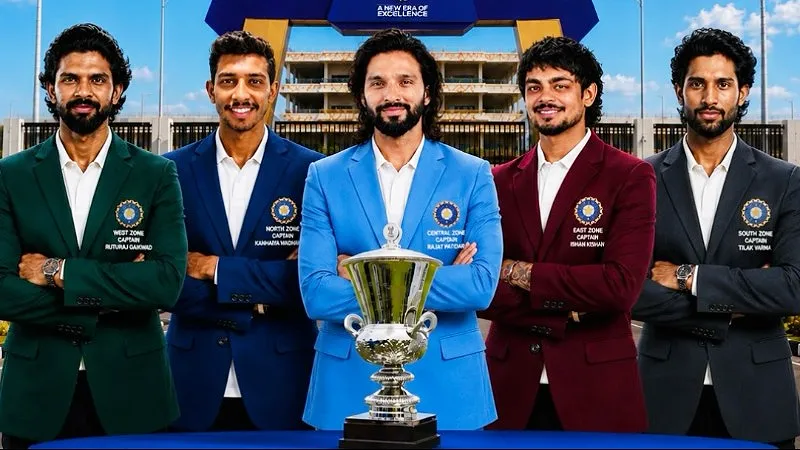

Five zonal captaincy appointments rarely make headlines, but this year’s list reads like a shortlist for who leads India in Tests once Shubman Gill’s cycle ends. Ruturaj Gaikwad gets West Zone, Rajat Patidar leads Central, and three other players in their prime carry zones into the 63rd edition. BCCI has historically used this tournament to test decision-making under first-class pressure before trusting someone with the senior job. Selectors are already building a bench, and these five names are the clearest evidence of who is on it.
Five Zonal Leaders Now Confirmed
The 63rd edition of this competition runs from August 23 to September 10, and five zones now have confirmed leadership. Ruturaj Gaikwad takes West Zone, Ishan Kishan leads East, Arshdeep Singh captains North, Tilak Varma returns for a second consecutive year with South, and Rajat Patidar leads Central. The North East Zone appointment has not been announced yet. Historically, leading a zonal side has been the clearest stepping stone toward senior national leadership consideration, which is what makes this particular list worth reading closely.
Zone | Captain | Prior Captaincy Experience | National Leadership Relevance |
|---|---|---|---|
West | Ruturaj Gaikwad | CSK IPL captain, India T20I captain at series level | Most credible Test captain candidate with a strong first-class record |
East | Ishan Kishan | India T20I player, no national captaincy yet | Experienced international in a developmental leadership role |
North | Arshdeep Singh | No prior red-ball captaincy, regular India T20I bowler | First major first-class leadership test for a white-ball specialist in a new format |
South | Tilak Varma | India T20I vice-captain against Zimbabwe in 2026, second year leading South Zone | Young batter building a leadership track record |
Central | Rajat Patidar | RCB IPL captain since 2024, Madhya Pradesh Ranji captain | Key zone role building his senior leadership case |
A Deliberate Mix Of Leadership Styles
The five names split into three clear categories. Arshdeep and Tilak already carry white-ball leadership experience as India’s T20I strike bowler and recent vice-captain, respectively. Gaikwad and Patidar arrive as established IPL captains at Chennai and Bangalore. Kishan brings international experience without any prior captaincy tag attached to his name.
All five are active India cricketers in their prime rather than veteran domestic names nearing retirement, which tells you this is a deliberate pipeline decision rather than a reward for long service. Red-ball leadership at zonal level gives selectors exactly the decision-making data white-ball cricket cannot.
Duleep Trophy 2026 captaincy picks India
Look past the individual assignments and the pattern becomes obvious. Selectors are not just filling zonal vacancies; they are running a live audit of who can manage bowling changes, field settings and momentum swings across four days without a coach whispering instructions. That is precisely the skill set white-ball captaincy does not test in the same way. Every one of these appointments doubles as an evaluation selectors will reference the moment India needs a new Test leader after Gill’s current cycle winds down.
Gaikwad’s Case Stands Out Clearly
Gaikwad has captained Chennai Super Kings across the 2025 and 2026 IPL seasons and already led India in a T20I series, giving him the most complete leadership record outside Gill in the current generation. He also bats left-handed, which changes the tactical shape at the top of a Test order that has been built around right-handers for years now.
His promotion to lead West Zone for this cycle formalises what has already been widely floated as the most likely succession scenario inside Indian cricket circles. None of the other four zonal captains currently match that combination of franchise leadership, international captaincy experience and consistent first-class output.
Zonal Leaders Often Rise Nationally
India’s last three permanent Test captains, Rohit Sharma, Virat Kohli and MS Dhoni, all led zonal sides in this exact competition before taking over the senior job. Selectors watch how a captain reacts when a semifinal is slipping away far more closely than how they perform chasing a T20 total under lights. That distinction is exactly why this tournament keeps producing India’s future leadership group.
Gill is only 26, so nothing changes immediately, but if India does enter a transition cycle from 2027-28 onward, the players who built leadership records now will be first in line. That is exactly why the Duleep Trophy 2026 captaincy picks India has just confirmed matter more than a routine domestic announcement ever would.
Is Ruturaj Gaikwad now the clear front-runner to captain India in Tests once Gill’s cycle ends, or is it too early to call? Drop your pick below.
Frequently Asked Questions (FAQs)
Who captains each zone in this year’s tournament?
Ruturaj Gaikwad leads West Zone, with Ishan Kishan, Arshdeep Singh, Tilak Varma and Rajat Patidar leading East, North, South and Central respectively. The North East Zone captain has not been announced yet.
When does the 63rd edition begin?
The tournament runs from August 23 to September 10 at the BCCI Centre of Excellence in Bengaluru. Central and South Zones enter the knockout stage directly on August 30.
Who is the front-runner to succeed Shubman Gill as Test captain?
Ruturaj Gaikwad is the most discussed candidate right now. He already captains Chennai Super Kings in the IPL and has led India in a T20I series.
How many zones compete in the tournament?
Six zones compete: North, South, East, West, Central and North East. The format runs round-robin play into knockouts starting August 30, with Central and South earning a bye.
Have zonal captains gone on to lead India in Tests before?
Yes, Rohit Sharma, Virat Kohli and MS Dhoni all captained zonal sides before leading India in Tests. It remains the most direct red-ball leadership pathway in Indian domestic cricket.