

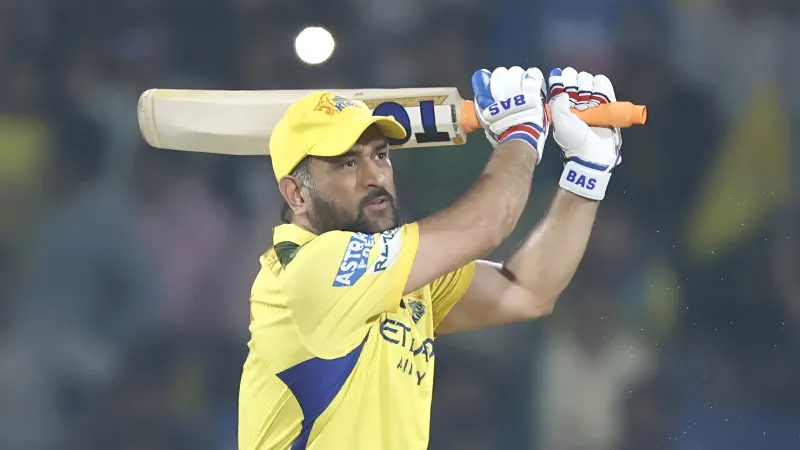

CSK haven’t announced MS Dhoni’s return. They haven’t needed to. Every selection call since his absence has pointed in one direction. The backup wicketkeeper slot, the reshuffled batting order, the redistribution of finishing responsibility across the middle order none of these changes read like reactive squad management. They read like preparation. When a franchise with CSK’s planning track record starts structuring around a vacancy rather than filling it permanently, the signal is unmistakable: the slot isn’t open. It’s reserved. And every match that passes without a permanent replacement confirms that the timeline is closer than the official silence suggests.
Selection Builds a Smooth Dhoni Return
CSK’s approach against GT was a direct wicketkeeper swap rather than a structural overhaul. That’s a precise, deliberate choice. Introducing a replacement who occupies the same positional role means Dhoni can walk back into the XI without forcing anyone else to shift position, absorb a new batting slot, or carry unfamiliar responsibilities.
This isn’t accidental. CSK have managed transitions this cleanly before in previous campaigns, handling moments of change so smoothly that external observers barely noticed the shift. The setup against GT follows that exact model. Every player in the lineup has a defined function and Dhoni’s function, wicketkeeper finisher in the final four overs, remains vacant rather than reassigned. The management isn’t replacing him. They’re holding the space.
Sanju Samson Holds CSK Together Now
While the squad waits for Dhoni, Sanju Samson is the player making the current XI competitive. His ability to bat deep into the innings gives CSK’s total a dependable foundation even when the middle order contributes inconsistently.
The pattern across recent CSK matches is clear. When Samson bats through to overs 16 or beyond, the total rises, and the chasing pressure on the bowling unit drops. When he departs early, the lower order scrambles to compensate. That dependency reflects both his current value and a structural fragility that Dhoni’s return directly addresses. Two finishers operating from different points in the innings dramatically reduce the risk of a single wicket swinging the match.
IPL 2026 Conditions Demand Dhoni’s Finishing
Slow pitches that assist spin in the middle overs and quicken up in the final four overs create a very specific challenge for finishers. Reading the surface, manipulating field placements, and accelerating through unconventional angles under pressure are skills that take years to develop.
Dhoni has spent two decades mastering exactly this skill set, and IPL conditions at spin-friendly venues reward that experience more than raw hitting power. On a surface where a batter needs 20 runs from 8 balls against quality death bowling, his decision-making becomes as valuable as his strike rate. CSK posting 200-plus scores without him in the current campaign confirms the batting depth is real. His return converts that depth from a statistical achievement into a match-winning structure in close finishes.
Batting Order Built for the Transition
Promoting a top-order batter to number three redistributes pressure in a way that protects the lower middle order from needing to overachieve consistently. CSK’s current structure keeps overs 17 to 20 relatively open in terms of responsibility, which is precisely where Dhoni will operate.
Don’t mistake this for a batting order built around an absence. It’s a batting order engineered around an imminent return. The roles are defined, the sequences are mapped, and the finisher position sits ready. CSK knows the timeline. The playing XI against GT confirmed it.
- Does this mean Dhoni returns for CSK’s next match, or will Chennai hold him back for a specific fixture in the IPL run-in? Drop your pick in the comments and follow for IPL updates.
FAQs
Q1: What will CSK’s playing 11 look like after MS Dhoni returns?
A direct swap with the backup wicketkeeper, keeping the rest of the lineup unchanged.
Q2: Why is Sanju Samson important for CSK right now?
His ability to bat deep stabilizes the innings and directly improves CSK’s match totals.
Q3: How does MS Dhoni improve CSK’s finishing?
He brings two decades of death over experience and pitch reading that no current CSK batter replicates.
Q4: Which role will MS Dhoni play on return?
Wicketkeeper finisher in the final four overs, the same position CSK have kept vacant.
Q5: Can CSK win IPL 2026 with this strategy?
Their current structure already competes well. Dhoni’s return makes the final overs significantly harder to defend against.
Disclaimer: This blog post reflects the author’s personal insights and analysis. Readers are encouraged to consider the perspectives shared and draw their own conclusions.