

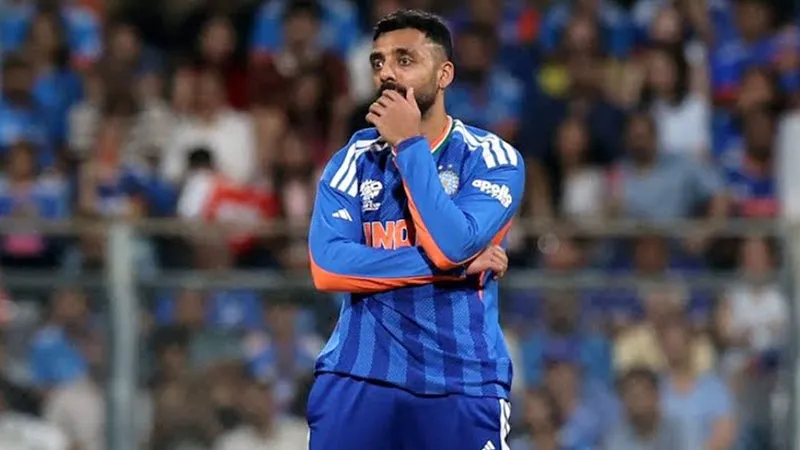

Chakravarthy heads into the Afghanistan series in Delhi carrying two separate concerns rather than one. A hamstring injury in England cost him the back end of that T20I series and the entire Zimbabwe tour that followed, while a full year of opposition scouting has started to chip away at the mystery that once made his variations so hard to read. Both problems converge at exactly the wrong moment, just as India needs its spin attack sharp for a Delhi surface that rewards batters who read the hand early.
From Match-Winner to Question Mark
Less than six months before this series, Chakravarthy was firmly India’s X-factor at the 2026 T20 World Cup, finishing as joint-highest wicket-taker with 14 wickets and a group-stage economy of just 6.88. The tournament, though, split cleanly into two very different halves.
In the Super 8s and knockouts, his economy climbed to 10.25, nearly double his group-stage figures. He conceded 47 runs in four overs against South Africa, then bled 64 runs in four overs for a single wicket against England in the semi-final, one of the costliest spells in T20 World Cup history. India still won the title, but that second-half fragility was real.
Varun Chakravarthy Afghanistan T20I Series Form
He’s back in India’s 15-member squad, led by Shreyas Iyer, after a hamstring injury ruled him out of the Zimbabwe assignment entirely. He’s confirmed alongside Ravi Bishnoi as a specialist spin option once again.
His IPL 2026 campaign offers a mixed picture: 11 wickets in 11 innings at an economy of 8.78. His first three matches for KKR produced zero wickets at 11.66, including 48 runs conceded in four overs against Mumbai Indians on opening night. He recovered sharply after that, going at 7.31 across his next four matches with 10 wickets, but the pattern of expensive early returns has become a consistent theme across formats.
The Scouting Report That Changed Everything
His full arsenal- leg break, googly, carrom ball, flipper, and top spinner- worked precisely because batters simply lacked enough video on it. That gap is closing fast now. An ESPN analysis from February found that across his last 10 T20I matches, his economy had climbed to 8.47, barely better than India’s overall team rate, a sharp fall from his earlier benchmark of 6.74.
His coach has explained that he knows when to bring out the googly or leg break against a particular batsman, but as scouting operations grow more detailed, that calculation needs constant reinvention. Batters including David Miller have shown that reading his release point is achievable with enough preparation.
Phase | Economy Rate |
|---|---|
T20 World Cup vs South Africa | 11.75 |
T20 World Cup vs Zimbabwe | 8.75 |
T20 World Cup Semi-Final vs England | 16.00 |
IPL 2026, Matches 1-3 (average) | 11.66 |
IPL 2026, Matches 4-7 (average) | 7.31 |
The Batting Line-Up Waiting in Delhi
The opposition squad arriving in Delhi includes Ibrahim Zadran, captaining his first series as full-time T20I skipper, alongside Rahmanullah Gurbaz, Azmatullah Omarzai, Darwish Rasooli and veterans Rashid Khan, Noor Ahmad, Mujeeb Ur Rahman and Mohammad Nabi. This is certainly not a batting line-up unfamiliar with facing spin.
A side that has grown up practising against Rashid Khan, the all-time leading wicket-taker in T20 cricket, develops instincts for reading unorthodox actions that most nations simply lack. India have won 7 of their last 9 T20Is in this exact fixture, but comfortable runs against mystery spin should never be assumed against a batting group used to wrist-spin from both sides of the wicket every single day.
The Fix Required Before Delhi
Fitness alone doesn’t solve this particular challenge. He needs to vary his release points far more unpredictably and resist the tendency to default to his stock leg break whenever pressure builds, a trigger that experienced analysts now specifically watch for closely. His IPL recovery already proved he can recalibrate mid-tournament when it matters.
But on the flat, true surface at the Arun Jaitley Stadium, where balls sit up and batters get time to read the hand, the Varun Chakravarthy Afghanistan T20I series form question comes down to whether that adjustment starts from over one, not after it. That’s the real test of whether the mystery still has an edge.
Can Chakravarthy rediscover his World Cup form in Delhi, or has the mystery gone for good? Tell us who you would trust with the ball instead.
Frequently Asked Questions (FAQs)
Why did Chakravarthy struggle in IPL 2026?
His first three matches produced zero wickets at an economy of 11.66. That stretch included 48 runs conceded in four overs against Mumbai Indians on opening night, before he recovered to 7.31 in his next four games.
What is Chakravarthy’s recent economy rate in T20I cricket?
His economy across his last 10 T20I matches has climbed to 8.47. That is a sharp rise from his earlier benchmark of 6.74, though still marginally better than India’s overall team economy.
Is Chakravarthy playing in the Delhi series against Afghanistan?
Yes, he has been named in India’s 15-member squad for the three-match series. He returns after a hamstring injury forced him to miss the entire Zimbabwe tour beforehand.
How does the opposition line-up handle spin bowling?
Their batters are among the most spin-accustomed in world cricket. Growing up facing Rashid Khan, Noor Ahmad and Mujeeb Ur Rahman in practice has sharpened their instincts against wrist-spin specifically.
What variations does Chakravarthy bowl?
He bowls a mix of leg break, googly, carrom ball, flipper and top spinner. His effectiveness depends on disguising these deliveries from one action, something opponents are now reading more easily.