

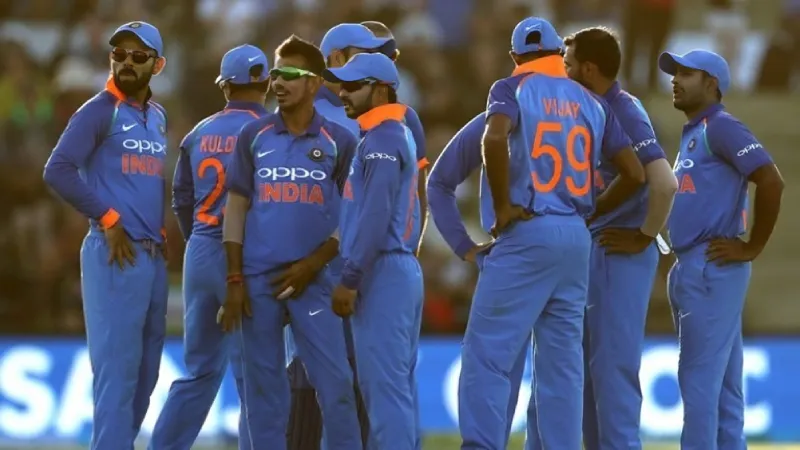

The 2026 slide is worse, and it isn’t close once you weigh the context. Losing consecutive bilateral series happened once before, in 2018-19, but that came from a weakened squad missing four first-choice players and recovered within weeks. This time the full-strength era has ended, a fresh captain has lost his first four completed matches, and the record defeat arrived weeks after India lifted the World Cup. History has a precedent. It just isn’t as damaging as this one.
Revisiting the 2018-19 Slump Era
In February 2019, India lost a three-match bilateral series for the first time in their history, going down 1-2 to New Zealand away from home and ending a run of ten straight series without defeat. The opening match alone brought an 80-run defeat, the worst in India’s T20I history at that point, a mark that would stand for years. Crucially, that squad was missing Virat Kohli and Jasprit Bumrah, both rested, plus Hardik Pandya and KL Rahul, suspended after a television controversy. Rohit Sharma led a depleted group. Weeks later, a fuller squad under Kohli still lost 0-2 at home to Australia, handing the visitors their first-ever T20I series win on Indian soil.
The Post-World Cup Collapse in Context
This year’s slide arrived in a completely different setting. India had just won the T20 World Cup in March 2026, their third title and second in a row, becoming the first side to retain it. Weeks later, Suryakumar Yadav was replaced as captain by Shreyas Iyer, and the new-look side flew to Ireland, a team India had never lost to in any format. Ireland won both matches, by 34 runs and by a single run, ending India’s streak of twelve consecutive bilateral series without defeat. The India camp pointed to player fatigue and an overloaded travel schedule as partial explanations, but against a side ranked well below them in the format, the result itself was what mattered.
India T20I Bilateral Series Losses 2026
The scorelines that followed were harsher than anything from 2018-19. England bowled India out for 76 at Trent Bridge on July 7, their second-lowest total ever behind only 74 against Australia in 2008, and the 125-run margin eclipsed the 80-run record set during the earlier slump. It was also the first completed innings in which no Indian batter reached 20. Five matches without a win, four defeats and a washout, is now the longest winless run in the format’s history for India, comfortably surpassing the previous worst runs of four straight losses recorded in both 2009 and 2021.
Personnel and Leadership Then and Now
In 2018-19, India were building toward the 2019 ODI World Cup and treated T20Is as a lower priority. Kohli’s absence was planned rotation, the Pandya-Rahul suspensions were external disruption, and the first-choice XI remained intact once fully assembled. This year reflects a genuine changing of the guard. Rohit, Kohli and Suryakumar have all stepped back from the format, and Iyer now leads a side built around fifteen-year-old Vaibhav Sooryavanshi and several debutants easing into international cricket at once. Where 2018-19 was a temporary absence of familiar names, this is closer to a full changing of the guard, with a middle order still working out fixed roles and batting positions from match to match rather than settling into a pattern.
Era | Opponent | Series Result | Captain |
2018-19 | New Zealand | Lost 1-2 | Rohit Sharma |
2026 | Ireland | Lost 0-2 | Shreyas Iyer |
The Slump Carrying the Bigger Risk
The 2018-19 dip was a blip inside an era of dominance, and India recovered almost immediately, going on to string together twelve consecutive bilateral series wins, a record streak at the time. This year offers no such cushion. It lands at the start of a new leadership cycle, after a wholesale exit of senior batters, under a captain still searching for his method. Whichever way the India T20I bilateral series losses 2026 numbers get read, by scoreline, by opponent, or by how soon they followed the team’s biggest recent win, this slump carries more weight than anything from 2018-19, and there is no precedent for a defending champion unravelling this quickly against opposition of this calibre.
Which slump would you rank worse, the depleted squad of 2018-19 or this year’s post-World Cup collapse? Drop your take below.
Frequently Asked Questions
When did India first lose a bilateral T20I series of three or more matches?
India first lost a three-match bilateral T20I series in February 2019, going down 1-2 to New Zealand. That defeat ended a run of ten straight bilateral series without a single loss.
What is India’s biggest defeat in T20I history?
India’s biggest T20I defeat is a 125-run loss to England at Trent Bridge on July 7, 2026, after being bowled out for 76. It eclipsed the previous record of an 80-run loss to New Zealand in 2019.
Had Ireland ever beaten India in T20I cricket before 2026?
No, Ireland had never beaten India in any international format before their 2-0 T20I series win in 2026. Both wins came by tight margins, 34 runs and then a single run, in Belfast.
How did India recover from their 2018-19 T20I slump?
India recovered quickly, going on to string together twelve consecutive bilateral series wins without defeat, a record streak at the time. A fuller squad returned soon after the New Zealand series ended.
What is India’s longest winless run in T20I history?
India’s longest T20I winless run is five straight matches without a win, four defeats plus one washout, set in 2026. It surpasses the previous worst runs of four straight losses in 2009 and 2021.
Disclaimer: This blog post reflects the author’s personal insights and analysis. Readers are encouraged to consider the perspectives shared and draw their own conclusions.