

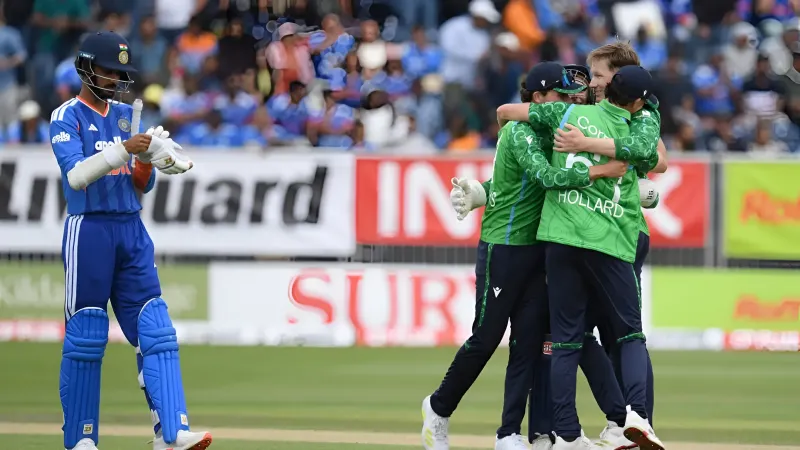

One bowler with an unusual angle did most of the damage. Jai Moondra, a debutant left-armer, dismissed Sanju Samson first ball in both chases and finished the series with five wickets from just two matches. His release angle, not raw pace or turn, was what India’s top order genuinely couldn’t read. Backed by George Dockrell’s control and two more debutant seamers each taking three wickets in a single match, Ireland turned an unfamiliar mix of angles and a slow, gripping surface into a problem India never once solved across either innings.
Moondra’s Twin Assaults on the Top Order
Jai Moondra, a 29-year-old Rajasthan-born left-armer making his debut for Ireland, was the single biggest reason for the upset, finishing with 5 wickets across both matches and winning Player of the Series. He dismissed Sanju Samson with the first ball of both run chases, bowling him through the gate in the opener and trapping him lbw with an inswinger in the second. That same over he removed Abhishek Sharma for a golden duck, only the fourth time in T20I history both openers have fallen for ducks in the same innings, before bowling Shreyas Iyer through the gate to leave India 19 for 3 inside three overs of their second run chase, a collapse that set the tone for the rest of the innings.
The Bowling Mix Behind the Damage
Ireland’s attack combined left-arm pace variation with genuine control from the back end. Moondra’s angle into the right-hander, followed by movement away off a slow Stormont surface, regularly beat the outside edge. George Dockrell, a left-arm orthodox spinner, added control and variety through the middle overs, while Gareth Delany’s change of pace accounted for Axar Patel in the first match’s death overs. Matt Hollard, a right-arm debutant, took 6 wickets across the series, 3 for 28 and 3 for 26, and won Player of the Match in the opener. Matthew Humphreys chipped in 4 more wickets across the two games, rounding out a pace-heavy attack that gave India’s batters no obvious release from the pressure at either end of the innings.
Ireland vs India T20I 2026 Spin Attack
India’s top order struggled specifically to read Moondra’s angle at the point of release, since left-arm pace into a right-hander behaves differently from anything bowled by a right-arm seamer. Three of the top four, Samson, Abhishek and Iyer, fell to his variations before the powerplay ended in the second match. In the first, Ishan Kishan, Iyer for just 3, and Washington Sundar were all dismissed playing against that same angle, with the slow, low Stormont surface punishing anyone who tried to attack purely on instinct rather than reading the conditions in front of them first.
Bowler | Wickets | Economy | Key Dismissals |
Jai Moondra | 5 | 7.13 | Samson (both matches), Abhishek, Iyer twice, Dube |
Matt Hollard | 6 | 6.75 | Kishan, Iyer, Washington Sundar, Axar |
Matthew Humphreys | 4 | 8.80 | Tilak, Rana, Arshdeep |
The Top Order’s Recurring Read Problem
Ireland’s bowling depth runs a good deal deeper than their associate status suggests to most outside observers. Fielding two debutant pacers who took three wickets each against the reigning T20 World Champions in the same match points to genuine depth, not a lucky afternoon. Afghanistan remain the benchmark among associate nations through Rashid Khan’s leg-spin, but this angle-heavy pace attack, supported by Dockrell’s control, gave Ireland a distinct bowling identity capable of troubling any full-strength batting order on a surface that offers genuine lateral movement early on.
Lessons Before the Tougher Assignments Ahead
Moondra’s five wickets exposed a real gap in India’s rebuilt top order, an inability to pick left-arm angle bowling moving both into and away from the stumps. England carry similar left-arm threats in home conditions, where swing adds another layer of confusion for batters who haven’t faced it often. Gambhir described the batting effort as simply not good enough, but the deeper issue is technical rather than a question of application or intent, which makes it harder to fix in the short term. The Ireland vs India T20I 2026 spin attack duel made one thing clear: until this top order learns to read different release angles on unpredictable surfaces, left-arm variation stays a consistent weak spot for India away from home.
Does this top order need a technical rework before England’s remaining pace threats, or was Ireland just a one-off blip? Share your view below.
Frequently Asked Questions
How many wickets did Jai Moondra take against India?
Jai Moondra took 5 wickets across the two-match series, 2 for 25 in the first game and 3 for 32 in the second, at an economy of 7.13. He was named Player of the Series.
Who won Player of the Match in Ireland’s first T20I win over India?
Matt Hollard won Player of the Match in the first T20I with figures of 3 for 28. He added 3 for 26 in the second match for 6 wickets in the series.
Why did India’s top order struggle against Ireland’s bowlers?
India’s batters struggled to read Jai Moondra’s left-arm angle, which behaves differently to right-arm pace as it nips into and away from right-handers. Three of the top four fell to him inside one powerplay.
Had Ireland ever beaten India in T20I cricket before this series?
No, Ireland had never beaten India in any international format before winning this two-match T20I series 2-0. The wins came by tight margins, 34 runs and then a single run, in Belfast.
Who is the benchmark spin bowler among cricket’s associate nations?
Afghanistan’s Rashid Khan remains the benchmark leg-spinner among associate nations. Ireland’s George Dockrell, a left-arm orthodox spinner, offers similar control and experience through the middle overs for his side.
Disclaimer: This blog post reflects the author’s personal insights and analysis. Readers are encouraged to consider the perspectives shared and draw their own conclusions.