

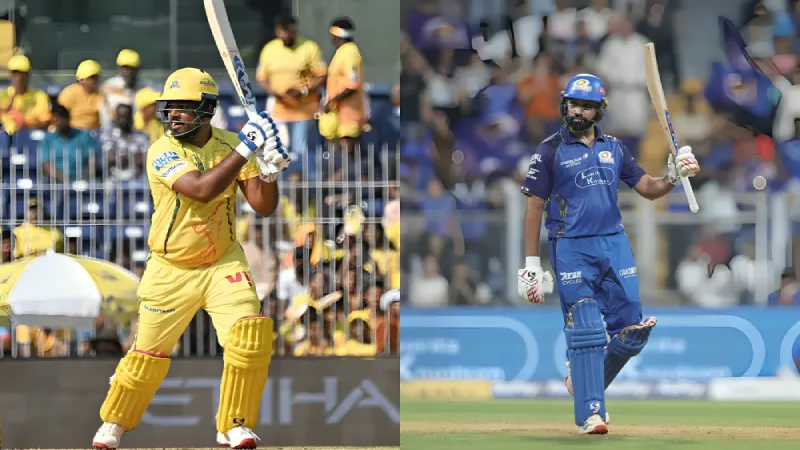

Rohit Sharma scored 1,234 runs from 41 IPL opener innings at an average of 34.27 for the Mumbai Indians. Sanju Samson has scored 1,185 across the same sample at 32.02 with a strike rate of 146.29 compared to Rohit’s 131.69. Two centuries for Chennai Super Kings this season against Delhi Capitals and Mumbai Indians changed the conversation around Samson completely. The question isn’t whether Rohit’s record was exceptional. It was. The question is which approach produced more damage for their franchise across the same innings count.
Samson Attacks the Powerplay Differently
Sanju Samson’s approach at CSK is built around scoring boundaries before bowling attacks settle into a rhythm. His intent against both pace and spin from ball one pushes scoring rates into territory that forces captains into early field adjustments rather than allowing conventional powerplay containment plans to operate freely.
Rohit’s prime years for the Mumbai Indians prioritised wicket preservation alongside boundary hitting. He built innings steadily before accelerating, producing more half-centuries and fewer explosive collapses. That method suited the T20 environment of his peak years when middle-order acceleration was considered sufficient to reach competitive totals.
Sanju Samson vs Rohit Sharma Stats Table
Player | Runs | Average | Strike Rate | 100s | 50s | 6s |
Sanju Samson | 1,185 | 32.02 | 146.29 | 2 | 5 | 55 |
Rohit Sharma | 1,234 | 34.27 | 131.69 | 0 | 10 | 46 |
Rohit leads in runs, average, and half-centuries. Samson leads in strike rate, centuries, and sixes. The two-century advantage reflects innings that changed match outcomes rather than simply contributed to them. Rohit’s 10 half-centuries reflect an opener who converted starts reliably without the same explosive ceiling. Samson’s 55 sixes against Rohit’s 46 across the same innings count confirms that boundary-clearing frequency has increased despite a marginal average deficit. The four distributions tell a supporting story: Rohit’s 130 fours reflect better gap-finding consistency, Samson’s 116 reflect a batter trading placement for power without sacrificing scoring rate.
Rohit’s Winning Impact Still Leads
The match-context comparison is where Rohit’s record maintains its clearest advantage. In victories across his 41 innings in the opener, Rohit averaged 48.35 at a strike rate of 134.53 from 21 winning matches. Samson has won 18 of his 41 matches, averaging 43.46 at a strike rate of 154.50 in those victories.
Rohit won more matches and scored more heavily in those victories. That record reflects an opener who produced match-defining contributions consistently rather than occasionally. Samson’s strike rate advantage in winning confirms his explosiveness remains intact under pressure. The average gap confirms Rohit converted more of those situations into innings that MI’s batting structure could build around reliably across different bowling quality levels.
Two Eras, Two Different Batting Demands
The Sanju Samson vs Rohit Sharma comparison ultimately reflects two elite openers shaped by different versions of the same tournament. Rohit’s prime years coincided with a period when disciplined seam bowling in power plays and strong spin attacks in the middle overs made aggressive openers more vulnerable to early dismissals. He adapted by balancing risk with control in ways that produced consistency regardless of bowling quality.
Samson operates in an IPL where shorter boundary profiles, batting-friendly pitches, and impact player rules create an environment that rewards boundary-first intent more directly. His aggressive approach produces more value in this specific context than it would have during Rohit’s dominant seasons. The century count advantage reflects a specific modern T20 quality: the ability to convert a good start into a match-defining innings rather than a solid platform for others. Rohit’s ten half-centuries reflect the version of opening batting that worked before the game demanded more. Samson’s two centuries reflect the version it demands now.
- Does Rohit’s consistency across wins make him the greater IPL opener despite Samson’s strike rate advantage, or does the current game make Samson’s approach more valuable? Drop your pick in the comments and follow for IPL opener updates.
FAQs
Q: Who scored more runs after 41 IPL opener innings, Samson or Rohit?
Rohit Sharma leads with 1,234 runs compared to Samson’s 1,185 across the same 41-innings sample.
Q: Who has the better strike rate in the Samson vs Sharma opener comparison?
Samson leads with 146.29 compared to Rohit’s 131.69 across their first 41 innings as IPL openers.
Q: How many IPL centuries has Sanju Samson scored as an opener compared to Rohit?
Samson has scored two centuries as an opener while Rohit scored none across the same 41-innings sample.
Q: Who performed better in winning IPL matches as an opener?
Rohit averaged 48.35 in victories from 21 wins compared to Samson’s 43.46 from 18 wins across the same sample.
Disclaimer: This blog post reflects the author’s personal insights and analysis. Readers are encouraged to consider the perspectives shared and draw their own conclusions.