

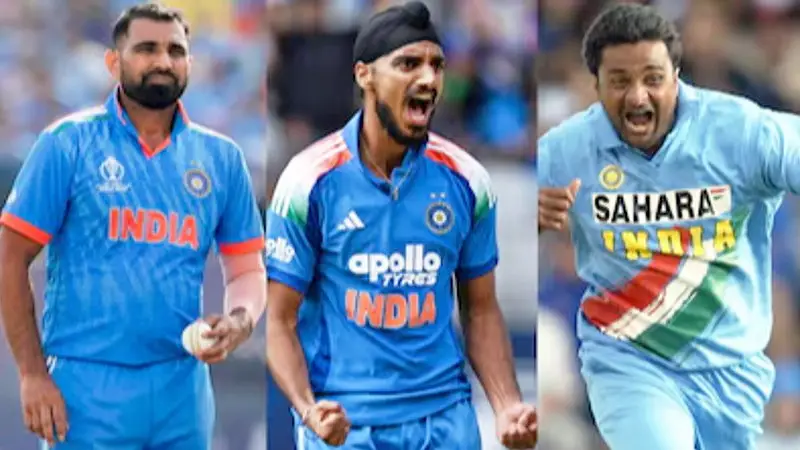

Shami had the better Test career, and the gap shows up the moment you stop counting wickets and start measuring how quickly and cheaply they came. Srinath edges the raw tally, 236 scalps across 67 matches against 229 in 64, yet Shami beats him on average, strike rate and returns in India and overseas alike. The case below weighs those rates, the split between home and away, and the very different eras the two men bowled in, before landing on a firm verdict for fans.
Two Pacers Separated by Seven Wickets
Shami’s exit on 6 November lets both records finally sit side by side as finished products. Srinath bowled for India between 1991 and 2002, while Shami’s Test years ran from 2013 to 2023, so the careers never overlapped. Neither man got near the top of India’s pace list, where Kapil Dev sits on 434 and Zaheer Khan and Ishant Sharma share 311. That leaves a contest for the next tier, closer on the surface than underneath.
Srinath’s advantage is pure volume: seven extra wickets, three extra matches and ten five-wicket hauls against Shami’s six. Every efficiency measure flips the other way. Shami conceded 27.71 runs per dismissal, almost three fewer than Srinath’s 30.49, and the strike-rate gap is wider still.
Stat | Mohammed Shami | Javagal Srinath |
|---|---|---|
Tests | 64 | 67 |
Wickets | 229 | 236 |
Average | 27.71 | 30.49 |
Strike rate | 50.28 | 64.00 |
Five-wicket hauls | 6 | 10 |
Home wickets | 65 | 108 |
Away wickets | 153 | 128 |
Mohammed Shami Javagal Srinath Test Career and the Wicket Clock
Strike rate is where the argument tilts hardest. Shami struck once every 50.28 deliveries, while Srinath had to wait 64 balls on average for each breakthrough. Srinath sent down 15,104 balls to reach 236, whereas Shami got to 229 in roughly 11,515, a saving of about 3,600 deliveries. That is close to 600 overs of extra toil for a nearly identical haul.
Twelve Indians have passed 200 Test wickets, and only Jasprit Bumrah, at 42.86, gets wickets faster than Shami. Among the six seamers in that group, Bumrah is also the only one with a cheaper average. Srinath, by contrast, owns the slowest strike rate of those six pacers. For a strike bowler, that gap outweighs any cumulative total.
Bowling at Home and Abroad
On Indian pitches, Shami averaged 22.1 across 21 matches, cheaper than the 26.61 Srinath managed over 32. Overseas the pattern held, with Shami’s 145 wickets in 41 away Tests costing 30.33 each, against Srinath’s 33.76 for 128 wickets across 35 away matches. Eight more of Shami’s wickets came at neutral grounds, where Srinath has none. Add those to the away tally and 63 percent of Shami’s haul came outside India, compared with 54 percent for Srinath.
The opponent splits mostly favour Shami too. Against South Africa he collected 48 wickets at 20.93, cheaper than the 24.48 Srinath paid for 64, and against Australia the difference balloons to 32.09 versus 42.33. Srinath does own the New Zealand comparison, 27.69 against 32.74, while England saw the pair finish almost dead level, at 38.47 and 38.29.
The Nineties Burden on India’s Seamers
Srinath’s strongest defence is the era he bowled in. India’s home Tests in the 1990s were built around spin, and between 1995 and 2002 the country’s seamers as a collective averaged 31.27 on home soil. Srinath beat that comfortably, taking 100 wickets from 29 matches at home in that stretch at 25.37. Partner Venkatesh Prasad managed only 27 at 31.25, so the load fell largely on one man.
Shami never carried that kind of solitary load. He shared the new ball with Bumrah, whose 19.79 average drew pressure away from everyone else. That context narrows the gap between them, but no reasonable adjustment for conditions erases a difference this large on every rate.
Quality Beats Volume in the End
Srinath deserves real credit for his longevity, his ten five-wicket hauls and the weight he shouldered through a spin-first decade. Those reward durability, though, not bowling quality. Shami was cheaper, quicker to strike, better at home and better abroad.
Put those four measures together, and the Mohammed Shami Javagal Srinath Test career debate has a clear winner: Shami, by a margin his slightly smaller wicket tally does nothing to hide. India lost an elite red-ball seamer this month.
Would you still back Srinath for carrying India’s attack alone through the spin-heavy nineties, or do Shami’s numbers settle it for you? Tell us in the comments.
Frequently Asked Questions (FAQs)
How many wickets did Mohammed Shami take in Test cricket?
Mohammed Shami finished with 229 Test wickets from 64 matches. He bowled at an average of 27.71 and a strike rate of 50.28, with six five-wicket hauls before retiring on 6 November 2026.
What was Javagal Srinath’s final Test wicket tally?
Javagal Srinath ended his Test career with 236 wickets in 67 matches between 1991 and 2002. His average settled at 30.49, and his ten five-wicket hauls remain four more than Shami managed.
Which Indian fast bowlers have the most Test wickets?
Kapil Dev leads India’s pace bowlers with 434 Test wickets. Zaheer Khan and Ishant Sharma follow on 311 apiece, ahead of Srinath on 236, Bumrah on 234 and Shami on 229.
When did Mohammed Shami announce his Test retirement?
Shami ended his Test career with an announcement on 6 November 2026. His final Test appearance came in the World Test Championship final of 2023, and he continues to play white-ball cricket.
What bowling average did Mohammed Shami finish with in Tests?
Shami finished with a Test bowling average of 27.71. Only Jasprit Bumrah, at 19.79, has a lower average among the six Indian seamers who have passed 200 Test wickets.