

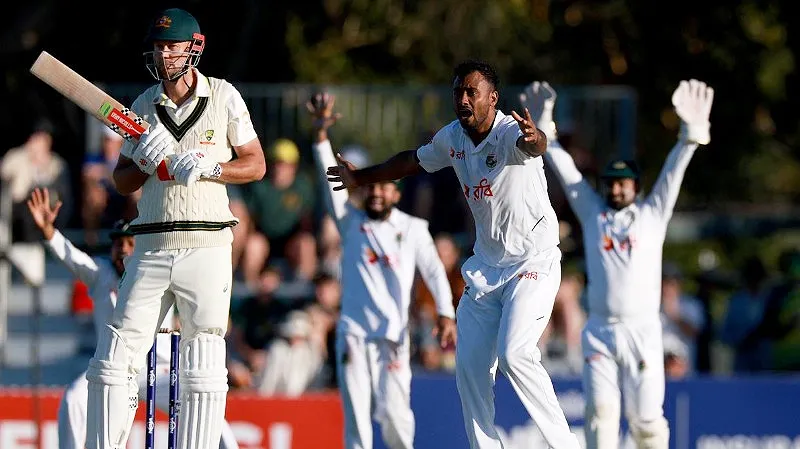

Seam did far more damage to Australia’s batting than spin across this series, accounting for roughly three-quarters of their wickets lost overall. But that number hides where the real technical failure actually showed up. Mehidy Hasan Miraz’s second-innings spell in Darwin exposed something seam movement alone never could: an inability to read turning deliveries on a flat, unfamiliar pitch. Shoriful Islam’s pace burst at Mackay did the bulk of the numerical damage, but Mehidy’s five wickets are what actually cost Australia the series opener.
Darwin Defeat and Mackay Win in Two Days
The series produced two extreme results. In Darwin, Bangladesh won by nine wickets, their first Test win on Australian soil, bowling the hosts out for 198 and 284 while piling up 426 themselves.
A week later at Mackay, Australia hit back to win by an innings and 51 runs inside two days, rolling Bangladesh for 64 and 95. The series finished 1-1, with Starc taking 12 wickets across both Tests and Green scoring 184 runs.
Darwin’s drop-in surface began seam-friendly before slowing as it wore. Mackay’s grass-covered pitch offered sharp movement on the first morning before flattening out once the shine came off the ball.
Australia vs Bangladesh Test Series 2026 Batting
The numbers across both Tests combined tell a clear story. Of the 30 Australian wickets that fell across three innings, seam claimed the larger share by some distance.
Test | Venue | AUS 1st Inn | Wkts to Seam | Wkts to Spin | AUS 2nd Inn |
|---|---|---|---|---|---|
1st | Darwin | 198 | 8 | 2 | 284 |
2nd | Mackay | 210 | 9 | 1 | N/A (won) |
Seam took roughly 23 of Australia’s 30 wickets, close to 77%. That’s the blunt answer to the seam-versus-spin question, though the distribution across the two matches matters just as much as the total.
Bowler Type | Wickets Both Tests | Share |
|---|---|---|
Bangladesh Seam | 23 | 77% |
Bangladesh Spin | 7 | 23% |
How Mehidy Hasan Miraz Unpicked Australia’s Batters
Darwin was where spin made its case as the more dangerous threat, and it did so on a pitch that hadn’t been prepared for it. Mehidy’s five for 66 in Australia’s second innings, from 33.1 overs at an economy of 2.00, was the spell that ended Australia’s resistance.
Hasan Mahmud’s six for 55 had blown Australia away for 198 on day one, but it was Mehidy who unravelled the more organised second-innings push. Green’s century aside, the rest of the order couldn’t read bowling that gripped and turned on a surface they hadn’t expected.
The key dismissals told a technical story. Carey was caught behind feathering a ball that turned away, and Cummins was caught down the leg side padding at Mehidy. The middle order’s struggles against off-spin exposed a gap Green’s boundary hitting had partly hidden.
Shoriful Islam’s Seam Threat at Mackay
At Mackay, the contest flipped entirely. Shoriful Islam, returning from a hamstring injury, produced one of the most destructive spells by a Bangladesh pace bowler in Test history, seven for 48, taking Smith, Webster, Carey, Green and the lower order.
Starc became his seventh victim, bowled by a fellow left-armer who found late seam movement. Shoriful’s figures were so dominant they nearly overshadowed Taijul Islam managing just one wicket across two innings, spin virtually absent as a threat at that ground.
The surface, carrying about 3.5mm of grass, rewarded seam from both sides. Starc’s six for 12 and four for 39 sealed his fourth career ten-wicket Test haul, with two left-armers doing near-identical damage.
What Cricket Australia’s Pitch Shift Can Fix
Mackay was the third two-day finish in Australia’s last seven home Tests, forcing a formal response. Curators have been told to favour the batter when in doubt this season, leaning toward less grass cover, with session lengths adjusted too.
Nearly a third of Shield games last season, nine of 30, finished inside three days, up from just five the year before. Steve Smith pointed to greener wickets hurting batting averages at domestic level, feeding straight into the Test team’s production problems.
Whether friendlier surfaces repair the gap Mehidy exposed in Darwin, reading turning deliveries on a flat pitch, is a separate question from Shoriful’s pace threat at Mackay. What this Australia vs Bangladesh Test series 2026 batting collapse really shows is that both dangers, seam and spin, are now functioning against this batting line-up at once.
Which worries you more about Australia’s batting long-term, getting exposed by spin on flat pitches or being blown away by seam on green ones? Have your say.
Frequently Asked Questions (FAQs)
Why are Australian batters struggling in Test cricket?
Greener, seam-friendly domestic pitches are failing to prepare Australia’s batters for international bowling. Sheffield Shield batting averages have fallen sharply as matches increasingly finish inside three days.
How did Bangladesh beat Australia in Darwin?
Bangladesh won the Darwin Test by nine wickets, their first-ever Test win on Australian soil. Hasan Mahmud took six for 55 to bowl Australia out for 198 on the opening day.
What is wrong with Australia’s Test batting lineup?
Australia’s batters struggled against both seam and spin in this series. Hasan Mahmud and Shoriful Islam exposed poor handling of movement, while Mehidy Hasan Miraz exploited an inability to read turning deliveries in Darwin.
Are Sheffield Shield pitches too bowler-friendly?
Cricket Australia has admitted domestic pitches have become too bowler-friendly. Nine of 30 Shield matches finished inside three days last season, up sharply from just five the year before.
Who won the Australia vs Bangladesh Test series?
The series finished level at 1-1 after a Test apiece. Bangladesh won in Darwin by nine wickets, and Australia responded with an innings and 51-run win at Mackay.