

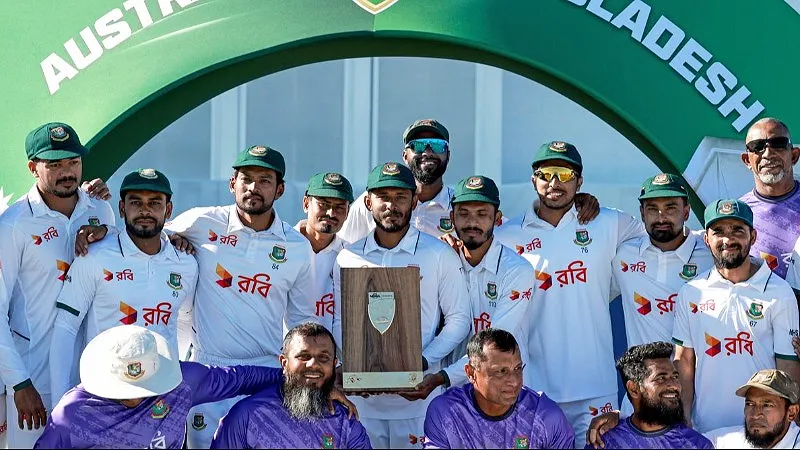

Great Barrier Reef Arena hosted its first-ever Test on 22 August 2026, and the match was already over by mid-afternoon the following day. Australia dismissed Bangladesh for 64, replied with 210, then bowled the tourists out again for 95 to win by an innings and 51 runs inside two days. It is becoming a habit: three of the last seven Tests played in Australia have finished inside two days, after only two such finishes on home soil in the previous hundred years.
A New Venue’s Debut Ends in a Hurry
Australia dismissed Bangladesh for 64 in the first innings after asking them to bat, and the innings was over inside 34 overs. Four of the top six batters were out for ducks, and by lunch Bangladesh were 35 for 6. Australia’s reply reached 210, a lead of 146, built on Cameron Green’s 67 and useful lower-order runs from Nathan Lyon.
Bangladesh’s second innings lasted 231 balls and yielded only 95, enough to hand Australia victory by an innings and 51 runs. The entire contest, across three completed innings, took just 750 deliveries.
Innings | Team | Runs | Wickets | Balls Faced | Result |
|---|---|---|---|---|---|
1st | Bangladesh | 64 | 10 | 204 | All out |
1st | Australia | 210 | 10 | 315 | All out |
2nd | Bangladesh | 95 | 10 | 231 | All out |
Total | – | 369 | 30 | 750 | Australia won by an innings and 51 runs |
Australia Bangladesh Mackay Test Shortest Balls
The scorecard behind that number tells its own story. Bangladesh’s first innings lasted 204 balls, Australia’s reply ran to 315, and Bangladesh’s second innings needed 231 more before the last wicket fell. Being bowled out under 100 in both innings had never happened to Bangladesh in a single Test before, and it was the first time any side had managed that in 21 years, since Zimbabwe suffered the same fate against New Zealand in 2005.
Australia’s 210 stands as the fourth-lowest total to produce an innings victory in men’s Test cricket, and the combined 369 runs across the match rank as the sixth-lowest aggregate for any completed men’s Test.
Starc and the Seamers Ran Riot
Mitchell Starc needed just 22 balls to take five wickets as Bangladesh slid to 12 for 5 in the first innings. He finished with 6 for 12, the most economical six-wicket haul of his career, with Pat Cummins offering support at 3 for 25 from the other end. Shoriful Islam hit back for Bangladesh with 7 for 48, the best figures by a Bangladeshi quick in Test cricket, but it barely slowed Australia down.
Starc struck again in the second innings, bowling Mominul Haque for a golden duck with his second ball, and Bangladesh never recovered. Cummins took 3 for 10 and Nathan Lyon claimed 3 for 25, including the final two wickets in three balls after tea on the second day. Starc’s ten wickets for the match came off just 109 deliveries, the quickest ten-wicket haul in Australian Test history.
This Result Ranks Among Cricket’s Quickest Finishes
Mackay’s Test debut ranks as the fourth-shortest completed men’s Test in history and the second-shortest ever played in Australia. The outright record belongs to India’s innings win over South Africa at Cape Town in January 2024, completed in 642 balls. Australia’s own innings victory over South Africa at Melbourne in 1935 needed 656 balls, and West Indies beat England in 672 balls that same year.
The previous shortest Test on Australian soil was the 1932 Melbourne match against South Africa, a contest that produced only 234 runs in total.
The Road Ahead for the Tourists
Bangladesh still drew the two-match series 1-1, thanks to a nine-wicket win in Darwin that was their first-ever Test victory on Australian soil, and it lifted them above ninth in the ICC Test rankings for the first time. Mackay exposed real gaps in their batting against quality pace on a bouncy surface, and captain Najmul Hossain Shanto conceded there was no hiding from the collapse, calling for more tours in seam-friendly conditions to close that gap.
The Australia-Bangladesh Mackay Test shortest balls conversation now shifts south, with Bangladesh facing two Tests in South Africa, at Johannesburg from 15 to 19 November and Centurion from 23 to 27 November, on pitches that offer little forgiveness.
Is 750 balls the new normal for Australian home Tests, or just a freak alignment of two out-of-form batting orders? Drop your take below.
Frequently Asked Questions (FAQs)
How many balls were bowled in the Australia vs Bangladesh Mackay Test?
A total of 750 balls were bowled across the match’s three innings. Bangladesh’s first innings used 204, Australia’s reply took 315, and Bangladesh’s second innings added 231 more.
What is the shortest completed Test match in cricket history?
India’s win over South Africa at Cape Town in January 2024 holds the record at 642 balls. The Mackay Test, at 750 balls, ranks fourth on that all-time list.
How many wickets did Mitchell Starc take in the Mackay Test?
Starc took ten wickets in the match, finishing with figures of 10 for 51. He completed the haul in just 109 balls, the quickest ten-wicket match in Australian Test history.
Did Bangladesh win any session in the Mackay Test?
No, Bangladesh did not win a single session outright in Mackay. Their only real contribution came from Shoriful Islam’s 7 for 48, the best figures by a Bangladeshi quick bowler in Tests.
Where does Bangladesh play next after the Australia series?
Bangladesh travel to South Africa for two Tests starting in November. The first is at Johannesburg from 15 to 19 November, followed by Centurion from 23 to 27 November.