

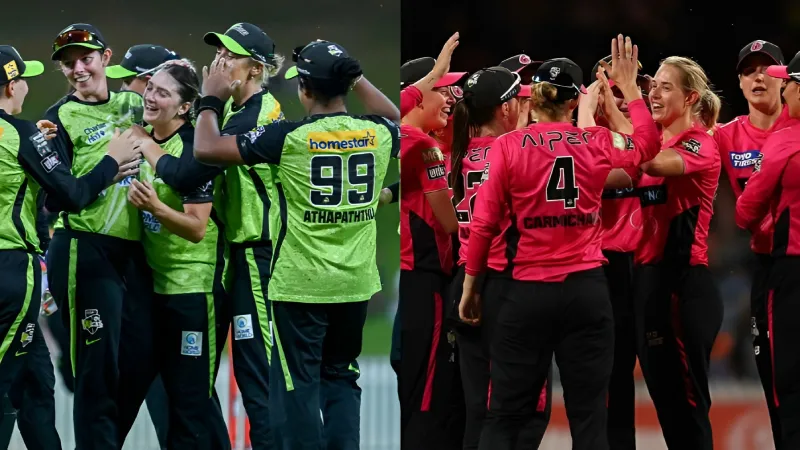

Melbourne’s two WBBL clubs do not actually face each other on opening day. The October 29 double-header pairs Melbourne Renegades against Sydney Thunder, then Melbourne Stars against Hobart Hurricanes, both at Junction Oval. What genuinely hangs over both fixtures is the ownership uncertainty around them: Cricket Victoria’s unilateral push to merge and rebrand the clubs, a state-wide vote on privatisation, and a Cricket Australia timeline that could bring the first-ever sale of a Big Bash franchise within months. Neither club is disappearing this season, but their long-term futures are genuinely unresolved.
Correcting The Record On Opening Day
The opening WBBL|12 fixtures on October 29 are Renegades against Sydney Thunder at 3:40pm local time, followed by Stars against Hobart Hurricanes at 7:10pm, both at Junction Oval. The evening game is the first WBBL match played under the venue’s new permanent floodlights.
A genuine Melbourne Derby between Renegades and Stars does feature this season, scheduled for Match 32 and Match 37, both also at Junction Oval, but neither falls on opening day. The season runs 43 matches over 38 days, concluding with the final on December 5.
Melbourne Renegades Stars WBBL privatisation
Cricket Victoria shocked Australian cricket around June 2026 by unilaterally announcing a merger of the Renegades’ and Stars’ administrations ahead of any Cricket Australia vote. The plan involved rebranding the Stars as a single Melbourne team, with trademark applications filed for three possible names, and selling the Renegades licence in full to a private investor.
Both clubs have since been confirmed for the 2026-27 WBBL and BBL seasons. Cricket Victoria shelved the rebrand plan for this season because of the extended timeline for a wider decision, telling members it would not proceed with a rebranded team for now. The Renegades will instead operate under caretaker administration led by former Stars general manager Max Abbott, funded by Cricket Victoria.
State chairs voted in principle roughly three weeks ago for a self-determination model letting each state choose its own privatisation timeline, the first time New South Wales and Queensland aligned with South Australia, Western Australia, Tasmania and Victoria. Cricket Australia’s original target of 2027-28 remains in play, though signs point to a possible agreement within a month, with clubs potentially heading to market for valuations by October.
The Officials Weighing In So Far
Cricket Australia‘s Alistair Dobson, speaking at the WBBL|12 season launch, said nothing was certain or decided about the future of either club, with plenty of work ongoing to settle the best model for the Big Bash going forward. He said the immediate focus was the season ahead, with both clubs’ lists in good shape.
Cricket Australia’s own statement acknowledged Cricket Victoria’s intentions and noted any outcome would still leave two teams in Melbourne, stressing nothing had been decided or approved. Chair Mike Baird called the recent state discussions productive and said they had continued momentum toward optimising the Big Bash Leagues.
The Australian Cricketers’ Association has been less convinced. Chief executive Paul Marsh said Australian cricket was not united on the right path to privatisation, publicly rejecting the current model, a stance that remains a key obstacle. Players are separately pushing for a bigger revenue share, from 27.5 to 30 percent.
Looking At Cricket’s Nearest Precedent
No Big Bash or WBBL franchise has ever been sold to a private investor, making any completed deal the first of its kind in Australian cricket. The Hundred in England is the closest comparison, with the same advisory group running both the ECB and Cricket Australia processes.
In that competition, Oval Invincibles became MI London after Reliance Industries bought a 49 percent stake, while Northern Superchargers became Sunrisers Leeds after a full takeover by the group behind Sunrisers Hyderabad, a deal worth roughly 189 million Australian dollars. The Hundred’s eight franchises were collectively valued at around 1.85 billion Australian dollars, and BBL clubs are estimated at 80 to 180 million each depending on the stake sold.
Nothing about that framework guarantees a smooth outcome for either Melbourne club, and the Renegades brand is expected to continue through any sale rather than disappear. Even so, the Melbourne Renegades Stars WBBL privatisation question now sits at the centre of Australian cricket’s next structural decision, with opening day arriving well before any of it is resolved.
Disclaimer: This blog post reflects the author’s personal insights and analysis. Readers are encouraged to consider the perspectives shared and draw their own conclusions.