

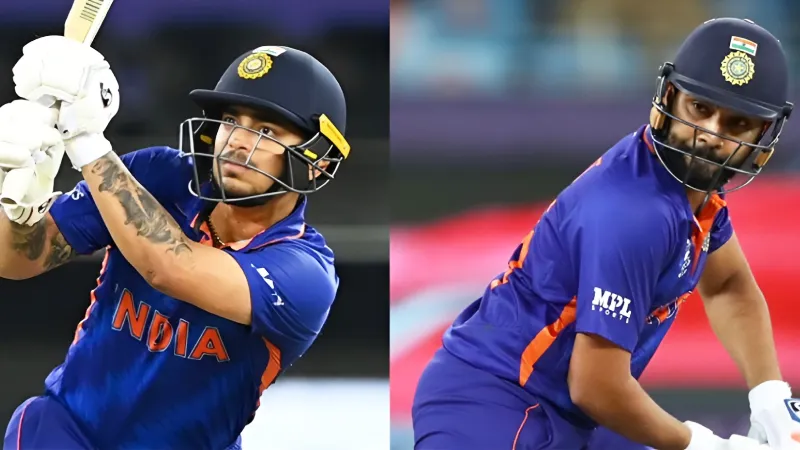

In Indian T20 cricket, patience is often seen as a weakness. In many cases, players are elevated far too rapidly and conversely dropped with the same speed at which they were selected. This is something that Ishan Kishan has experienced firsthand. It is not just that it has been some time since Ishan last played T20 cricket for India that explains why he has now been added to the India’s T20 Squad for the 2026 T20 World Cup, but it is equally true that when you have natural talent, timing is every bit as important.
But Kishan’s international numbers still divide opinion. That’s where the comparison becomes fascinating. Freeze the frame at 32 T20Is, and Kishan’s career trajectory starts resembling an early, lesser-remembered phase of Rohit Sharma before the “Hitman” became inevitable.
Early Output Under Different Expectations
Ishan Kishan has averaged 25.67 over his first thirty-two Twenty20 Internationals, scored a total of 796 runs, and hit at a strike rate of 124.37 in that time span, as compared to Rohit Sharma, who also played thirty-two Twenty20 Internationals where he batted for an average of 31.31 and struck at a rate of 127.48 for a total of 501 runs.
Although Rohit has an advantage in terms of average, it is important to put this into context. Kishan received a larger volume of balls, had more risk involved in each game, and was given more responsibilities during the power play than Rohit. The fact that Kishan was able to have an impact on games so much sooner, through sheer volume, tells its own story.
Strike Rate Context Changes the Narrative
While Kishan’s highest strike-rate criticism has been an overall Strike Rate statistic, there are individual team statistics that will be clearer than his overall stats. Kishan’s average is 41.20 with a strike rate of 150.36 when he bats against South Africa; while his strike rate increases to 144.73 when he bats against Australia.
Similar to Kishan, Rohit was conservative/ aggressive for his early years as an International T-20 Player. The consistent tempo is also usually a later developed commodity — most players develop an understanding of their role(s) before they can develop a consistent tempo.
Half-Centuries as Growth Markers
Kishan reached a 6th T20I fifty by match 32, while Rohit had achieved 5 fifties by that point; Kishan’s highest score to date (in terms of an innings where he did not get out early), 89 against Sri Lanka in Lucknow (2022), demonstrated his ability to bat through an innings as opposed to a “big hit” style of batting.
In comparison, Rohit’s best was 79 in Australia in the 2010 Twenty20 World Cup*; it indicated there was potential for Rohit to achieve more than what he had done, but neither batsman had established themselves as players yet; they were both developing their game.
Impact When Matches Tilt India’s Way
In matches India won, Kishan contributed 614 runs across 21 games, averaging 30.70. Rohit’s returns in victories were significantly stronger, 350 runs at an average of 58.33.
The gap reflects experience, not talent. Rohit had already begun mastering tempo control. Kishan is still learning when aggression needs restraint.
Batting First Comfort Versus Chasing Reality
Kishan thrives while setting totals of 350 runs at an average of 58.33, with a strike rate of 128.20. His numbers drop during chases, where decision-making becomes crucial. Rohit displayed a similar pattern early on. Chase management is an acquired art, sharpened over seasons rather than gifted at debut.
Between 2007 and 2012, Rohit Sharma was widely acknowledged as gifted but inconsistent. His transformation into a T20 powerhouse came only after role clarity and trust.
Kishan stands at a similar crossroads, explosive, questioned, yet statistically aligned with growth rather than stagnation. The difference is era. Kishan operates in a format where strike rate scrutiny is relentless, and patience is rare.
Key Takeaway
Ishan Kishan isn’t falling short of history; he’s following it.
FAQs
- What justified Ishan Kishan’s recall to the T20I squad?
His dominant Syed Mushtaq Ali Trophy performance and immediate impact potential.
- Why is Rohit Sharma a relevant comparison point?
Both players showed similar developmental patterns after 32 T20Is.
- How does Kishan differ from early-career Rohit?
Kishan plays in a faster, more unforgiving T20 era demanding instant returns.
Disclaimer: This blog post reflects the author’s personal insights and analysis. Readers are encouraged to consider the perspectives shared and draw their own conclusions.
Step into the world of cricket with JeetBuzz News—where expert opinions, trending Blogs, and behind-the-scenes insights meet all your favorite topics. Stay informed, stay entertained, and never miss the stories shaping the cricketing world—only on JeetBuzz News!