

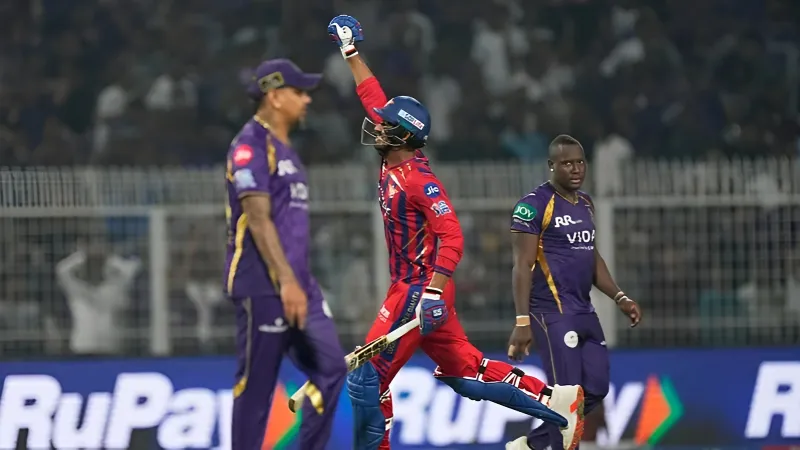

128 for 7. LSG needed 54 runs from the final overs. By every statistical measure available in T20 cricket, that match belonged to KKR. The required rate was climbing beyond what any lower-order partnership should produce. The bowling attack had already taken seven wickets. One more wicket and the match was finished. Instead, Vaibhav Arora bowled consistently outside off stump. Mukul Choudhary identified the pattern within his first four deliveries and began hitting boundaries from it. KKR didn’t lose that match because LSG played exceptionally. They lost it because the bowling plan that had produced seven wickets was abandoned at the exact moment when maintaining it would have produced the eighth.
Arora’s Wide Lines Handed LSG Everything
The specific technical error that converted a KKR win into an LSG chase is precise enough to identify without extensive analysis. Bowling consistently outside off stump against a lower-order batter in a situation requiring maximum pressure removes two of the three legitimate dismissal methods from the bowling equation; LBW and bowled both require the ball to be targeting the stumps.
With only the outside edge available as a wicket-taking mechanism, the batter can commit to driving through the off side without the risk of contact with the stumps producing unexpected outcomes. Choudhary didn’t need to innovate or play extraordinary shots. He needed to hit a ball arriving in the driving zone to the boundary, which is the specific shot that any batter capable of scoring at a 190 strike rate executes reliably rather than occasionally.
Choudhary Read the Pattern KKR Repeated
The specific quality that Mukul Choudhary demonstrated in this chase wasn’t power; it was pattern recognition. A finisher arriving at the crease with a required rate above twelve doesn’t have time for an extended assessment phase. The first two or three deliveries provide the information about line, length, and pace variation that determines whether the bowling plan can be attacked or must be survived.
Choudhary’s assessment produced a simple conclusion: Arora was going to bowl wide of off stump consistently. Once that conclusion was reached, the shot selection became straightforward. The delivery that keeps arriving in the same location stops being a bowling threat and becomes a batting opportunity.
IPL 2026 KKR Death Overs Cost Everything
The IPL 2026 pattern of KKR losing control in death overs that they appeared to be winning has now produced multiple match results that their earlier batting or bowling performance should have prevented. This specific match against LSG is the clearest example, seven wickets taken, 54 needed from the final overs, and a death bowling execution failure that converted an unlosable position into a lost match. The match-by-match pattern of reactive rather than proactive death over bowling suggests this isn’t an isolated execution failure. It’s a structural problem where the death bowling plan breaks down under pressure.
Plan and Execution Completely Fell Apart
The specific disconnect visible in this match is the mismatch between Rahane’s field placements and Arora’s delivery choices. Fields set to protect boundaries against driving on the off side require bowling that forces the batter to drive, which means the ball must be full and targeting the stumps rather than wide and inviting. Rahane’s field communicated one plan. Arora’s bowling communicated a different one.
When the field and the delivery are working toward different outcomes, the batter benefits from the gap between them, which is exactly what Choudhary exploited. The boundary protection field had no offside short cover or extra cover positioned to prevent the drive because the plan assumed the ball would be straight rather than wide. The plan assumed correctly. The execution didn’t follow.
- Does KKR address the death overs execution problem that has now cost them multiple matches in their IPL campaign, or does the structural bowling issue persist long enough to define their season rather than punctuate it? Drop your take and follow for IPL updates.
FAQs
What went wrong for KKR in the final overs vs LSG?
They failed to execute basic death bowling plans, especially targeting the stumps.
Why is Vaibhav Arora being criticized after the match?
His line outside off-stump allowed easy scoring opportunities in a high-pressure situation.
How does this loss affect the Kolkata Knight Riders?
It exposes tactical weaknesses that could impact their consistency in close matches.
What is the LSG vs KKR head-to-head record in IPL history?
LSG has had competitive results against KKR, often winning tight games.
Disclaimer: This blog post reflects the author’s personal insights and analysis. Readers are encouraged to consider the perspectives shared and draw their own conclusions.