

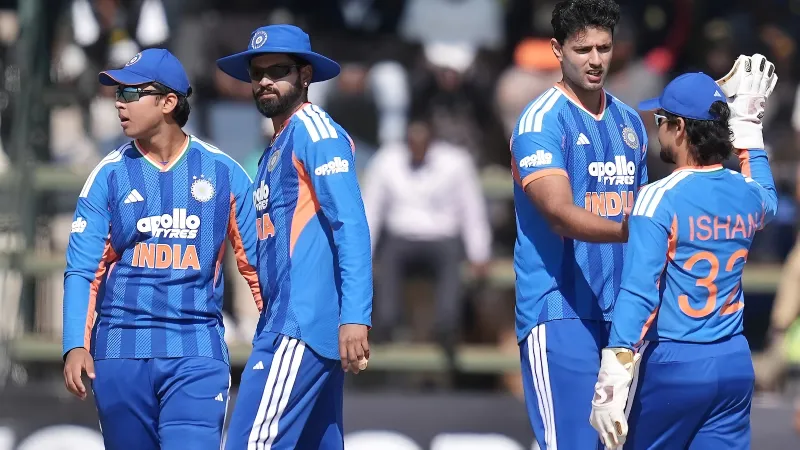

It demands near-perfect execution from the first ball, because India’s campaign starts in the quarter-finals with no group games to warm up. Three wins bring gold. One defeat ends the title defence on the spot. That puts pressure on selection, on death-overs planning and on how Shreyas Iyer uses a still-managed Jasprit Bumrah. India have done this before, taking gold through the same three-match path in 2022, and they haven’t lost a men’s T20I knockout since the 2022 T20 World Cup semi-final.
A Direct Bye Into the Quarter-Finals
Ten teams are in the men’s competition, but India play no group games at all. The six lowest seeds are split into two groups, with Afghanistan, Japan and Nepal in Group A and Hong Kong, Malaysia and Oman in Group B. They play a single round-robin from 24 to 26 September, and the top two from each group advance.
India, Pakistan, Bangladesh and Sri Lanka go straight into the quarter-finals on the strength of their ICC T20I rankings. Those ties begin on 28 September. The catch is obvious. The tournament starts at sudden death for India, with no earlier matches to shake off rust or test combinations. Group qualifiers will arrive with two competitive games behind them.
The Likely Quarter-Final Opponent From Group A
India face the Group A runner-up on 28 September. Afghanistan set the pace by beating Japan by 48 runs in the tournament opener, defending 129 and restricting them to 81. That leaves the second qualifying spot between Japan and Nepal. Afghanistan meet Nepal on 25 September, and Japan face Nepal on 26 September to complete the group.
India won’t know their opponent until both games are done. Preparing for two unfamiliar sides at once is its own small test. Whoever comes through will carry momentum from a pressure game only two days earlier.
Death Overs Plans With Bumrah and Arshdeep
India’s death bowling looked sharp in its latest outing. In the series opener against Afghanistan on 13 September, Shreyas Iyer turned to Arshdeep Singh and a returning Jasprit Bumrah for overs 17 to 19. The pair conceded just 15 runs between them.
Bumrah gave away only five in the 19th over, and Arshdeep finished with 3 for 19. That followed a rockier IPL 2026 for Bumrah, who went at an economy of 8.37 in the death overs for Mumbai Indians.
With a single defeat ending the campaign, the death-overs plan will shape results as much as any batting selection. Arshdeep’s 3 for 19 makes him the obvious first choice, but Bumrah’s 19th over is the one opponents will fear. How much of that late-innings load does Iyer trust to a still-managed Bumrah rather than his all-rounders?
India Asian Games 2026 Knockout Route
Every match India could play, from the quarter-final to the medal games, is scheduled for the same venue. There’s no travel and no change of ground, just three straight shots at gold.
Round | Date | Possible Opponent | Venue |
Quarter-final | 28 September 2026 | Group A runner-up (Japan or Nepal) | Korogi Sports Park, Nisshin |
Semi-final | 1 October 2026 | Winner of another quarter-final (TBD) | Korogi Sports Park, Nisshin |
Gold/Bronze medal match | 3 October 2026 | TBD | Korogi Sports Park, Nisshin |
The semi-final and medal-match opponents stay unknown until the remaining group fixtures and the other quarter-finals are complete. Familiarity with one ground is the only comfort the draw hands out.
Lessons From the 2022 Gold Medal Run
India already have a template for this format. At the 2022 edition, played in Hangzhou in 2023, a second-string side seeded straight into the quarter-finals needed only three matches for gold.
They beat Nepal in the quarter-final behind Yashasvi Jaiswal’s 49-ball century, then Bangladesh in the semi-final. The final against Afghanistan was rain-hit and decided on India’s higher seeding. Jaiswal’s century came in the same kind of game India now face first, against an Associate side with nothing to lose.
The bigger lesson is composure. Since the 2022 T20 World Cup semi-final loss to England, India haven’t lost a men’s T20I knockout, winning the 2024 and 2026 World Cup semi-finals and finals plus the 2025 Asia Cup final. That record is the best reason to trust the India Asian Games 2026 knockout route to a squad built for one-shot games.
Can India go three for three in Nisshin, or does sudden death finally catch them out? Tell us your prediction in the comments.
Frequently Asked Questions (FAQs)
When is India’s first match at the Asian Games?
India’s first match is the quarter-final on 28 September 2026. They received a direct bye past the group stage, so their campaign begins against the Group A runner-up at Korogi Sports Park.
Who will India play in the Asian Games quarter-final?
India will play the Group A runner-up, either Japan or Nepal. Afghanistan opened the group with a 48-run win over Japan, leaving the second spot to be settled in the final two group matches.
Why does India not play the group stage at the Asian Games?
India are seeded directly into the quarter-finals based on ICC T20I rankings. They are one of four teams to receive that bye, alongside Pakistan, Bangladesh and Sri Lanka.
Where is the Asian Games cricket being played?
All matches are being played at Korogi Sports Park in Nisshin. The venue sits on the outskirts of Nagoya, Japan, and hosts every round from the group stage through to the gold medal match.
How many matches does India need to win gold at the Asian Games?
India need to win three matches for gold: a quarter-final, a semi-final and the final. India followed the same path to gold at the 2022 edition, played in Hangzhou in 2023.
Disclaimer: This blog post reflects the author’s personal insights and analysis. Readers are encouraged to consider the perspectives shared and draw their own conclusions.