

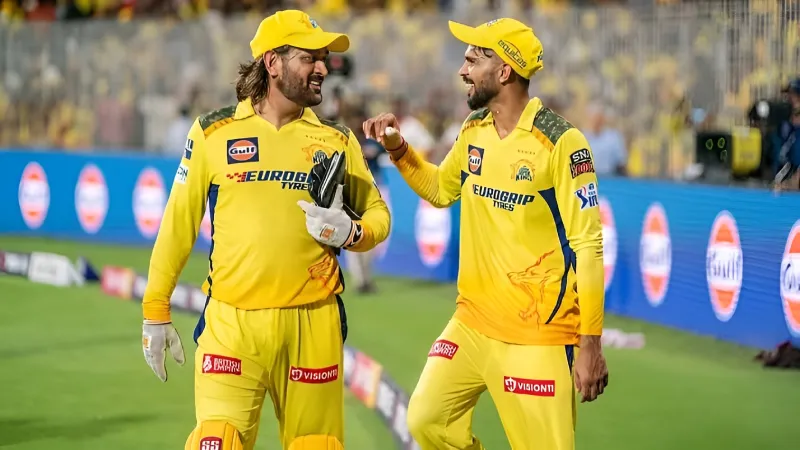

Every CSK playing XI discussion this season starts in the same place and ends with the same unresolved question. Where does MS Dhoni bat, how many overs does he get, and does his presence strengthen or complicate the team’s structure? Chennai Super Kings have enough quality around him to compete regardless, Ruturaj Gaikwad anchoring the top, Noor Ahmad’s 24 wickets from last season anchoring the bowling, and a spin-first strategy that Chepauk conditions have rewarded for over a decade. But the Dhoni question sits at the centre of every lineup decision, and it does not have a clean answer yet.
Gaikwad Sets the Platform First
Ruturaj Gaikwad’s role as the CSK innings foundation has become one of the most reliable constants in the franchise’s recent seasons. His ability to score at a rate that keeps bowlers honest without exposing wickets in the powerplay gives CSK a platform that more aggressive openers often fail to deliver consistently. The tactical logic at Chepauk is straightforward: preserve wickets through the first six overs, maintain a run rate above par, and arrive at overs seven to fifteen with most of the batting lineup intact. On slower surfaces that penalise reckless shot selection, Gaikwad’s approach is not conservative.
Dube and Brevis Change the Game
The middle-order construction around Shivam Dube and Dewald Brevis is where CSK’s batting has evolved most noticeably. Dube’s ability to clear the rope against both pace and spin makes him dangerous from overs eight onwards when fields are spread, and bowlers are looking to contain rather than attack. Brevis adds the kind of fearless aggression that younger players sometimes produce more naturally than experienced ones because the fear of failure has not yet calcified into caution. Sarfaraz Khan, alongside them, covers the scenario where early wickets require a batter who can rebuild and then accelerate rather than arrive swinging from ball one.
IPL 2026 Forces the Dhoni Decision
The Dhoni conversation in IPL 2026 is not about sentiment. It is about a specific batting position that either strengthens or weakens the XI depending on how it is filled. If Dhoni bats at six and arrives in over 15 with wickets in hand, his finishing ability remains genuinely valuable; his ability to read bowlers and execute under pressure does not diminish simply because his physical game has reduced.
The problem arises when CSK lose early wickets and need someone to rebuild from over ten. Dhoni at six in that scenario means either the middle order collapses around him or he is forced into a role his current game is not built for. The solution several analysts have suggested, a slightly earlier entry at five when the situation demands it, tests a different version of Dhoni but may produce better team outcomes than protecting him for a cameo that never arrives.
How Chepauk Shapes This Entire XI
The selection logic for CSK’s home XI is driven more by Chepauk’s surface than by any individual player’s form in isolation. The pitch grips through the middle overs, the boundaries are not short enough to reward pure power hitting from ball one, and the crowd creates an atmosphere that has historically made visiting teams uncomfortable chasing under lights. Every selection in this XI is filtered through that context. Two quality spinners for the middle phase. A top-order anchor who does not give away powerplay wickets cheaply. Middle order batters who can accelerate on a surface that rewards timing over brute force.
CSK’s campaign in this season lives or dies on two things: whether Noor Ahmad sustains last season’s form through a full tournament, and whether the Dhoni decision resolves itself cleanly in the first three matches or creates the uncertainty that slower starts have caused in previous campaigns. If both go well, this is a top-four XI. If neither does, the depth behind them is not deep enough to cover both gaps simultaneously.
- Where should Dhoni bat in CSK’s IPL lineup, and does he strengthen or complicate their XI? Drop your take in the comments and follow for IPL updates.
FAQs
Why is MS Dhoni’s role important?
His leadership remains crucial, but his batting role needs to evolve for better team balance.
How does the Impact Player rule affect CSK in IPL?
It allows CSK to adjust their lineup based on match conditions, adding flexibility to their strategy.
Which players could define CSK’s middle order?
Power hitters like Shivam Dube and versatile batters like Sarfaraz Khan are key options.
Can CSK rely on spin bowling?
Yes, especially in home conditions, where spin has historically been a major strength for Chennai.
Disclaimer: This blog post reflects the author’s personal insights and analysis. Readers are encouraged to consider the perspectives shared and draw their own conclusions.