

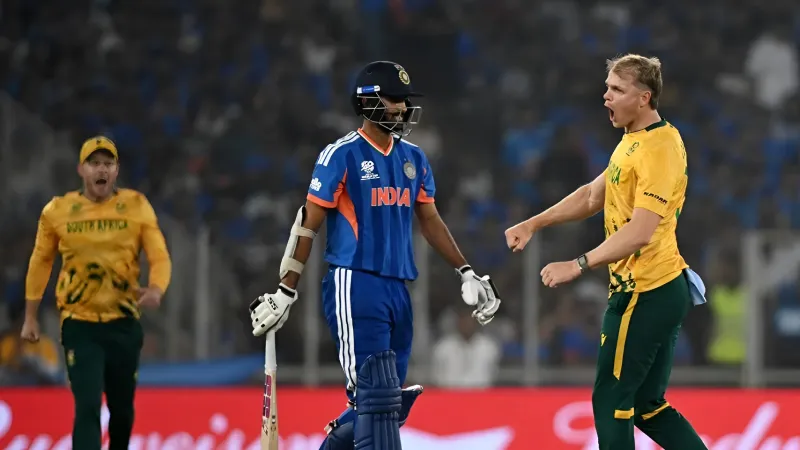

India’s lowest totals in T20WC history reveal a clear pattern of batting collapses against disciplined bowling attacks, including the recent setback in the T20WC 2026, where the Indian Cricket Team was dismissed for 111 by South Africa Cricket. From the leadership era of MS Dhoni to the current captaincy of Suryakumar Yadav, these totals highlight how conditions, pressure, and tactical misreading have contributed to India’s worst batting performances in global T20 tournaments.
79 All Out Against New Zealand in 2016
India’s lowest total came in Nagpur during the 2016 tournament when they were bowled out for 79 while chasing 127. The surface offered sharp turns and variable bounce, and New Zealand’s spinners applied constant pressure. India’s batters struggled to rotate strike, creating scoreboard pressure that forced risky strokes. The collapse showed how spin-friendly conditions can disrupt India’s rhythm when early wickets expose the middle order too soon.
110 for 7 Versus New Zealand in 2021
India managed only 110 for 7 in Dubai after choosing to bat first in the 2021 competition. The pitch offered seam movement early, and New Zealand’s bowlers maintained tight lengths throughout the innings. India never recovered from a slow power play, and the lack of boundary scoring created a defensive mindset. This total became one of the lowest because India failed to shift gears tactically when conditions demanded calculated aggression.
111 All Out Against South Africa in T20 World Cup 2026
India’s 111 all out in Ahmedabad during the ICC Men’s T20 World Cup 2026 stands as India’s third-lowest total. Chasing 188, India lost early wickets, which forced the middle order into a rebuilding phase instead of attacking. South Africa’s bowlers used slower deliveries and hard lengths effectively. This innings exposed how scoreboard pressure and disciplined bowling plans can dismantle India’s batting when chasing a high target.
118 for 8 against South Africa in 2009
India scored 118 for 8 while chasing 131 in the 2009 edition, struggling on a slow pitch that reduced stroke-making opportunities. South Africa’s bowlers focused on defensive lines, forcing India to take risks against the conditions. Even though the target was modest, India’s inability to accelerate during the middle overs played a decisive role in restricting the total.
119 All Out Against Pakistan in 2024
India were bowled out for 119 in the 2024 tournament despite batting first on a challenging pitch. The surface offered assistance to fast bowlers, and India’s top order failed to build partnerships. Although India eventually won due to excellent bowling, the total remains among India’s lowest totals in history and reflects how even strong teams can struggle in difficult batting environments.
Pattern Behind India’s Batting Collapses
A close analysis of India’s lowest totals in history shows a consistent pattern where early wickets and difficult pitch conditions combined to create collapses. In most cases, India lost multiple wickets inside the power play, which shifted the approach from aggressive scoring to survival. This tactical shift reduced scoring opportunities and allowed bowlers to dominate the middle overs. Whether facing spin in 2016 or pace variations in 2026, India’s biggest weakness has been adapting quickly to match conditions.
India’s lowest totals in history are not isolated failures but indicators of how match conditions, bowling quality, and tactical decisions influence performance. These totals show that India’s batting struggles usually occur when early wickets disrupt their preferred aggressive approach. However, these setbacks also provide lessons for future tournaments, especially in adapting to difficult pitches and managing pressure during chases.
Key Takeaway
India’s lowest totals consistently occurred when early wickets and difficult pitch conditions prevented their batters from controlling the game.
FAQs
Why does India struggle on spin-friendly pitches in T20WCs?
Spin-friendly pitches reduce scoring opportunities and increase pressure, forcing batters into mistakes.
How did South Africa dismiss India cheaply in the ICC Men’s T20 World Cup 2026?
South Africa used pace variations and disciplined bowling lengths to exploit scoreboard pressure.
Which captain faced India’s worst T20WC batting collapse?
MS Dhoni was the captain during the 79 all out in 2016, India’s lowest total.
Can India avoid such collapses in future ICC tournaments?
Yes, better adaptation to pitch conditions and stronger middle-order stability can reduce collapse risks.
Disclaimer: This blog post reflects the author’s personal insights and analysis. Readers are encouraged to consider the perspectives shared and draw their own conclusions.