

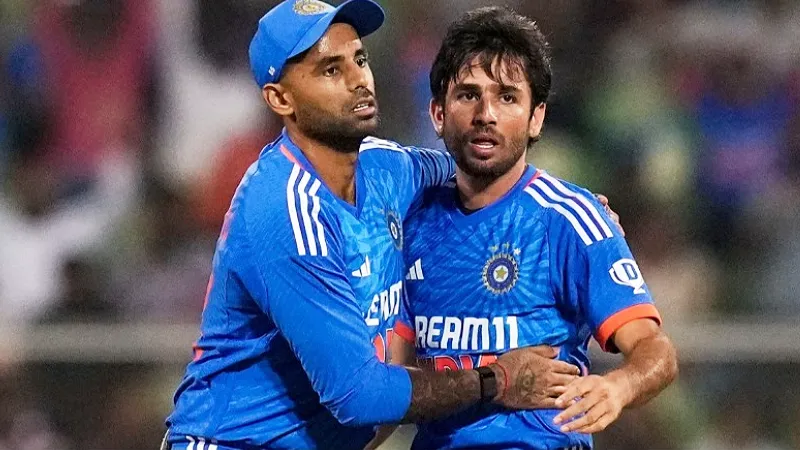

The game of cricket is always portrayed as being about meticulous planning. From selection meetings, workload charts, and World Cup roadmaps, it looks like everything is in order, and then the telephone starts ringing. Ravi Bishnoi was one of those players who got that call from England at a time when he had been quietly halted on his path to an international career rather than actively pursuing one.
Wickets Over Aesthetics in Middle Overs
Kuldeep Yadav’s recent dip has exposed an uncomfortable truth: control without wickets is no longer enough in modern T20s. The left-armer’s struggles, lack of bite, reduced use of flight, and inconsistent control even in familiar conditions have coincided with heavy multi-format workloads.
Ravi Bishnoi isn’t a carbon copy. He doesn’t rip the ball prodigiously or lure batters with exaggerated loop. What he does possess is something far more valuable in T20 cricket: repeatable wicket-taking instinct.
In 42 T20I appearances, Bishnoi has gone wicketless only nine times and has claimed two or more wickets in an innings on 19 occasions. That reliability matters. With Varun Chakaravarthy controlling tempo from one end, Bishnoi’s aggression restores India’s ability to attack relentlessly through the middle overs, the phase where matches quietly tilt.
A Tactical Shield Against Left-Handed Batters
Replacing Washington Sundar with a wrist-spinner raised eyebrows until the match-ups were examined closely.
Sundar’s value against left-handers is well documented, averaging 28 with an economy of 6.59 in T20s. But India’s current squad composition left them thin on specialists capable of consistently neutralising southpaws.
Enter Bishnoi. His Googly is his go-to weapon, not a surprise variation for him to use. He has averaged 23.40 against left-handers at an economy of 7.35, which is in line with his entire cricketing career so far. The most important factor, though, is his natural angle on bowling, which will push the ball out of the hitting area, making it difficult for left-handed batters to play the slog sweep or inside-out shot.
With Axar Patel and Varun Chakaravarthy more effective against right-handers, Bishnoi becomes India’s primary disruptor against New Zealand’s left-heavy core players like Michael Bracewell and Mark Chapman, who thrive on rhythm rather than chaos.
Phase-Spanning Flexibility Others Can’t Offer
Few spinners in India’s T20 setup can realistically operate across all three phases. Bishnoi can. By allowing Suryakumar Yadav the capacity for varied timing between each phase of play – at least 3 different options, including opening as a ‘roll-up’ or match-up selection; attacking while in between innings; and closing at the conclusion of innings allows Yadav greater latitude to build his team’s strategy for how best to sequence their bowling.
While Kuldeep has mostly bowled in the middle overs, Bishnoi does not. Against left-handed batsmen such as Devon Conway and Rachin Ravindra, he can bowl with the new ball rather than saving those overs for Varun Chakaravarthy and Axar Patel, who can then bowl their most high-impact middle-over duels against right-handed batsmen Daryl Mitchell and Glenn Phillips, since the new ball itself provides an extra element of leverage. Flexibility in T20s is not a luxury. It is leverage.
Bishnoi may not be the most classical wrist-spinner India has produced, but he fits the modern brief perfectly: wicket-hunter, match-up specialist, and phase-flexible operator. The New Zealand series isn’t a comeback tour; it’s an audition under pressure.
Key Takeaway
India didn’t recall Ravi Bishnoi for security; they recalled him for solutions.
FAQs
- What prompted Ravi Bishnoi’s sudden recall?
Washington Sundar’s injury and India’s need for a wicket-taking, flexible spinner ahead of the 2026 T20 World Cup.
- Why is Bishnoi preferred despite not being a like-for-like replacement?
Because wickets, match-ups, and phase flexibility matter more than stylistic similarity in T20s.
- How can this series shape India’s World Cup plans?
Strong performances could push Bishnoi into India’s core middle-over strategy alongside Varun Chakaravarthy.
Disclaimer: This blog post reflects the author’s personal insights and analysis. Readers are encouraged to consider the perspectives shared and draw their own conclusions.
Step into the world of cricket with JeetBuzz News—where expert opinions, trending Blogs, and behind-the-scenes insights meet all your favorite topics. Stay informed, stay entertained, and never miss the stories shaping the cricketing world—only on JeetBuzz News!