

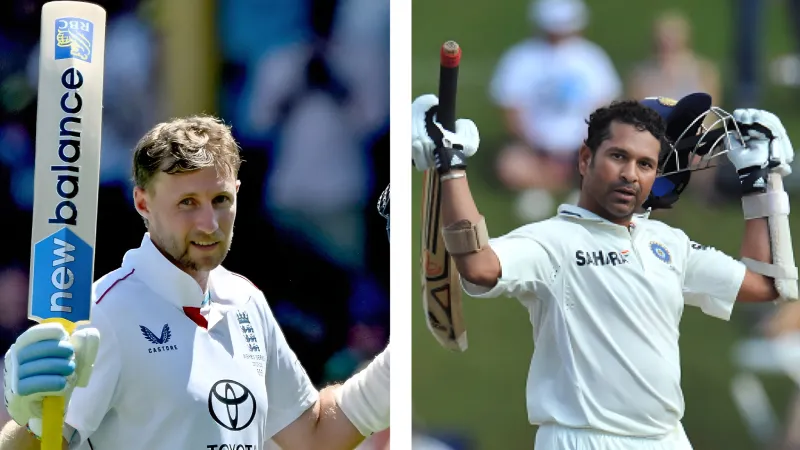

Root needs 1,921 more runs to pass Tendulkar’s 15,921 as Test cricket’s all-time leading run-scorer, and the answer to how long that takes depends entirely on which version of his batting shows up. At his post-2022 form, the gap closes inside 23 matches. At his full career rate, it takes 38. Everyone covering this story agrees he will get there eventually. Almost nobody has actually done the match count, which is the only number that turns a vague prediction into a real timeline.
Everyone Agrees He Can Do It
Mark Taylor, assessing an earlier stage of this chase, suggested the England batter had at least five years of cricket left in him and described the milestone as well within reach given his fitness and appetite for the format. One January 2026 projection had him adding roughly 1,257 runs across 22 innings over the following twelve months at his existing average.
A separate estimate published in June 2026 concluded he would need to keep playing until at least 2028 to have a real shot at the top spot. Most coverage of this story lands on the same broad conclusion. None of it actually works out the specific number of matches required to close the gap, a far more useful figure than a vague year attached to a headline.
Joe Root on Tendulkar Tests record
He began 2026 with approximately 13,943 career runs across 163 matches, batting at 51.07. By June, after England’s home series against India and the tour of Australia, that gap to the top of the all-time list had narrowed to 1,921 runs.
Scenario | Runs Per Match | Matches Needed | Estimated Year |
Optimistic, peak form continues | 60 | approx 32 | 2027-28 |
Realistic, current post-2022 rate | approx 50 | approx 38 | 2028 |
Conservative, gradual decline | approx 40 | approx 48 | 2029-30 |
Tendulkar’s total, 15,921 runs in 200 matches at an average of 53.78, has stood untouched since his retirement in November 2013. At 35, the Englishman remains the only active batter anywhere in the format with a realistic chance of passing it.
Where The Realistic Math Lands
His form since giving up the England captaincy in 2022 is the number that actually anchors the realistic scenario. Since stepping down, he has averaged close to 86 runs per match, one of the most productive sustained stretches any batter has produced in the format’s history.
At that rate, closing a 1,921-run gap takes fewer than 23 matches. At his full career average of 51, the same gap takes 38 instead, a meaningful difference. England typically schedules between 12 and 15 matches a year, which puts the higher-end scenario comfortably within a single season and the lower-end one within roughly three full seasons of cricket.
Factors That Could Change The Timeline
England’s home series against Pakistan starts August 19, 2026, and a home Ashes follows in 2027, together putting close to 20 more matches in view over the next twelve months. Sustained at his post-2022 average, that alone would cut the remaining gap to under 900 runs by the middle of 2027.
A form dip changes the picture just as quickly. Between 2019 and 2021 his average dropped below 40 runs per match for a sustained stretch, and a repeat of that kind of slump could push the timeline out to 2029 or even 2030. Injury is the other variable worth watching closely. He missed parts of the 2025 series against India, and fitness will matter every bit as much as form from here on.
The Year It Most Likely Falls
2028 is the single most probable year for the total to fall, based on how the realistic and optimistic scenarios line up. England play enough cricket, roughly 12 to 15 matches a season, and at 35 he plausibly has four more full seasons before workload management becomes a genuine selection question at all.
Sustaining something close to 1,000 runs a year, a pace he has already kept up consistently in recent seasons, would close the remaining gap between August and December of 2027, with the home Ashes providing the highest-profile stage imaginable for it to happen. Whatever the exact match, the Joe Root on Tendulkar Tests record question increasingly looks like a matter of when, not if, and 2027 into 2028 is where most of the realistic paths converge.
Does the 2027 home Ashes feel like the right stage for history, or is 2028 the safer bet? Tell us your prediction in the comments.
Frequently Asked Questions (FAQs)
How many Test runs does Joe Root have right now?
He had roughly 14,000 Test runs as of June 2026, with a 1,921-run gap remaining. That tally changes with every innings he plays across the current home season.
How many Test runs did Sachin Tendulkar finish his career with?
Tendulkar retired with 15,921 Test runs in 200 matches at an average of 53.78. He scored 51 centuries and 68 half-centuries before retiring in November 2013.
How many Tests has Root played in his career?
He had played 163 Tests as of January 2026, with more added since. He sits third on England’s all-time appearances list behind Stuart Broad and James Anderson.
Is Joe Root currently England’s Test captain?
He is serving as interim Test captain following Ben Stokes’ retirement during the New Zealand series. Marcus Trescothick is interim head coach, with Root’s tenure expected to run through the 2027 Ashes.
Who ranks second on the all-time Test run-scorers list?
He ranks second on the all-time run-scorers list, trailing only Tendulkar at the very top. He passed Ricky Ponting, Jacques Kallis and Rahul Dravid during the 2025-26 season alone.
Disclaimer: This cricket prediction reflects the author’s personal insights and analysis. We encourage readers to review the points shared and draw their own conclusions.