

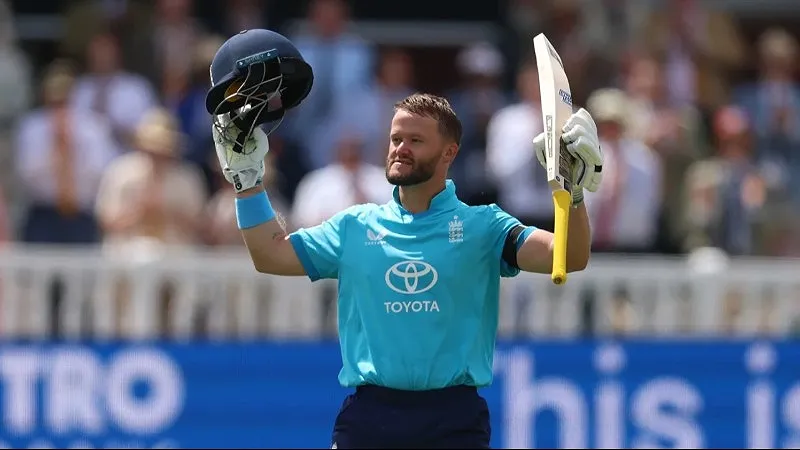

Duckett’s innings won’t last because scoring at this ground keeps accelerating every year, not slowing down. His 141 off 120 balls broke a record that had survived for forty seven years, only for the same afternoon to produce cricket’s second-highest score at this venue as well. Two centuries, one world record, one near miss, all landing in the very same match on the same ground. That collision of history and inflation is exactly why this particular mark already looks fragile, whatever the scoreboard says today.
The Numbers Behind His Innings
Duckett and Jacob Bethell added 192 runs in the opening stand, the largest for any wicket in an ODI at this ground, before Duckett reached his total off 120 balls with 11 fours and 2 sixes, caught and bowled by Prince Yadav. It was his fourth ODI century and a new career best score. England finished on 387 for 3, the highest ODI total ever posted at the venue. The stand between the two openers also broke the previous best opening partnership at the ground by more than fifty runs, a gap that shows how far ahead of the pack this particular innings was.
Player | Score | Year | Match |
|---|---|---|---|
Ben Duckett, England | 141 | 2026 | vs India, 3rd ODI, new record |
Viv Richards, West Indies | 138 not out | 1979 | World Cup Final vs England, held 47 years ago |
Rohit Sharma, India | 138 | 2026 | vs England, same match as Duckett |
Dennis Amiss, England | 137 | 1975 | vs India, 1st World Cup, June 7 |
Ben Duckett Lord’s ODI Record England India
Richards’ unbeaten knock came in the 1979 World Cup final, batting at number three for the West Indies in what commentators at the time called the defining innings of an era of Caribbean batting dominance. Nobody came remotely close until this new mark replaced it this year.
The extraordinary footnote is that the same afternoon also produced India’s second innings of 138, meaning the ground’s all-time record and its second highest score were both set in the same 50 overs. That combination, a record broken and a near miss in the very same match, had never happened at this ground before in nearly one hundred and fifty years of international cricket.
The Innings That Almost Matched It
India’s chase fell only three runs short of matching the new mark, with Rohit Sharma’s innings doing most of the damage before England closed it out. Shubman Gill added 77 in the same chase, and Jos Buttler finished unbeaten on 41, both players with strike rates capable of testing a total like this again at the same ground. Buttler’s approach at the death, refusing to simply see out the innings once the equation turned unlikely, showed how modern lower-order hitting can still make even a losing chase look competitive on paper.
Batters Who Could Break It Next
Phil Salt opening alongside either Bethell or Duckett gives England a genuine template for chasing a big total in an afternoon, and the accelerating pace of white-ball batting across the format makes a repeat performance well within reach inside the next few years. Modern openers no longer treat 120 balls as a full innings; they treat it as a platform for something far bigger. England’s depth through the middle order, with Root and Buttler both capable of finishing an innings at pace, means that platform no longer has to carry the entire scoreboard by itself.
Scores Keep Climbing at the Venue
The five highest ODI team totals at the venue are all recent: 387 this year, 330 from South Africa last year, and 328 from England in 2017. Before that stretch, the old record of 334 from the 1975 World Cup had stood for roughly forty years untouched.
Shorter square boundaries and a slope that consistently troubles fielders both help explain why totals keep rising rather than levelling off. Grounds with similarly tight square boundaries have shown the same pattern over the past decade, suggesting this is less about one venue’s quirks and more about how white ball batting has evolved everywhere at once. Track the Ben Duckett Lord’s ODI record in the England-India context and the acceleration is obvious: the highest team total moved from 334 to 387 in about fifty years, yet the most recent 15-run jump, from 330 to 387, took under twelve months to arrive.
Which current opener breaks 141 at this ground first, Duckett again or someone chasing history? Leave your pick below.
Frequently Asked Questions (FAQs)
What is the highest individual score in an ODI at Lord’s?
Ben Duckett holds it, 141 for England against India, reached on July 19, 2026. His innings passed Viv Richards’ 138 not out, a mark that had stood since 1979.
Who held the record before Ben Duckett?
Viv Richards of the West Indies, with an unbeaten 138 in the 1979 World Cup final. He batted at number three that day and remained not out as West Indies won the match.
How many runs did England score in Duckett’s record innings?
England posted 387 for 3, the highest ODI total ever made at the ground. Bethell added 91, Joe Root finished on 74 not out, and Buttler chipped in an unbeaten 41.
What was Viv Richards’ score in the 1979 World Cup final?
Richards finished unbeaten on 138 at number three for the West Indies. That innings held the ground’s ODI record for forty seven years before this year’s match.
Who else has scored ODI centuries at Lord’s?
Duckett, Richards, Rohit Sharma and Dennis Amiss own the four biggest individual scores on record there. Rohit made 138 in the same 2026 match, three runs short of Duckett’s new mark.