

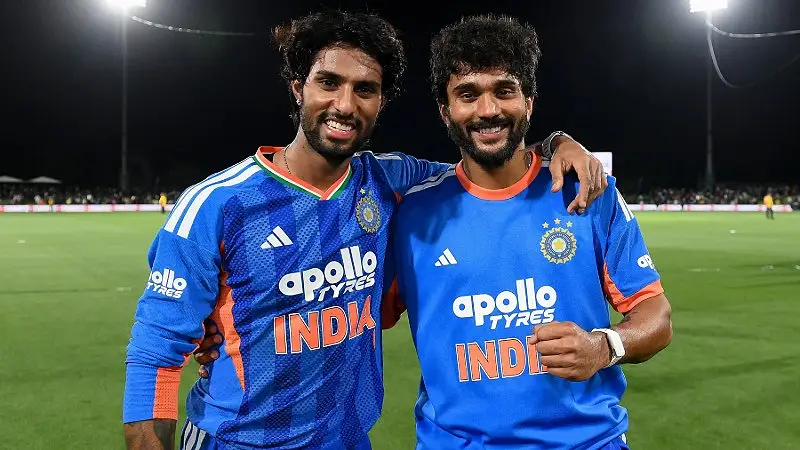

Naman Dhir is the better fit for India’s lower order if the job is to finish an innings quickly, while Nitish Reddy offers more with the ball and a more balanced game. Dhir has scored at a strike rate of 246.67 in T20Is and hit 42 not out off 15 in the first match against New Zealand. Reddy’s bowling and his unbeaten 26 off 13 in the second game make this a closer call than the hitting numbers suggest.
The Lower Order Problem for India
India’s squad is thinner than planned. Kishan is out injured, and Bumrah and Hardik are unavailable, so the back half of the batting card has been rebuilt around whoever remains. Dhir and Reddy have stepped into positions seven and eight, a pairing that must supply both power and bowling options.
That is why the question of fit matters. A finisher at seven arrives with the run rate climbing and the overs disappearing, while an eighth batter must still add something with the bat and share the bowling load. The two candidates answer that brief in very different ways. Neither can be judged on a strike rate alone, because the XI needs the second skill as much as the first.
NZ vs IND 2026 Naman Dhir Nitish Reddy
Dhir’s numbers are the louder of the two. In seven T20Is, he has made 111 runs off only 45 balls, a strike rate of 246.67 with an average of 37. He has also taken five wickets with off-spin, although an economy of 11.00 and best figures of 3/31 mark him as a part-time bowler.
Reddy’s case rests on balance. He has 181 runs at a strike rate of 174.04 from 104 balls, along with 11 wickets in 11 matches and an economy of 9.30 across 30 overs. Those figures describe a genuine all-rounder who contributes in both departments, even if the hitting is less explosive.
Statistic | Naman Dhir | Nitish Kumar Reddy |
|---|---|---|
Batting position, 1st T20I | 7 (scored 42* off 15) | 8 (scored 2) |
Batting position, 2nd T20I | 7 (scored 31 off 17) | 8 (scored 26 off 13) |
Career strike rate | 246.67 (111 off 45) | 174.04 (181 off 104) |
Career economy | 11.00 (121 runs in 11 overs) | 9.30 (279 runs in 30 overs) |
Career wickets | 5 in 7 matches | 11 in 11 matches |
Finishing Power Versus Bowling Value
Dhir’s role is clear: a power-hitting finisher with a few overs of spin in reserve. He has faced only 45 balls across seven matches, which means he arrives late and still scores at a rate few can match. His strike rate sits more than 70 points above his rival’s.
Reddy has spent longer at the crease, facing 104 balls, and he carries a far heavier bowling load of 30 overs against 11 for Dhir. An economy of 9.30 against 11.00 and eleven wickets against five make the bowling gap substantial. For a side that needs overs, that gap counts, and the numbers favour Reddy here.
Evidence From Two New Zealand Games
Dhir walked in during the first T20I with 59 needed off 33 balls and smashed 42 not out off 15, without bowling a delivery. In the second match, he made 31 off 17 and sent down one over for 7. He batted seventh both times.
Reddy batted eighth in each game, managing 2 in the opener before an unbeaten 26 off 13 in the second. He also bowled three overs for 31 and took a wicket. That outing showed what he brings: a quick finish and a wicket in the same match. Set beside the explosive Dhir innings, it is a useful contrast when choosing a role.
A Verdict Built on Roles
For pure end-of-innings hitting, Dhir is the safer choice. His scoring rate is far higher, and his 42 not out in the opener showed he can turn a steep chase into a manageable one. But with Hardik unavailable, India also need overs, and Reddy supplies more of them at a lower price.
India should pick Dhir to finish and keep Reddy as the second all-rounder when the XI needs overs. That split settles the NZ vs IND 2026 Naman Dhir Nitish Reddy debate better than choosing one man for both jobs, because each fills a gap the other leaves open.
Who would you pick to finish India’s innings, the hitter or the all-rounder? Tell us in the comments.
Frequently Asked Questions (FAQs)
Is Naman Dhir a bowler or a batter?
Dhir is primarily a power-hitting batter who also bowls part-time off-spin. He has five wickets in seven T20Is, though an economy of 11.00 shows that bowling is a secondary skill.
How did Nitish Reddy perform in the second T20I against New Zealand?
Reddy scored 26 not out off 13 balls while batting at number eight. He also bowled three overs for 31 runs and took one wicket.
What is Naman Dhir’s T20I strike rate?
Dhir has a strike rate of 246.67 in T20Is. He has made 111 runs off only 45 balls across seven matches, which is well above his rival’s 174.04.
Which of the two has the better T20I bowling record?
Reddy has the better bowling record, with 11 wickets at an economy of 9.30. Dhir has taken five wickets at 11.00 an over, with best figures of 3/31.
What did Dhir do in the first T20I against New Zealand?
Dhir scored 42 not out off 15 balls. He arrived when India needed 59 off 33 balls and did not bowl in that match.