

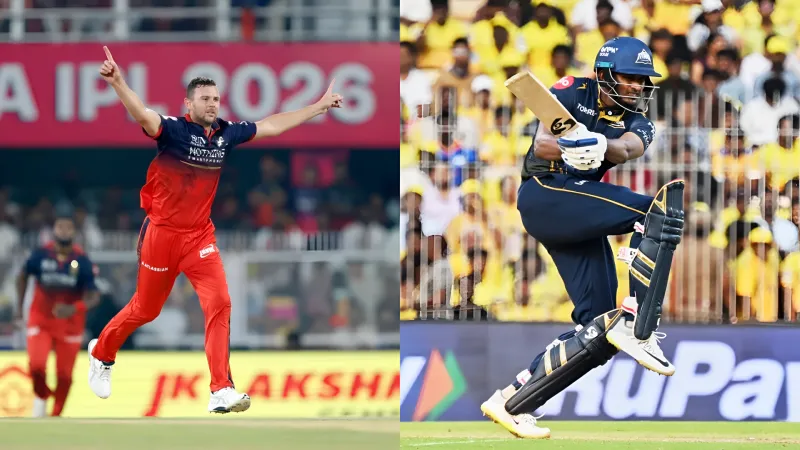

Sai Sudharsan has scored 322 runs in eight matches at a strike rate exceeding 160, and he does it by solving problems that hard-length bowling is supposed to create rather than neutralise. Josh Hazlewood‘s back-of-a-length deliveries are his primary weapon, but they give Sudharsan exactly the time he needs to execute the shots he does best. For RCB, that technical reality demands a tactical adjustment before the first over is bowled. If Hazlewood arrives at this match bowling his natural length, the contest tilts toward Sudharsan before it properly begins.
Late Play Turns Bounce Into Runs
The mechanism is counterintuitive but well-established in T20 cricket. Bowlers generating steep bounce expect it to rush batters into mistimed contact by reducing their decision time. Sudharsan removes that expectation entirely by delaying his shot until the last possible moment. When Hazlewood lands the ball back of a length, and it climbs quickly, Sudharsan doesn’t commit early to a defensive push or an attempted drive.
He waits, reads the trajectory fully, and either pulls through midwicket with control or guides behind square on the offside. Both shots exploit the extra carry that bounce generates without requiring him to play through the line against movement. The ball doing more off the surface gives Sudharsan more scoring options, not fewer. Hazlewood’s most effective delivery at this ground becomes the one Sudharsan most comfortably converts into runs.
Fuller Length Forces Sudharsan to Commit
Hazlewood’s adjustment is clear in theory and harder to execute consistently under match pressure. Bowling fuller means landing the ball in the hitting zone rather than the bounce zone, which creates its own risks on a flat Ahmedabad surface that rewards powerful driving. The tactical logic holds regardless: a fuller length forces Sudharsan to play through the line rather than off the back foot, removing the late-play window he relies on against pace. Going around the wicket adds an angle that restricts his preferred scoring arc on the offside.
Deliveries angling toward his pads from that position push him toward leg-side options where his timing is less reliable, and fielding placements cover boundaries more effectively. RCB need Hazlewood to execute this adjustment from his opening over rather than discovering the need for it three overs too late.
Numbers Reveal Who Controls This Duel
The head-to-head numbers between Hazlewood and Sudharsan suggest a contest closer than recent form implies. Hazlewood has dismissed Sudharsan twice across 21 deliveries while conceding 28 runs, a reasonable return against a high-quality top-order batter. The 28 runs alongside those wickets show the control wasn’t absolute. Sudharsan struck at above 80 across those 21 deliveries, reflecting comfortable engagement rather than survival against a bowler of Hazlewood’s quality.
His current season form amplifies that picture significantly. Three hundred and twenty-two runs across eight matches at an average above 40 and a strike rate exceeding 160 describe a batter at the peak of his T20 output. Hazlewood has taken his wicket before, but sustaining control against this version of Sudharsan across a full spell is a genuinely different proposition.
IPL 2026 Duel Demands Hazlewood Adapt
Historical T20 patterns consistently confirm that batters playing late outperform expectations against bowlers relying primarily on bounce. The required adjustment is well understood: pitch fuller, change angles, and introduce cutters. Executing it under powerplay pressure against a batter averaging above 40 this season requires abandoning a natural approach that has produced results across different conditions throughout a career.
Batting-friendly surfaces amplify technical mismatches earlier and more decisively than variable pitches do. If Hazlewood opens with his default back of a length plan, Sudharsan will convert the powerplay into a scoring phase before RCB’s captain can intervene with a bowling change.
- Does Sudharsan’s late play make Hazlewood’s bounce irrelevant at Ahmedabad, or can a fuller length and a change of angle reclaim the powerplay duel for RCB before the damage is done? Drop your pick in the comments and follow for IPL updates.
FAQs
Q: What makes Sai Sudharsan so difficult to bowl at with pace and bounce?
His late play gives him extra time to read length, turning steep bounce into comfortable pull shots or guided boundaries.
Q: How should Hazlewood adjust his bowling against Sudharsan?
He needs to pitch fuller and go around the wicket to remove Sudharsan’s back-foot scoring options and cut off the offside.
Q: What are Sai Sudharsan’s IPL 2026 stats before the GT vs RCB match?
He has scored 322 runs in eight matches at an average above 40 and a strike rate exceeding 160.
Q: What does the Hazlewood vs Sudharsan head-to-head record show?
Hazlewood has dismissed Sudharsan twice in 21 deliveries but conceded 28 runs, showing control without dominance.
Disclaimer: This blog post reflects the author’s personal insights and analysis. Readers are encouraged to consider the perspectives shared and draw their own conclusions.