

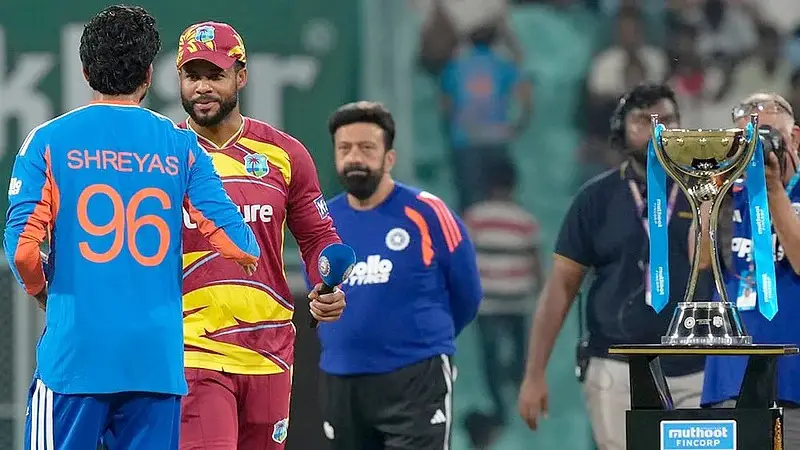

West Indies won from behind, while South Africa won from the front. At Centurion, the chasers lost no wickets in the first half of the innings, whereas in Ranchi West Indies were three down inside the powerplay and still finished with nine balls to spare. One pursuit was built on an opening stand, the other on a recovery led by Shai Hope and Sherfane Rutherford. Both games ended inside 19 overs, but that contrast separates a 252/4 triumph from the record 259.
Comparing the Two Biggest Targets
On 9 October 2026 in Ranchi, West Indies hunted down 250 against India, getting there on 252/4 after 18.3 overs, which left nine deliveries unused. Only one successful pursuit in men’s T20Is has gone higher, South Africa’s 259 at Centurion in 2023, again against West Indies.
Both teams finished inside 19 overs, yet the routes could hardly have been more different. The table below ranks the four highest successful chases in men’s T20Is by target.
Match | Chase Target | Balls Remaining | Highest Partnership | Top Scorer |
|---|---|---|---|---|
South Africa v West Indies, Centurion, 2023 | 259 | 7 | 152 (de Kock, Hendricks) | de Kock 100 (44) |
West Indies v India, Ranchi, 2026 | 250 | 9 | 120 (Hope, Rutherford) | Hope 102* (45) |
Australia v New Zealand, Auckland, 2018 | 244 | 7 | 121 (Warner, Short) | Short 76 (44) |
West Indies v South Africa, Johannesburg, 2015 | 232 | 4 | 152 (Gayle, Samuels) | Gayle 90 (41) |
Powerplay Starts That Shaped Both Games
South Africa created the blueprint with 102/0 at the end of the powerplay, the first 100-plus opening six overs in any T20I. Australia in 2018 started their pursuit on 91/0, and West Indies in 2015 on 86/1.
Ranchi broke that pattern. Kamil Pooran and Shimron Hetmyer went in the opening over, with Rovman Powell following in the sixth, but West Indies still reached 72/3, scoring at 12 an over. Few sides recover from a start like that.
Chase | Powerplay Score |
|---|---|
South Africa 2023 | 102/0 |
West Indies 2026 | 72/3 |
Australia 2018 | 91/0 |
West Indies 2015 | 86/1 |
IND vs WI T20I series 2026 run chase and how it unfolded
At the start, West Indies needed 12.50 an over, and when the powerplay finished, they required 178 from 84 balls, an asking rate of 12.71. The next eight overs, from the seventh to the fourteenth, brought 106 runs without a dismissal and left 72 needed from 36 balls (12.00). Even after Rutherford departed during the 15th over, the final 26 balls produced 74.
South Africa never relied on a late charge. Their required rate began at 12.95, eased to 11.21 once the powerplay was over and sat at 11.00 at halfway, with the openers unbroken on 149. They needed just 41 from the final 24 balls, a rate of 10.25. The contrast comes down to this: South Africa banked runs early, while West Indies repaired early damage.
Stands That Decided Each Contest
The Ranchi turnaround rested on Hope and Rutherford, who built 120 in only 54 balls, moving the score from 58/3 up to 178/4 for the fourth wicket, a new West Indies best for that slot in T20Is. Rutherford struck 84 from 37 deliveries, including seven sixes and seven fours, while Hope made 33 of the stand before finishing on 102 not out from 45, including nine sixes and six fours. Romario Shepherd then closed it out, unbeaten on 34 from 13.
South Africa’s template came from the top of the order. Reeza Hendricks and Quinton de Kock produced 152 for the first wicket, and de Kock’s hundred took 44 balls, his fifty coming after only 15. The West Indies stand was shorter but arrived when the game was in danger.
Ranking Ranchi in T20I History
Measured by target, the Ranchi effort is second, ahead of the 244 Australia reached against New Zealand in 2018. No side has chased more against India since the previous best was 223, made by Australia at Guwahati in 2023. For West Indies, it is also their own record, replacing their 2015 pursuit of 232 against South Africa.
Ranchi yielded 501 runs, and 204 of the 252 West Indies runs scored arrived through fours and sixes. Any conversation about the IND vs WI T20I series 2026 run chase now starts with that innings, because only a single side has ever chased more.
Which was the more impressive chase, South Africa’s front-loaded 259 or West Indies’ comeback 252? Tell us in the comments.
Frequently Asked Questions (FAQs)
Which team owns the biggest winning run chase in men’s T20 internationals?
South Africa own the record at 259. Facing West Indies in Centurion on 26 March 2023, they won with seven balls to spare after a 152-run opening stand.
Where does the Ranchi chase sit all time?
It is the second-highest in T20I history. West Indies overhauled 250 against India on 9 October 2026 with nine balls to spare, and it is also the biggest chase ever completed against India.
Has any team chased more against India in a T20I?
No, West Indies set the mark. The old record against India was Australia’s 223, set at Guwahati in 2023, so Ranchi lifted it by 27 runs.
Who scored the century in the Ranchi chase?
Shai Hope scored an unbeaten 102. He faced 45 balls, hit six fours and nine sixes, and shared a 120-run fourth-wicket stand with Rutherford, whose 84 came off 37.
How many balls did the West Indies have left?
Nine balls remained when they won. West Indies took the match by six wickets, ending on 252 for 4 after 18.3 overs, having lost three wickets inside the powerplay.