

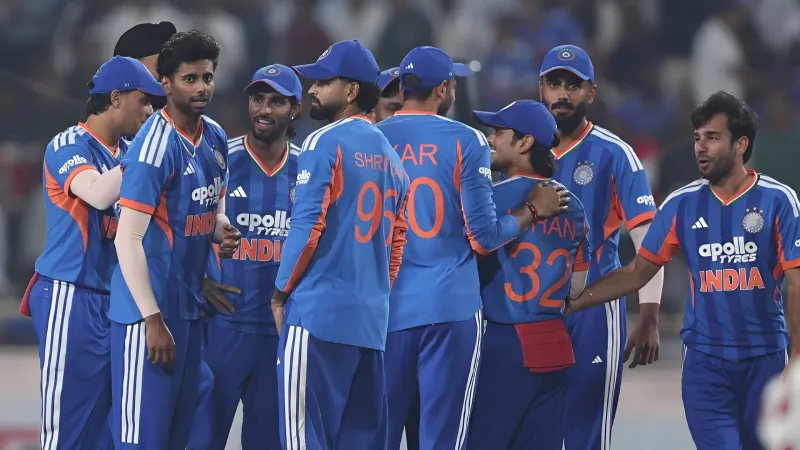

India will face West Indies in the third T20I of the five-match series at Holkar Stadium in Indore on October 11. After winning the opening match in Lucknow by eight wickets, the hosts suffered a six-wicket defeat in Ranchi, leaving the series level at 1-1. India produced an impressive batting display in the second T20I, posting 249/5, but West Indies completed a remarkable chase with nine balls to spare. Shai Hope remained
unbeaten on 102 off 45 balls, while Sherfane Rutherford smashed 84 off 37 deliveries to lead the visitors to victory. With the series finely balanced, India will look to improve their bowling execution while retaining the firepower that helped them cross the 240-run mark. Here is the predicted
playing XI for the third T20I.
1. Abhishek Sharma
Abhishek Sharma is expected to continue opening the innings. The left-hander provides India with an aggressive option during the powerplay and can put opposition bowlers under immediate pressure.
Although he could not make a substantial contribution in Ranchi, his attacking approach remains important to India’s plans. The team management is likely to back him to provide a quick start in Indore.
2. Sanju Samson (wk)
Sanju Samson is likely to retain his place after an outstanding performance in the second T20I. The wicketkeeper-batter scored 82 off 41 deliveries, combining clean hitting with excellent placement to give India a strong platform.
His innings demonstrated why he remains a dangerous option at the top of the order. Another substantial contribution would help India establish early control and put West Indies’ bowlers under pressure.
3. Ishan Kishan
Ishan Kishan is expected to bat at No. 3 after contributing 43 runs in Ranchi. The left-hander can accelerate against pace and spin, making him a valuable option during the middle overs. His ability to maintain the scoring rate after the powerplay will be important, particularly if India lose an early wicket.
Kishan’s wicketkeeping ability also provides the team with another option behind the stumps, although Samson is likely to retain the gloves.
4. Shreyas Iyer (c)
Captain Shreyas Iyer should continue to occupy the middle order. He scored an unbeaten 102 off 43 balls in the first T20I, producing a sensational innings that helped India chase down 172 comfortably. Iyer made 40 in the second match, contributing to India’s late acceleration.
His experience and ability to attack spin make him central to India’s batting plans, and he will be keen to lead the team to a series advantage.
5. Tilak Varma
Tilak Varma is expected to retain his place after playing an important role in India’s late surge in Ranchi. He combined with Iyer to produce a rapid partnership that helped India finish with a formidable total. Tilak’s adaptability allows him to build an innings when required or accelerate against the older ball. His left-handed presence also adds variety to India’s middle order.
6. Shivam Dube
Shivam Dube is likely to feature as the designated power-hitter in the middle order. His ability to clear the boundary, especially against spin, gives India an important attacking option. Dube’s bowling could provide an additional option, but India will primarily expect him to contribute with the bat. Against a West Indies side that struggled to contain India’s late acceleration, his finishing ability could be crucial.
7. Axar Patel
Axar Patel should retain his place as a spin-bowling all-rounder. He offers control in the middle overs and can contribute useful runs in the lower order. His experience will be particularly important after India’s bowlers struggled to defend a total of 249 in Ranchi. Axar will need to vary his pace and lengths more effectively to prevent West Indies’ aggressive batters from finding their rhythm.
8. Ravi Bishnoi
Ravi Bishnoi could be considered as a tactical inclusion if India decide to strengthen their specialist spin options. His leg-spin and variations offer a different challenge compared with Axar Patel and Kuldeep Yadav. India may prefer an additional wicket-taking option in the middle overs after failing to contain Hope and Rutherford. However, the team management could also retain the previous combination, making Bishnoi’s inclusion a selection possibility rather than a certainty.
9. Kuldeep Yadav
Kuldeep Yadav is expected to retain his place as India’s principal wrist-spinner. He can create wicket-taking opportunities through changes of pace, flight and turn. Against West Indies’ powerful middle order, Kuldeep’s role will be to break partnerships and prevent batters from settling. His ability to attack rather than simply contain runs could prove decisive in Indore.
10. Arshdeep Singh
Arshdeep Singh should continue as one of India’s leading pace options. His left-arm angle, control with the new ball and experience at the death make him a valuable member of the attack.
India will need better execution of yorkers and slower deliveries after conceding a record-breaking chase in Ranchi. Arshdeep’s ability to handle high-pressure overs could be crucial.
11. Mayank Yadav
Mayank Yadav is likely to retain his place despite the expensive nature of the second T20I. His pace can trouble batters, and he made an impact by taking early wickets against West Indies.
The challenge will be to combine his speed with greater control. If Mayank can avoid predictable lengths and execute his plans at the death, he could play a significant role in India’s attempt to regain the series lead.
Predicted India Playing XI vs West Indies
No.| Player| Role
1| Abhishek Sharma| Opener
2| Sanju Samson (wk)| Opener/wicketkeeper
3| Ishan Kishan| Batter
4| Shreyas Iyer (c)| Batter
5| Tilak Varma| Batter
6| Shivam Dube| All-rounder
7| Axar Patel| All-rounder
8| Ravi Bishnoi| Leg-spinner
9| Kuldeep Yadav| Wrist-spinner
10| Arshdeep Singh| Fast bowler
11| Mayank Yadav| Fast bowler
Disclaimer: This blog post reflects the author’s personal insights and analysis. Readers are encouraged to consider the perspectives shared and draw their own conclusions.