

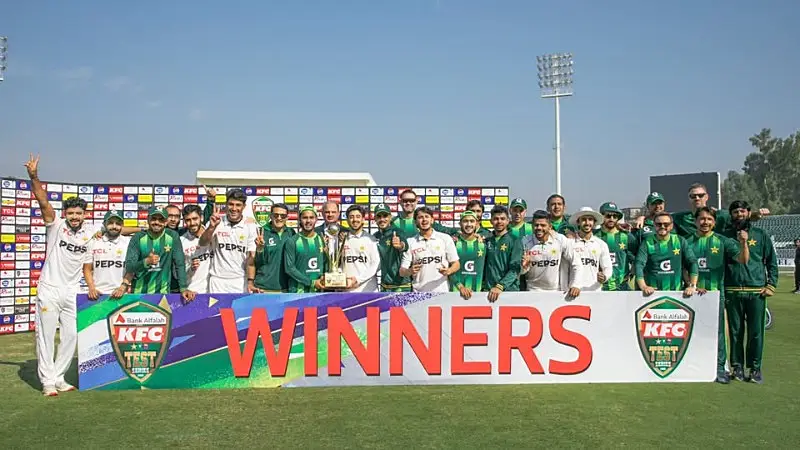

Pace did almost all of it. Pakistan beat Sri Lanka 1-0 at home, with the series sealed at Rawalpindi on 20 November, and seamers claimed 29 of the 30 wickets that fell. The result ended a wait that began in October 2024, when two spinners, Sajid Khan and Noman Ali, did the damage on tailored surfaces. Neither of them played this time, so the change of method is the real story of the series, and it deserves a closer look.
A Brutal Year Forced a Rethink
Nothing in 2026 hinted at a series victory. Bangladesh took a 2-0 result in May, and Pakistan managed only a 1-1 draw in the West Indies, where Sajid’s ten-wicket match at Port of Spain supplied their lone victory. England then won 3-0, a run that began at Headingley, where Pakistan lost by an innings.
Babar Azam took the captaincy back from Shan Masood in July, and Pakistan left England with a single World Test Championship point. The selectors responded ahead of the Sri Lanka series by dropping Masood along with Sajid and Noman. The opening match brought Test debuts for four players, which left a bowling unit built almost from scratch.
The Pakistan Test Series Win Over Sri Lanka in Numbers
Pace bowlers accounted for 29 of Sri Lanka’s 30 wickets in the series, and the remaining one fell to the occasional off-breaks of Salman Agha. Against England in 2024 the split had run the opposite way, with Sajid and Noman collecting 39 of the last 40.
Debutant Saqib Khan finished on nine wickets at an average of 18.33 and an economy of 3.81, while Mohammad Abbas conceded under two runs an over across his eight. Aamer Jamal averaged 15.17 from a single Test, and Razaullah’s six wickets cost 46.17 each. Jamal played only the second Test and Minhas only the first, so both sets of figures rest on one match.
Bowler | Type | Series Wickets | Average | Economy |
|---|---|---|---|---|
Saqib Khan | Pace | 9 | 18.33 | 3.81 |
Mohammad Abbas | Pace | 8 | 17.13 | 1.69 |
Aamer Jamal | Pace | 6 | 15.17 | 3.08 |
Razaullah | Pace | 6 | 46.17 | 4.62 |
Salman Ali Agha | Part-time spin | 1 | 43.00 | 3.91 |
Arafat Minhas | Left-arm spin | 0 | n/a | 4.38 |
Rawalpindi Showed Pace Can Still Win
The opening Test was played on a green surface and ended in a draw. Sri Lanka scored 446, and Pakistan replied with 434 for 9 declared, with debutant Saqib taking 7/130, including five in one eight-over burst on day four. Their declaration at 434 for 9 left the hosts 12 runs short of the visitors, so the draw owed much to the batting.
The second Test moved faster. Babar chose to bowl first, and Sri Lanka folded for 98, with Abbas taking 3/14 and Jamal and Razaullah three apiece. Pakistan made 325, Sri Lanka answered with 316, and a target of 90 was reached in 13 overs after Jamal struck an unbeaten 34 from 22 balls.
Spin Still Has a Place
Spin has not vanished from the plan. Sajid’s ten-wicket haul at Port of Spain came in August, so that option is far from dead, even if this series did not call for it. The question is how often pitches allow it.
The lone specialist picked, left-arm all-rounder Arafat Minhas, scored a fifty on debut but went wicketless through 21 overs that cost 92, and he was left out of the second Test. Saqib’s hamstring strain on day two then handed Agha eight overs, which went for 34.
Tougher Tours Will Test This Method
Going by the evidence, the answer is not yet. Home conditions are the easiest test a pace plan will ever face. The Rawalpindi surfaces both carried grass, and Saqib’s seven wickets arrived under cloud with the ball swinging. Razaullah took six wickets yet conceded 277 runs, and Sri Lanka still reached 316 in their second innings while Saqib was off the field.
In August England scored 409 at Headingley while Pakistan were dismissed for 171 and 135, which is the standard of a sterner batting order. Babar called this a fresh side of newcomers and said a positive environment was the aim. That is a fair summary of where the Pakistan Test series win over Sri Lanka leaves them: a promising start from an unfinished side.
Is a pace-first plan right for the long term, or did Pakistan simply get the pitches they wanted? Tell us what you think in the comments.
Frequently Asked Questions (FAQs)
When did Pakistan last win a Test series?
Their most recent series victory arrived in October 2024, a 2-1 home result against England. Spin did the work there, with Sajid Khan and Noman Ali sharing 39 of the last 40 wickets.
Who won the Pakistan vs Sri Lanka Test series in 2026?
Pakistan won 1-0. The first Test was drawn, and the second ended in an eight-wicket victory at Rawalpindi on 20 November after Sri Lanka folded for 98 in the first innings.
Who took the most wickets in Pakistan vs Sri Lanka in 2026?
Saqib Khan led the series with nine wickets, seven of them on debut. Mohammad Abbas took eight and collected the Player of the Match award in the second Test.
Where are Pakistan in the WTC table now?
They sit ninth and last in the table, with 16 points. Their points percentage is 12.12, and slow over-rate penalties across this cycle have cost them 24 points in total.
Who is Pakistan’s Test captain in 2026?
Babar Azam leads the side. He was reinstated in July after Shan Masood lost the captaincy, and he has since won a Test series, 1-0 over Sri Lanka at home.