

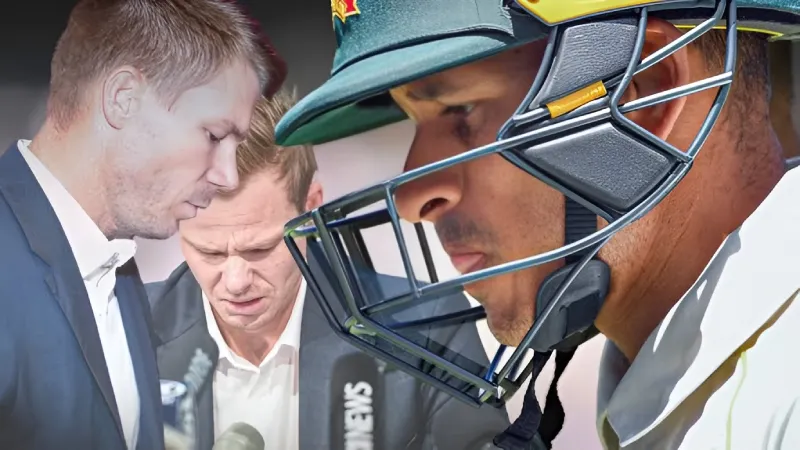

Critics say the Cape Town ball-tampering inquiry spoke to too few players and looked at too narrow a window, and Usman Khawaja’s new book has given that complaint fresh life. He claims the entire squad knew, that sandpaper appeared in a Test earlier at Port Elizabeth, and that no investigator ever interviewed him. The governing body counters that it questioned eight of the 11 who played at Cape Town, yet nobody outside the board can check who was left out, and the gap leaves the original verdict open to doubt.
Khawaja’s Book Makes Three Claims
Sabr, which appeared in early November 2026, argues that the whole dressing room understood the ball would be roughed up, a group far wider than the three men who served bans. In Khawaja’s telling, the subject came up openly. He adds that sandpaper was already in use at Port Elizabeth, one Test before Cape Town, and that he was never summoned despite sitting beside Bancroft at Newlands.
Pat Cummins rejected the suggestion that players knew sandpaper was heading onto the field, calling it wholly wrong. Nobody has independently verified any part of Khawaja’s account, so every new statement carries weight.
Cricket Australia 2018 Sandpapergate Investigation
Pat Howard, then in charge of team performance, led the board’s inquiry with integrity chief Iain Roy. Its meeting on 28 March 2018 gave Bancroft nine months, while Smith and Warner were each suspended for a year. The scope never went past Cape Town, so earlier Tests were left alone. Todd Greenberg puts the number interviewed at eight of the eleven men who played in that match.
A separate cultural review ran in parallel. Simon Longstaff wrote the Ethics Centre report, which came out on 29 October 2018, and Rick McCosker headed a player review helped along by Peter Collins as facilitator. It assessed the culture inside CA, and it never set out to establish who knew what at Newlands.
The Players Left Without Interviews
In an Instagram post, Warner said CA, as far as he knew, never spoke to Mitchell Starc, Josh Hazlewood or Nathan Lyon, and he questioned how anyone could claim the bowlers were unaware. He later said it smelled like a cover-up. Greenberg’s figure of eight from 11 means three Cape Town players were never questioned, and since the report remains unpublished, those three names cannot be checked.
Bancroft raises another gap. By his own account, he withheld some details in 2018 to shield the process and those close to him. The four bowlers issued a joint denial of any knowledge in 2021, and Starc maintains his memory of events has not shifted.
Person | Role in 2018 | Position in 2026 | Date of Statement |
Usman Khawaja | Squad batter | Author of the claims | 10 Nov |
David Warner | Vice-captain, banned | Backs Khawaja | 9 and 15 Nov |
Cameron Bancroft | Banned for nine months | Backs Khawaja | 18 Nov |
Pat Cummins | Bowler | Denies | 13 Nov |
Mitchell Starc | Bowler | Denies | 10 Nov |
Hazlewood and Lyon | Bowlers | Neutral, no new comment | 20 Nov |
Peter Collins | Review facilitator | Neutral on facts, wants probe | November |
Reasons CA Won’t Reopen the Matter
Collins, who helped deliver the cultural review, now wants a further investigation, with Khawaja interviewed and his notes from the time examined. Greenberg sees no compelling reason to go back. He says the board is comfortable with how things ended, arguing that Khawaja’s version clashes with other people’s recollections.
Greenberg and the interim chair, David Boon, unveiled a closed, voluntary forum on 18 November, open to everyone who travelled on the 2018 tour, whether player or staff member. Greenberg insisted it is not a re-investigation, and Boon added that nobody wants to reargue what happened. No sanctions can follow, and the board alone decides what gets published, a setup Khawaja has already questioned.
Three Things That Could End the Dispute
The first fix is the cheapest: release the list of the eight players interviewed, so everyone knows who the other three were. The second is Collins’s request, which means reading Khawaja’s contemporaneous notes. Both steps would test the claims against documents.
The forum offers neither, so the row will probably continue. Until someone names the unheard witnesses, the Cricket Australia 2018 Sandpapergate investigation will keep drawing the same criticism, and the board’s confidence will rest on a report that fans cannot read.
Do you think CA should open the file again, or is the forum enough? Tell us in the comments.
Frequently Asked Questions (FAQs)
What does Khawaja claim in his autobiography?
He says every player in the squad knew of the plan to alter the ball. He also says sandpaper came out of a Test earlier in Port Elizabeth, and that investigators never interviewed him at any stage.
Is a fresh inquiry into Cape Town going ahead?
No, CA has rejected any re-investigation. It has set up a confidential, voluntary forum instead, with no sanctions and publication decisions left entirely to the board.
Has Pat Cummins admitted knowing about the sandpaper?
No, he rejects the claim outright and calls it wrong. Khawaja and Warner dispute his version, yet nothing has been proven either way, and no account has been independently verified.
Which players received bans over the ball-tampering scandal?
Smith and Warner each received 12 months, and Bancroft received nine. Warner was also handed a lifetime leadership ban back then, though that penalty has since been revoked.
What is Khawaja’s autobiography called?
The book is called Sabr, and it is billed as his life story in the game. Released in early November 2026, this autobiography carries his allegations about the 2018 tour and the investigation that followed.
Disclaimer: This blog post reflects the author’s personal insights and analysis. Readers are encouraged to consider the perspectives shared and draw their own conclusions.