

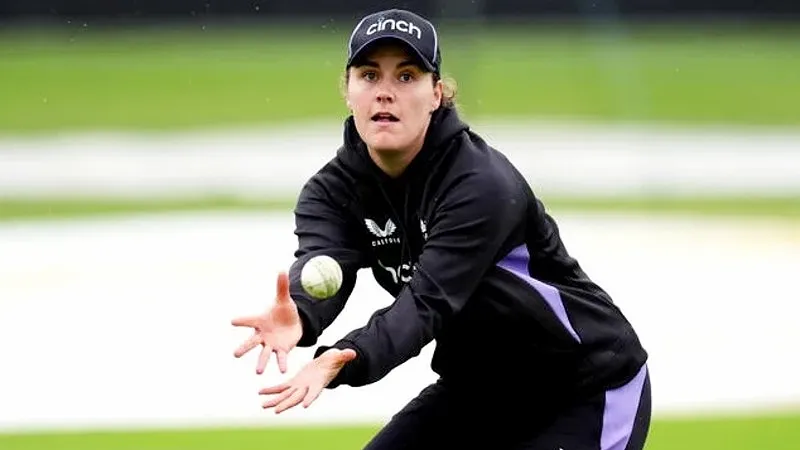

England has already run the experiment and recorded the result. Back-to-back 2-1 T20I series wins against New Zealand and India, six matches, zero overs from Nat Sciver-Brunt, two series victories. A calf tear in late April removed her bowling entirely from England’s preparation window. What it also did was force a clearer picture of what this squad actually is without relying on her as an all-rounder. The answer is more than enough. Head coach Charlotte Edwards has confirmed Sciver-Brunt will bat at number three from the tournament’s first match, with bowling reserved only if her calf allows later. That clarity of role is the starting point for England’s title case.
Two Series Wins That Proved the Point
The New Zealand series established the blueprint. England won 2-1 without Sciver-Brunt contributing a delivery, and the bowling unit filled the gap across formats and conditions. The India series confirmed it wasn’t a fluke. England closed it out on June 3 in Taunton, chasing 181 in 18.3 overs. Alice Capsey made 82 off 43 balls, Heather Knight an unbeaten 70 off 42. That chase, against a side of India’s T20 quality, without their captain bowling, against a target of 181, is the strongest possible evidence that England’s squad functions at the highest level in its current shape.
Bell, Ecclestone and the Bowling Unit That Stepped Up
Lauren Bell has been England’s standout bowler across both series. She dismissed Georgia Plimmer with the first ball of the New Zealand campaign, took 3/34 in the first T20I against India with two wickets in her opening over, and returned 2/36 in the decisive third match at Taunton. Her bowling strike rate of 15.2 is the best among any England woman with 50 or more career T20I wickets.
Sophie Ecclestone, England’s all-time leading T20I wicket-taker with 144 career wickets, bowled 1/11 at 2.75 runs per over in the New Zealand series decider at Hove. Linsey Smith took 6 wickets across the New Zealand T20I series at an economy of 4.16 and won Player of the Series. Dani Gibson returned career-best T20I figures of 3/14 in that same decisive match at an economy of 3.50.
Player | Role | T20I Wkts (2026) | Economy |
Lauren Bell | Pace, Spearhead | 5 | 5.62 |
Sophie Ecclestone | Left-arm Spin | 2 | 5.98 (career avg) |
Linsey Smith | Left-arm Spin | 6 | 4.16 |
Dani Gibson | Medium Pace / AR | 4 | 3.50 (vs NZ) |
Lauren Filer | Pace | 0 | Squad cover |
England Women T20WC 2026 Sciver-Brunt Batting Squad Depth
Sciver-Brunt’s batting record makes her number three slot non-negotiable regardless of injury: 2,960 T20I runs in 137 matches at a career average of 29.01, among the highest in England’s T20I history for a player with over 100 caps. At number three, she reads powerplay conditions, builds a platform when needed, and accelerates when the game demands it. That game intelligence, rotating strike, targeting field placements, absorbing pace before the spinners take over, is a harder asset to replace than eight overs of medium pace ever was.
Danni Wyatt-Hodge has returned from maternity leave to strengthen the top of the order. Capsey and Knight both contributed match-winning innings in the India series. England’s batting isn’t built around Sciver-Brunt; it’s built with her at its centre, which is a different thing entirely. That distinction matters in a tournament where conditions change match to match, and the batting order needs to absorb pressure at different stages.
What a Home World Cup Means for This England Side
England won the Women’s T20 World Cup in 2009, the only time the tournament was held on home soil. The 2026 edition opens on June 12 at Edgbaston against Sri Lanka. Swing-friendly English conditions suit Bell’s pace, and English surfaces assist Ecclestone’s drift and turn in ways no touring side can prepare for in the same way England can. The home advantage isn’t just crowd support. It’s pitch knowledge, conditions familiarity, and the ability to pick a team built precisely for each ground.
No touring side walks into Edgbaston with the same understanding of what the pitch will do at 7 PM as the side that trains there. The England Women T20WC 2026 Sciver-Brunt batting squad depth is the foundation, and home conditions are the multiplier that makes it a genuine title-winning combination.
Does England’s bowling unit hold up deep into the knockout rounds without Sciver-Brunt’s overs, or does the calf need to recover for England to win their second home World Cup? Drop your prediction in the comments.
FAQs
Will Nat Sciver-Brunt bowl at this tournament?
Sciver-Brunt will bat at number three without bowling, though Edwards left open the possibility that her calf recovers later in the tournament. She did not bowl in any of England’s six T20I matches in 2026.
How has England performed without Sciver-Brunt bowling this year?
England won back-to-back T20I series 2-1 against New Zealand and India in 2026, with Sciver-Brunt absent from all bowling duties. The India series ended with a chase of 181 in 18.3 overs at Taunton.
What is Nat Sciver-Brunt’s T20I batting record?
Sciver-Brunt has scored 2,960 runs in 137 T20I matches at a career average of 29.01. She is among England’s most productive T20I batters among players with over 100 caps.
Who leads England’s bowling attack at this tournament?
Bell leads with a bowling strike rate of 15.2, best among England women with 50-plus T20I wickets, backed by Ecclestone (144 career wickets) and Smith. Gibson adds seam depth.
Can England win as hosts?
England beat New Zealand and India 2-1 in 2026 without Sciver-Brunt bowling, and open on June 12 at Edgbaston with home conditions suiting Bell and Ecclestone. They won the only previous home Women’s T20 World Cup in 2009.