


England in June is not a batting paradise. Edgbaston, Headingley, and Lord’s offer genuine seam movement and pace carry that punish one-dimensional batting orders. The team that lifts the trophy on 5 July needs more than one brilliant batter at the top; it needs four or five who can handle lateral movement and score through it. Five title contenders arrive with very different answers to that question. Some have depth. Some have one exceptional player and a problem waiting to happen.
England Conditions: Why Batting Depth Wins
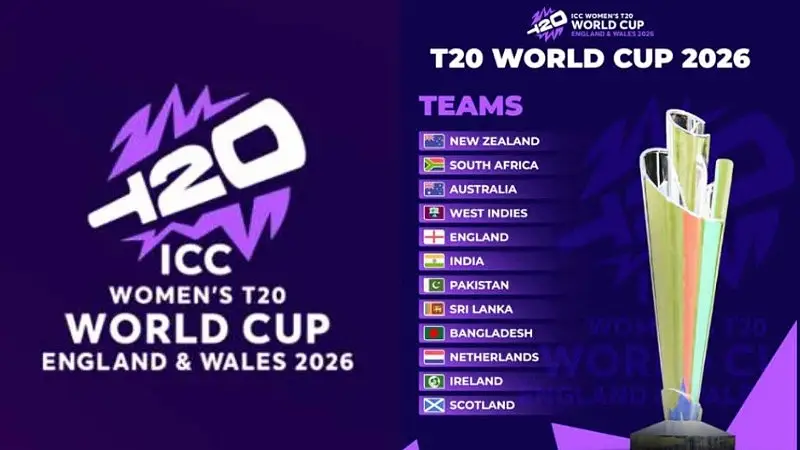
The 2026 ICC Women’s T20 World Cup runs from 12 June to 5 July across England and Wales, 33 matches involving 12 teams, with the final at Lord’s. Edgbaston, Headingley, Old Trafford, and Lord’s share one characteristic: they reward bowling when the ball swings and carries low. A batting order that folds after its best player departs won’t survive a tournament run. Four reliable contributors who can handle lateral movement and score freely are the minimum requirement in these conditions.
Team | Top Batter | Batting Depth Rating | England Conditions Advantage |
Australia | Georgia Voll | Strong | Yes |
England | Nat Sciver-Brunt | Strong | Yes |
South Africa | Laura Wolvaardt | Strong | Partial |
India | Smriti Mandhana | Average | Partial |
New Zealand | Amelia Kerr | Thin | Partial |
Women’s T20 WC 2026 Batting Depth England Conditions
Australia arrives as the deepest batting side in this tournament. Georgia Voll, 22, tops the ICC Women’s T20I batting rankings and hit 101 from 53 balls against the West Indies in March 2026, the highest score by an Australian batter since the previous T20 World Cup. Beth Mooney, Phoebe Litchfield, Ashleigh Gardner, Tahlia McGrath, and Ellyse Perry add five more reliable contributors around her. Six or seven batters handling seam and swing make Australia the tournament favourites.
India’s worry is their middle order. Smriti Mandhana and Shafali Verma give them a dangerous opening pair, but the pre-tournament series against England in May 2026 confirmed the problem directly: once both openers departed, India lost momentum in both matches. Coaching staff identified middle-order stability as the key issue before June 12.
Wolvaardt’s Form and England’s Home Edge
Laura Wolvaardt is the form batter entering this tournament. She scored 330 runs against India in a five-match T20I series at a strike rate of 168.36 and an average of 82.5, including one century and three fifties. Marizanne Kapp, Chloe Tryon, Nadine de Klerk, and Dane van Niekerk extend a batting unit that goes seven or eight deep, and eight Proteas squad members played the 2017 ODI World Cup in England. The one vulnerability: if Wolvaardt fails, the pressure on those behind her is significant.
England holds the clearest conditions edge. Nat Sciver-Brunt captains a side that also includes Danni Wyatt-Hodge (eighth T20 World Cup), Sophia Dunkley, Heather Knight, and Alice Capsey. Knight, 35, scored a century against India at the 2025 ODI World Cup. England defeated India 1-0 in the pre-tournament series and are the only team for whom these grounds are genuinely home. England won the inaugural edition of this tournament in 2009, which was also played in England.
New Zealand’s Retirement Problem
The defending champions face the most significant transition of any title contender. Sophie Devine, 36, and Suzie Bates, 38, have confirmed they will retire after this tournament alongside pace bowler Lea Tahuhu. Bates and Devine are New Zealand’s two most prolific run-scorers across all formats combined, and captain Amelia Kerr acknowledged the side has worked hard “to develop batting depth” in the preceding 12 months.
Georgia Plimmer, Maddy Green, and Brooke Halliday are the next generation. All three are capable domestically but untested at a full World Cup in English conditions. New Zealand won the 2024 title, but their batting depth beyond two players who are simultaneously their best and their last is the thinnest among the main title contenders.
Australia and England Lead the Field
The verdict across the five contenders is relatively clear. Australia has the broadest batting resources: six or seven contributors who handle swing and seam, with the world’s top-ranked T20I batter setting the tone. England’s five experienced top-order batters know every pitch on the schedule. South Africa’s depth is real, but it depends on Wolvaardt. India’s opening pair is world-class, but the middle-order fragility confirmed in May 2026 is a documented weakness. New Zealand must navigate a full tournament knowing their two most important batters are playing their final matches at every ground they visit. The teams with the best answer to the Women’s T20 WC 2026 batting depth England conditions test are Australia and England, and on current evidence, Australia have the deeper batting resources of the two.
Australia has six genuine batting options, England has home ground, which squad do you back to lift the trophy at Lord’s on 5 July? Tell us in the comments.
FAQs
When does Women’s T20WC 2026 start?
The Women’s T20 World Cup 2026 starts on 12 June 2026, with the opening match in Birmingham. The final is at Lord’s on 5 July, with 33 matches across 12 teams.
Who are the favourites for the Women’s T20WC 2026?
Australia is the tournament favourites, ranked No.1 and targeting a record-extending seventh Women’s T20 World Cup title. Georgia Voll tops the ICC Women’s T20I rankings with five reliable contributors around her.
Who is the top-ranked Women’s T20I batter in 2026?
Georgia Voll is the top-ranked batter in the ICC Women’s T20I rankings. The 22-year-old hit 101 from 53 balls against the West Indies in March 2026.
Are New Zealand defending Women’s T20WC champions?
Yes, New Zealand is the defending Women’s T20 World Cup champions, winning in 2024. Sophie Devine and Suzie Bates will both retire after the 2026 tournament.