

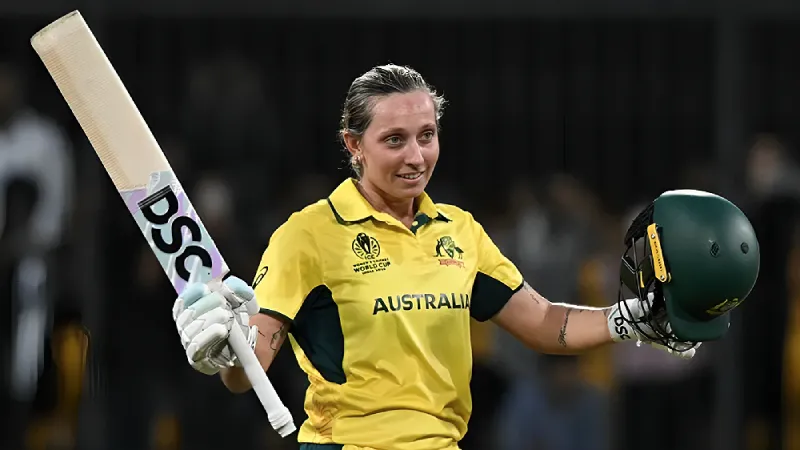

Ashleigh Gardner will become the seventh Australian woman to play 100 T20 Internationals when she faces West Indies in St Vincent. Her T20I career batting average is 19.93 with an economy rate of 6.07, consistent
enough to confirm her bowling value, modest enough to confirm her batting has not matched her ODI returns of 104 not out against England and 115 against New Zealand in 2025. Australia has lost back-to-back ICC
semifinals, to South Africa in the 2024 T20 World Cup and to India in the 2025 ODI World Cup final. The T20 WC 2026 in England begins on June 12. Gardner knows what she needs to do. The question is whether she can
do it against the teams that have beaten Australia when it mattered most.
Why the Batting Average Gap Is the Central Problem
Gardner’s T20I batting average of 19.93 against her ODI batting average, reflected in two centuries in 2025, represents the clearest statistical evidence of the gap between what she produces in the longer format and what
she delivers in the shorter one. The explanation she gives is the most honest assessment any senior international player has offered publicly about their own decline from peak: experience has added fear. Where she once
attacked situations instinctively, she now calculates them, and in T20 cricket, calculation that replaces instinct produces the 19.93 average rather than the 104 not out.
What Australia’s Two Semifinal Exits Confirm
Australia lost the 2024 T20 World Cup semifinal to South Africa after setting 134 for 5, a total that in their peak years would have been 155-plus. They lost the 2025 ODI World Cup final to India in a 338-run chase, a game where their batting did not match the opposition’s at the specific moment the tournament required it most.
Both exits have a common thread that Gardner’s self-assessment identifies: the moments where Australia needed their senior players to access their best form under maximum pressure produced cautious rather than instinctive responses. The 2018, 2020, and 2023 T20 World Cup victories were built on Australia’s senior players, including Gardner, performing above their average when the occasion demanded it. The two losses have been built on the opposite pattern.
Why Australia’s T20 World Cup 2026 Title Depends on Which Gardner Shows Up
The T20 World Cup 2026 Group A schedule confirms Australia’s toughest moment arrives early. The June 28 match against India at Lord’s is the blockbuster group fixture where Australia’s tournament trajectory will most
visibly be established. India is the defending champion after winning the 2025 ODI World Cup. Gardner’s off-spin against India’s right-handed middle order, the specific matchup her 5 for 12 best figures were built around,
is the bowling contribution that gives Australia their most reliable wicket-taking option in the middle overs.
But the match that Gardner’s batting needs to answer is not the one where Australia is set a simple target, and she can build naturally from position. It is the match where Australia are 3 for 65 in the thirteenth over, and
she arrives at the crease with the required rate above ten. Those are the specific moments her 2025 ODI centuries were built around. They are also the moments where her T20I average of 19.93 suggests her instinct is not
yet back to where it needs to be.
The fearless version of Gardner that she is trying to rediscover would attack that seam threat from ball one rather than managing it. Three T20 World Cup titles confirm what that version produces. Getting back to it before
June 12 is the work.
- Do you think Ashleigh Gardner can rediscover her fearless approach in time for the T20WC 2026, or has the caution that experience has brought become a permanent feature of her game? Drop your view in the comments and follow for cricket coverage.
FAQs
What is Ashleigh Gardner’s role in the Australian Women’s T20 team?
She plays as a middle-order all-rounder responsible for accelerating the innings and contributing with the ball.
Why is Ashleigh Gardner’s T20 form inconsistent compared to ODIs?
T20 demands immediate impact, while ODIs allow her to build innings, adapting to a key challenge.
How important is Ashleigh Gardner for the Australian Women’s team in 2026?
She is crucial as a middle-order match-winner, especially in knockout matches.
Can the Australian women win the T20WC 2026 without Gardner’s form?
It would be difficult, as middle-order stability and finishing ability are essential in tight games.
Which conditions could impact Gardner’s performance the most?
English pitches with seam movement and slower surfaces will test her adaptability and shot selection.
Disclaimer: This blog post reflects the author’s personal insights and analysis. Readers are encouraged to consider the perspectives shared and draw their own conclusions.