

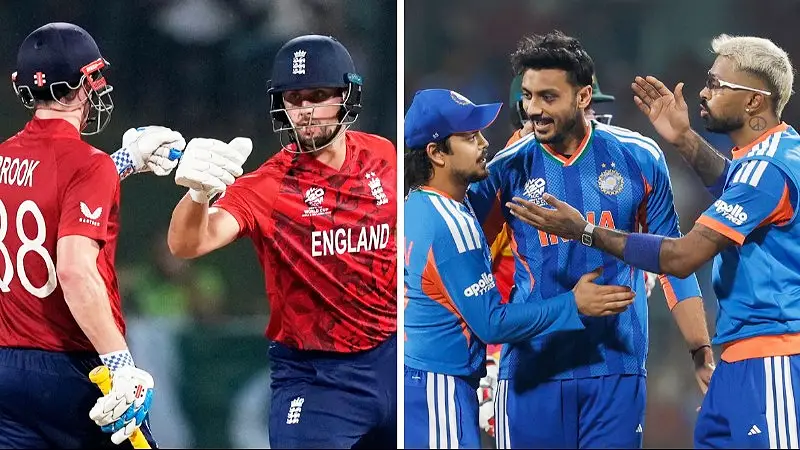

India and England arrive at Wankhede as the two most tactically layered sides left in this tournament. Neither team wins through raw power alone. Both build through matchups, phase management, and specific bowling plans designed around individual opposition batters. The duel between Arshdeep Singh and Phil Salt has been the most discussed individual contest heading into this fixture, and for good reason. How that battle unfolds in the powerplay will shape everything that follows across 40 overs. Get it right, and the semi-final opens up. Get it wrong, and the recovery is almost impossible on a ground where momentum compounds quickly.
How Archer Tests India’s Left-handers
Jofra Archer’s first spell will be directed primarily at India’s left-handed batters. Abhishek Sharma and Tilak Varma have shown in this tournament that they neutralise pace by creating width and accessing square boundaries. Archer’s response to that approach, whether he comes over the wicket to angle it away or goes wide on the crease to cramp the cut, will determine whether India scores freely or loses wickets in the powerplay.
At Wankhede, the pace of the ball travels to the boundary quickly, but predictable angles get punished even faster. If Archer finds the hard length on a consistent line, he creates doubt. If he strays wide or goes too full, Abhishek in particular will hurt him through the offside. India’s powerplay approach is to take those risks early and absorb whatever pressure comes after.
Rashid vs India’s Right-Left Rotation
Between overs 7 and 15, Adil Rashid is England’s most important bowler. His googly does not need a heavy turn at Wankhede to be effective. His pace through the air and the subtle change of angle on a flatter pitch create misreads from batters who think they have picked the delivery.
India’s counter to Rashid is well established. Right and left-hand batting combinations disrupt his line, and the calculated rotation of the strike denies dot ball clusters from building. If Rohit Sharma or Samson can work Rashid for ones and twos consistently rather than targeting boundaries, England loses their primary control option. If Rashid creates two dot ball overs in this phase, India’s acceleration window shrinks, and the scoring burden shifts to Suryakumar Yadav later in the innings.
T20WC 2026 Most Dangerous Powerplay Duel
Arshdeep Singh against Phil Salt is the most statistically loaded individual contest of the T20WC 2026 Semi-Final 2. Arshdeep has dismissed Salt multiple times in recent international cricket, most effectively through the short ball into the body with fine leg protection. Salt has responded in recent meetings by taking the risk early, backing away to create room, and attacking the first short delivery rather than fending it off.
At Wankhede, that counterattack strategy carries real risk. The short ball at this ground can be hit, but anything into the body with a packed leg side field forces a miscue rather than a clean pull. If Arshdeep executes his first two deliveries to Salt correctly, hard length or short, into the body on off stump, he can end the contest inside three balls. If he misses his length and gives Salt width, the first over could go for 12 to 15 runs, and England are immediately ahead of the required rate.
Axar’s Role Nobody Talks About
Axar Patel will likely bowl in overs four and six of the powerplay, and that decision could quietly shape the entire match. His flat trajectory and disciplined line limit aerial hitting from batters like Will Jacks, who prefer pace on the ball to time their shots.
If England tries to force Chakravarthy into early overs by attacking Axar aggressively, they risk losing wickets against controlled spin before the field spreads. That is India’s trap. The powerplay is not just about Bumrah and Arshdeep. Axar’s overs in the middle of those six are where England’s batting plan either holds or breaks down before it has properly started.
Wankhede semi-finals traditionally start tighter than the ground’s reputation suggests. Both teams know the pitch and the dew pattern. The team that adjusts length and pace one over earlier than the other gains an edge that compounds through the innings.
FAQs
Why is Varun Chakravarthy unlikely to bowl early?
India prefers to use him once field restrictions ease, maximizing his variations against set batters.
How important is Adil Rashid in this match?
Rashid controls England’s middle overs; if he restricts scoring, England can dictate the tempo.
Is Wankhede favourable for spinners in T20s?
It can be challenging due to short boundaries, but disciplined spin with smart fields remains effective.