

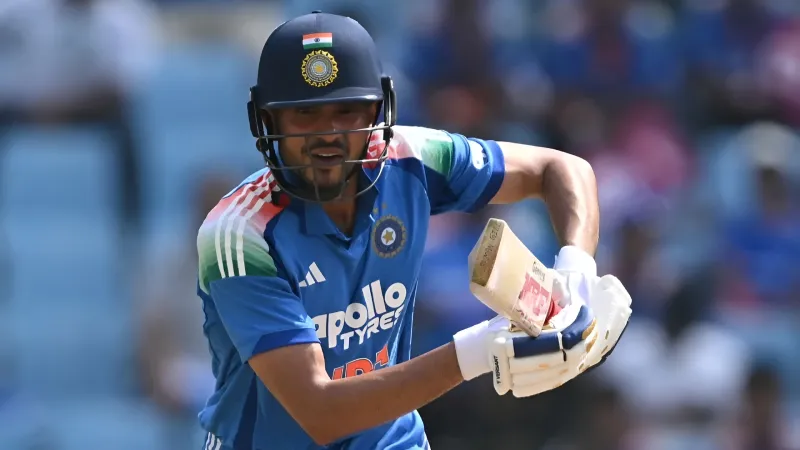

After 57 innings opening in ODIs, Gill averages 57.72 at a strike rate of 99.35, numbers that exceed any Indian opener at the same stage. That record is the starting point for a conversation India’s team management shouldn’t actually be having. The “move him to No. 3” argument misses two things: India already tested it in Lucknow, and No. 3 isn’t vacant. Kohli has owned that position for 311 matches. Disrupting both slots to solve a problem that doesn’t exist isn’t a blueprint; it’s a risk.
Gill’s Opening Record In Context
Gill’s unbeaten 84 against Afghanistan in Dharamsala on June 13 brought his opener’s ledger to 2,771 runs in 57 innings. The comparison that landed quickest was Sourav Ganguly, and the numbers justify it. After the same 57 innings, Gill’s average of 57.72 and strike rate of 99.35 sit well clear of Ganguly’s 44.09 and 70.30, making this the most productive start any Indian opener has had in ODI history.
That gap isn’t about one outlier innings distorting the average. It’s a body of sustained production built across different conditions, bowling attacks, and match contexts, stretching now beyond 60 innings, which is precisely what makes the discussion about moving him so puzzling.
Shubman Gill ODI Opener or Number Three
The move was actually trialled. In the second ODI at Lucknow on June 17, Yashasvi Jaiswal opened with Rohit Sharma and fell for 4, with Gill walking in at No. 3 and scoring 154 off 110 balls, his highest ODI score, in a 224-run stand with Ishan Kishan. India posted 402 all out and won by 170 runs.
That innings is genuinely compelling, but it’s one data point against 57 innings of evidence at the top. Gill has batted at No. 3 fewer than five times in his career and has no stable average there. The 154 in Lucknow proved he can do it against an Afghanistan attack. It didn’t prove he should be permanently repositioned there, particularly given who already occupies that slot.
India’s Actual No. 3 Options
The vacancy case for moving Gill falls apart on examination.
Player | Position | Innings | Average | Strike Rate |
Shubman Gill | Opener (career) | 57 | 57.72 | 99.35 |
Shubman Gill | No. 3 (rare) | Under 5 | 154 and 9 (no stable avg) | 122.14 |
Virat Kohli | No. 3 (career) | 311 matches | 58.71 | 93.82 |
Shreyas Iyer | No. 4/5 (career) | 72 | 45.68 | ~98.7 |
Sai Sudharsan | ODI (brief) | 3 | 63.50 | 89.44 |
Kohli has averaged nearly 59 at No. 3 across his entire career. Shreyas Iyer, though patchy in 2026, has 3,015 runs in 72 innings and is India’s vice-captain. Sai Sudharsan, regularly cited in this discussion, has played three ODIs and scored 127 runs, and is presently being prepared as India’s Test No. 3, not an ODI one. None of this suggests a gap that needs filling at Gill’s expense.
The Rohit Sharma Lesson
Rohit spent his first six years as a middle-order batter, averaging 32.74 across 81 ODI innings. Pushed to open in 2013, he averaged 55.57 across 176 innings afterward and became one of the format’s great run-scorers. That story is often cited as justification for bold batting order decisions. The lesson cuts the other way just as firmly: disrupting a batter from the role where they’ve built their best returns is equally likely to undo what made them valuable as it is to unlock something new, especially when the existing role is producing at an average above 57.
The Case For Leaving It Alone
Head coach Gautam Gambhir has said India’s 2027 World Cup blueprint will be shaped through this year’s bilateral calendar, identifying “players who are suited” to specific roles rather than making wholesale changes. Fifty-seven innings of evidence at the top of the order is about as settled a case of suitability as Indian selectors are likely to find, and No. 3 already has a batter averaging nearly 59 there in 311 matches.
The Shubman Gill ODI opener or number three debate rests on a single Lucknow century against an Afghanistan attack, which is not the sample size on which position changes should be built across a World Cup cycle. One brilliant innings at three doesn’t outweigh 57 innings of evidence at one.
Should India leave Gill at the top, or was the Lucknow 154 enough to change your mind? Drop your take below.
FAQs
What is Shubman Gill’s batting average as an ODI opener?
Gill averages 57.72 across 57 innings as an opener, at a strike rate of 99.35. Those figures make him the most productive Indian opener at the same stage, ahead of Sourav Ganguly’s 44.09 and 70.30 after the same number of innings.
Has Shubman Gill batted at number three in ODIs?
Yes, on a handful of occasions, most recently scoring 154 against Afghanistan in Lucknow on June 17, 2026. He came in at No. 3 after Yashasvi Jaiswal fell for 4, adding 224 with Ishan Kishan.
Who bats at number three for India in ODIs?
Virat Kohli has held the position through almost his entire ODI career, averaging 58.71 there in 311 matches. There is no vacancy that requires Gill to be moved from the top of the order.
How does Shubman Gill compare to Sourav Ganguly as an opener?
After 57 innings each, Gill averages 57.72 at a strike rate of 99.35 against Ganguly’s 44.09 and 70.30. The gap holds across both average and strike rate.
Disclaimer: This blog post reflects the author’s personal insights and analysis. Readers are encouraged to consider the perspectives shared and draw their own conclusions.