

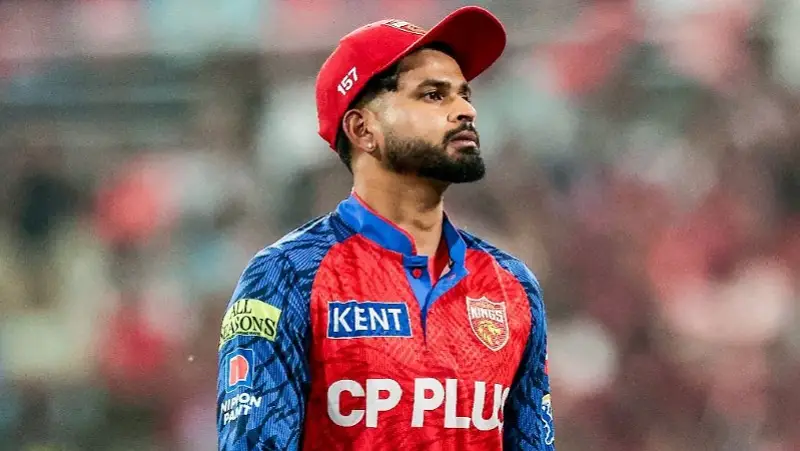

There was a time when the short ball to Shreyas Iyer was a bowling plan rather than a delivery option. Hit him hard in the body. Force the rushed pull. Set the field for the top edge. Repeat until dismissed. Multiple bowling attacks used that blueprint across multiple IPL seasons, and it worked consistently enough that it became the standard approach. It doesn’t work anymore. His trigger movement has changed. His bat swing is more compact. He’s reacting later rather than committing early. The bowlers who arrive at PBKS matches with the same plan they used three seasons ago are discovering that the weakness they prepared for has been removed.
Short Ball Fixed Now Bowlers Panic
The specific technical change behind Iyer’s short ball improvement is his trigger movement, the initial foot movement he makes as the bowler enters the delivery stride. Previously, his movement was slightly forward-biased, which committed him to front-foot play before the ball’s length was clear. Against the short ball, that forward commitment left him fighting the bounce from a compromised position. His trigger now loads backward first, keeping his weight distribution neutral long enough to make the back-foot choice naturally rather than urgently. The compact bat swing that followed removed the big horizontal shot that produced top edges. What remains is controlled aggression, pulling or swaying rather than committing to a premeditated shot that the bowler designed to disrupt.
Strike Rate Now Matches His Ambition
The evolution in Iyer’s strike rate consistency isn’t dramatic; it’s architectural. He doesn’t hit boundaries at a visibly higher frequency than he did two seasons ago. What he does is accumulate runs between boundaries at a rate that prevents dot-ball pressure from building. The specific improvement is his ability to rotate strike against spin in the early phase of his innings, getting off the strike, denying the bowler the dot ball that creates the pressure that produces the risky shot that ends the innings. By keeping the strike rotating while reading the bowling, he reaches the phase where acceleration is appropriate with wickets intact and options available.
IPL 2026 Number Four Role Redefined
The number four position in IPL 2026 demands a specific kind of batter, one who can arrive after early wickets and rebuild without losing the scoring rate, or arrive on a platform and accelerate without taking unnecessary risks in either scenario. Iyer’s evolution has made him the most complete version of that profile currently playing for any franchise. His spin handling gives him the middle-overs scoring options that rebuild innings efficiently. His improved pace handling removes the specific phase where teams previously targeted his position. His captain’s tactical awareness gives him the match-reading quality that allows him to choose between rebuild and accelerate rather than defaulting to one approach regardless of context.
Technical Changes That Made Everything Sustainable
The reason Iyer’s evolution is sustainable rather than a form peak is that the changes are mechanical rather than psychological. A batter who improves their short ball handling through confidence alone regresses when confidence dips. A batter who improves through trigger movement adjustment maintains that improvement because the physical pattern has been retrained rather than temporarily reassured. His more lateral bat lift, the stable head position through back foot play, and the compact swing that removes the mechanical vulnerability are training-floor changes that carry across formats, surfaces, and opposition types. They don’t disappear when the bowling attack is good. They function specifically because the bowling attack is testing them.
- Has Shreyas Iyer become the most complete number four batter, or does his evolution still have one remaining test that reveals the limits of what he’s fixed? Drop your take and follow for IPL updates.
FAQs
What changed in Shreyas Iyer’s T20 batting technique?
His improved trigger movement and bat lift allow better control against short balls and quicker adaptation to pace.
Why is Shreyas Iyer effective at number four in T20s?
He balances stability and acceleration, making him ideal for handling middle-over pressure and finishing phases.
How does Shreyas Iyer maintain strike rate consistency in T20?
He rotates strike efficiently early and accelerates later without relying on risky shots.
Can Shreyas Iyer now handle fast bowlers consistently?
His recent adjustments suggest he is far more comfortable against pace, especially short-pitched deliveries.
Is Shreyas Iyer’s evolution sustainable in future tournaments?
Because the changes are technical and tactical, they appear sustainable across different conditions and formats.