

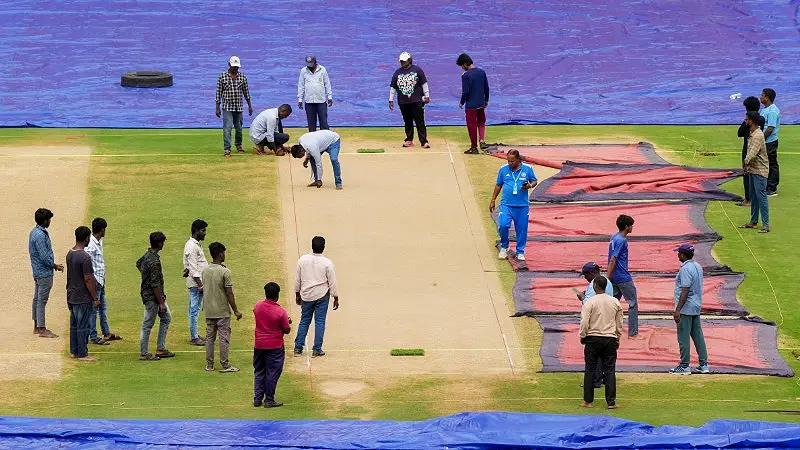

Sunrisers Hyderabad built their squad around one specific proposition: the most destructive batting lineup in the competition should be placed on surfaces that allow them to express that destruction fully. Travis Head is attacking in the power play. Heinrich Klaasen is accelerating in the middle overs. A lineup that averaged above ten runs per over across their best phases last season. The pitches being prepared at Rajiv Gandhi International Stadium are slow and slightly sticky. The ball stops rather than comes onto the bat. Power hitting on a surface that grips is fundamentally harder than on a surface that rewards timing. SRH is preparing conditions that specifically reduce the advantage their batting is designed to create.
Slow Pitch Wrong Team Obvious Problem
The specific disconnect between SRH’s squad composition and their Hyderabad pitch preparation is straightforward enough to be visible without statistical analysis. A batting lineup built around high strike rate power hitting against pace, Head’s aggressive starts, Klaasen’s brutal middle-over acceleration, and Abhishek Sharma’s powerplay dominance, produces those results on surfaces where the ball arrives at bat height consistently and timing generates the pace that clearing the boundary requires.
On a slow pitch where the ball grips and stops, the same swings that produce sixes on flat surfaces produce mistimed shots. The batters haven’t changed. The surface has been prepared to reduce its specific advantage rather than amplify it.
The Early Wicket Pattern Destroying SRH
11 for 3 in one match. 29 for 3 in another. The early wicket pattern isn’t a series of individual failures accumulating by coincidence; it’s the systematic consequence of aggressive batters trying to play their natural game on surfaces that don’t support it. New batters settling on slow pitches require more deliveries to calibrate their timing against the surface grip. Aggressive openers who attack from ball one don’t take those calibration deliveries; they commit to attacking shots against deliveries the pitch has made harder to time, and the mistimed shot produces the wicket.
The result is that SRH’s most dangerous batting phase, the powerplay, has become their most vulnerable one, specifically because the pitch reduces the margin for aggressive shot-making.
IPL 2026 Rescue Acts Aren’t Enough
Klaasen and Nitish Kumar Reddy’s partnership rescuing SRH from 29 for 3 to 156 in an IPL match is evidence of genuine individual quality rather than team strategy working correctly. 156 built from 29 for 3 on a slow surface represents exceptional middle-order batting. It also represents a total that was always likely to be 15 to 20 runs below what the same batting lineup would have produced from a functioning power play on a batting-friendly surface.
Rescue acts can win individual matches when the bowling attack defends modest totals exceptionally. They can’t sustain a tournament campaign where the consistent failure to establish powerplay momentum produces below-par totals in most matches, regardless of how good the rescue is.
SRH is Helping Opponents Win Too
The additional cost of SRH’s pitch preparation strategy is what it does for the visiting team. A slow, gripping surface that restricts SRH’s batting, specifically because they’re power hitters attacking early, is a surface that assists visiting bowling attacks, who can bowl conventional lines and lengths and receive natural help from the pitch rather than needing to generate all their control themselves.
LSG’s bowling in the match where SRH posted 156 was disciplined and well-executed, but their discipline was assisted by a pitch that did some of the work by reducing SRH’s timing windows. A batting-friendly surface forces visiting bowlers to generate their own pressure rather than receiving it from the pitch. SRH is removing that advantage from themselves.
- Does SRH fix their pitch preparation strategy for home matches and restore the batting-friendly conditions their squad was built for, or does the slow surface approach continue costing them? Drop your take and follow for IPL updates.
FAQs
Why is SRH struggling in IPL 2026 despite a strong batting lineup?
Their home pitches are slow and not suited for aggressive batting, leading to frequent top-order collapses.
What happened in the SRH vs Lucknow Super Giants match?
SRH posted a modest total after early wickets, and Lucknow chased it successfully with better adaptation to conditions.
How important is pitch strategy in IPL matches?
Pitch conditions heavily influence match outcomes, especially in T20s, where powerplay momentum is crucial.
Can Heinrich Klaasen and Nitish Kumar Reddy consistently rescue SRH?
They have performed well, but relying on middle-order recoveries is not a sustainable winning strategy.
What should SRH change going forward in IPL 2026?
They need to prepare more batting-friendly pitches and improve their powerplay approach to maximize their strengths.