

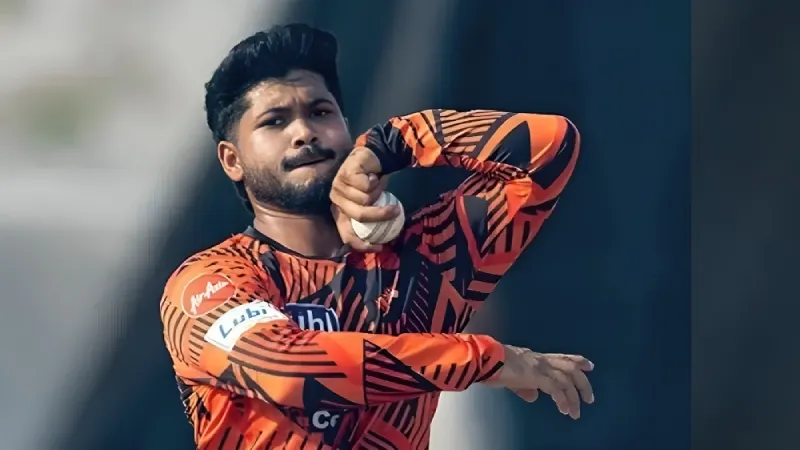

Five wickets in a short domestic tournament window. A strike rate in T20 cricket that reflects genuine attacking intent rather than survival. Left arm wrist spin, a bowling type so rare in Indian cricket that most IPL franchises have never had one in their squad. Shivang Kumar isn’t a household name yet. He’s the kind of player who becomes one through a single match where conditions suit him perfectly, he takes three wickets in the middle overs and hits 22 from twelve balls at the death, and suddenly SRH fans are asking why he wasn’t playing from match one.
Five Wickets Made SRH Take Notice
A five-wicket haul in a condensed tournament window isn’t a lucky performance; it’s the evidence of a bowler who can exploit conditions quickly rather than needing three or four overs to settle into his spell. Shivang’s five-wicket return in the Vijay Hazare Trophy came against competitive domestic batting lineups, which removes the concern that the numbers were inflated against weak opposition. His wicket-taking reflects the specific skill of identifying what the surface is doing and applying the right variation against the right batter at the right moment. SRH’s bowling needs that instinct in the middle overs, where the match is being won or lost between boundaries.
The Bowling Variation SRH Always Needed
Left arm wrist spin and right arm leg spin from the same bowling hand are genuinely different challenges for batters despite occupying the same conceptual space. Left arm wrist spin angles differently into right-hand batters, turns away from left-handers who expect conventional left arm orthodox to come in, and provides a release point that most batters have faced infrequently enough that their footwork is less reliable against it. SRH’s spin options have historically leaned toward conventional variations. Adding Shivang’s specific bowling type gives the captain a middle-overs option that creates problems through unfamiliarity rather than relying on the surface to do the work.
IPL 2026 Suits Kumar Specifically
Slower IPL surfaces, Hyderabad, Lucknow, Chennai, produce the conditions where Shivang’s left arm wrist spin operates at its most dangerous. The ball grips. The bounce varies. Right-hand batters who have loaded up for the conventional length find themselves playing a delivery that starts outside off and turns further away than they anticipated. SRH’s home fixtures at Rajiv Gandhi International Stadium provide exactly this environment.
Batting Depth Is Shivang’s Second Weapon
His lower-order hitting profile, quick scoring bursts rather than anchoring innings, covers the specific batting function that SRH’s lineup needs at seven or eight. When SRH post a top-heavy total that their bowling must then defend, having a batter at seven who can add 18 from nine balls rather than 8 from twelve means the first innings closes above the par score the pitch suggests. Shivang’s natural instinct to accelerate rather than consolidate suits the position and the match contexts SRH put their lower order in. He’s not a finishing option in the Hetmyer sense; he’s the batter who extends an innings past the point where the established batters have been dismissed.
His left arm wrist spin creates problems that no other SRH bowler can create from the same phase. That specific advantage doesn’t function from the dugout. SRH needs to trust the domestic evidence, give him the conditions that suit his profile, and let the IPL 2026 campaign reveal whether the potential is as real as the five-wicket haul suggested it was.
- Does Shivang Kumar break into SRH’s XI and prove his left-arm wrist spin is the missing piece, or does he spend the season watching from the bench while SRH’s middle overs struggle without him? Drop your take and follow for IPL updates.
FAQs
What is Shivang Kumar’s role in Sunrisers Hyderabad?
He is likely to play as a lower middle-order batter and wrist-spin bowling allrounder, depending on the team combination.
Why is Kumar considered a promising IPL player?
His ability to contribute with both bat and ball makes him valuable in T20 formats, where balance is crucial.
How did he perform in domestic cricket?
He delivered impactful performances in domestic tournaments with both wickets and quick scoring innings.
Can Kumar become a regular in the SRH playing XI?
His chances depend on conditions and team needs, but versatility gives him an advantage.
Disclaimer: This blog post reflects the author’s personal insights and analysis. Readers are encouraged to consider the perspectives shared and draw their own conclusions.