

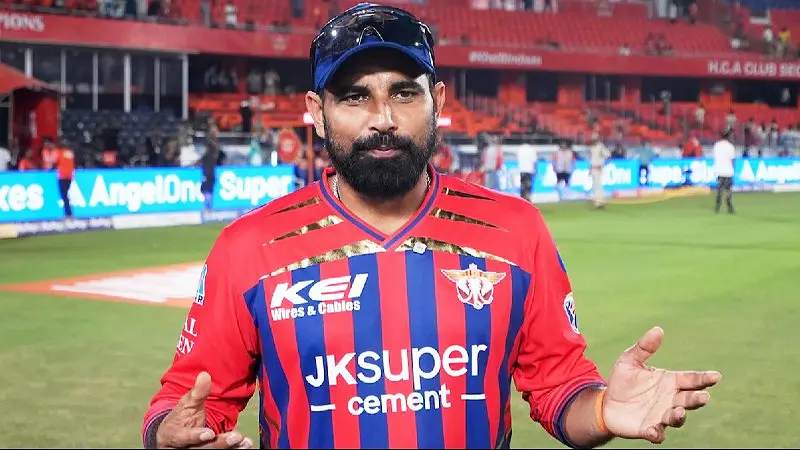

Mohammed Shami came back from injury as a seam-and-swing bowler. That’s what everyone expected to see. The bounce, the outswing, the hard length that climbs above the hands. What IPL 2026 batters are actually facing is something different, a Shami who mixes pace in the powerplay before the batter has established their timing, bowls fuller than his rhythm suggests, and uses the slow ball as a disruption device rather than a death-over safety option. The seam and swing are still there. The additional dimension is what’s causing problems. Batters who prepared for the Shami they knew are facing a version that’s evolved beyond that preparation.
Shami Got His Rhythm Back Finally
The specific difference between Shami’s earlier comeback phase and his current IPL 2026 form isn’t technical; it’s rhythmic. A fast bowler whose release point shifts by two centimetres across deliveries produces inconsistent results regardless of how good their plan is. The release point variation came from match rust rather than technical regression , the kind of inconsistency that only sustained competitive cricket resolves.
The full domestic season before IPL 2026 provided exactly that. His run-up looks fluent rather than effortful. His release is consistent over-to-over rather than varying based on fatigue or pressure. That rhythmic stability is what makes everything else in his bowling effective; the plan works because the execution hits the same spot repeatedly.
Fuller Lengths Broke the Openers’ Plans
The specific tactical adjustment that’s producing early wickets is Shami’s decision to bowl fuller than the hard length that most pace bowlers default to in powerplay conditions. Aggressive openers who look to free their arms early set their trigger movements for the hard length that bounces above the hitting zone.
The fuller delivery arrives at bat height and hits the base of the stumps before the trigger movement has loaded for the attacking shot. The resulting dismissals look like the batter misjudged the length, which they did, because Shami had adjusted from the length they anticipated. That anticipation gap, created by bowling differently from expectation, is the specific mechanism behind his powerplay wicket-taking pattern.
IPL 2026 Shami’s Slow Ball Is Devastating
The evolution in Shami’s IPL 2026 arsenal that opposing teams haven’t fully accounted for is his willingness to use the slow ball in the power play rather than exclusively in the death overs. Batters who are premeditated against pace, who have decided before the delivery that they’re attacking a 140-plus ball, arrive at the crease with their hands already committed to a swing that the 115-pace slow ball doesn’t deserve.
The mis-hit goes to mid-on or mid-off rather than over the boundary. Using this delivery in the powerplay rather than the expected death-over phase removes the anticipation that makes it avoidable. Batters know Shami has a slow ball. They don’t know when it’s coming, and in IPL 2026, it’s coming when they least expect it.
How Shami Dismantled GT’s Top Order
His performance against the Gujarat Titans confirmed that the tactical evolution is match-specific rather than generic. Against GT’s aggressive top-order combination, Shami identified that fuller deliveries with minimal width would remove the scoring zones that their trigger movements were designed to exploit. No bounce to attack. No width to cut or drive. The stumps were targeted rather than the edge.
GT’s top-order batters, who expected either aggressive short pitch or conventional good length, found neither; they found a bowler who had specifically studied their preferred scoring areas and removed them before the first ball was bowled. The resulting dismissals came from batters forced into low-percentage responses rather than Shami generating impossible deliveries.
- Does Mohammed Shami’s slow ball evolution continue producing early wickets, or do batting teams decode the variation quickly enough to make the adjustment that turns his disruption into expensive overs? Drop your take and follow for IPL updates.
FAQs
What changed in Mohammed Shami’s bowling this IPL?
His increased use of slower balls and fuller lengths in the powerplay has made him less predictable and more effective.
Why is Mohammed Shami effective in the powerplay now?
He denies bounce and controls scoring areas, forcing attacking batters into mistakes early in the innings.
How does the slow-ball strategy help Shami in IPL?
It disrupts batter timing, especially when used unexpectedly in the power play instead of only at the death.
Which matches highlight Mohammed Shami’s IPL performance breakdown?
Games like his performance against GT show how matchup-based bowling and disciplined lengths drive his success.