

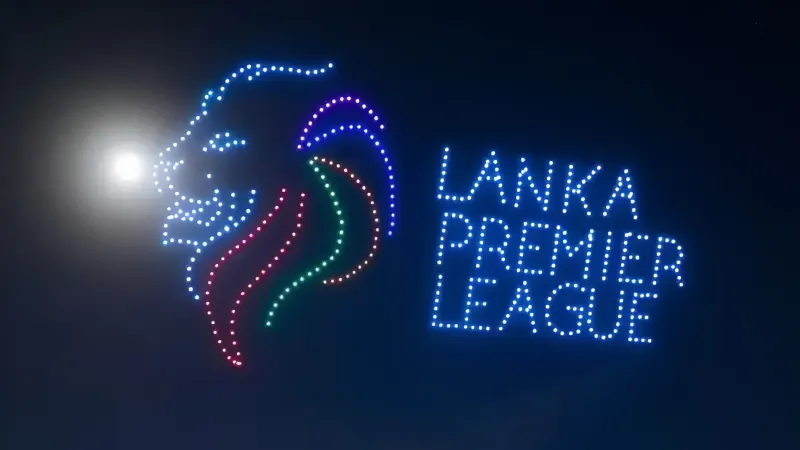

Sri Lanka’s franchise league opened its sixth season with five hundred drones lighting up the sky at a venue it had never used before, and the spectacle answers less than it appears to. Two of the tournament’s five teams had no confirmed owner as recently as May, the fallout from two terminations for unpaid contractual obligations in April 2025. IPG Group is using scale to project stability, but broadcast deals across India, Pakistan and Sri Lanka are the numbers that matter for the league’s health.
A Drone Show Built for Headlines
IPG Group built the night around scale: a five hundred drone synchronised light display, a trophy reveal staged like a product launch, team introductions and a full concert bill. The company framed the ceremony as proof the league has outgrown its early identity, treating experience as the real product on sale. SSC Colombo hosting an LPL fixture for the first time added to that sense of a rebrand in progress.
What actually moved the needle happened away from the drones. Star Sports locked in broadcast rights on July 11. FanCode secured India’s digital streaming two days earlier, and A Sports agreed terms for Pakistan. SLTMobitel’s Peo TV had already renewed as the exclusive domestic partner back in May. Those four deals, not the light show, are the signals worth reading here.
LPL 2026 Opening Ceremony Financial Struggles
Twelve months earlier, Sri Lanka Cricket terminated two of the league’s five franchises inside the same month. Colombo Strikers and Jaffna Kings both lost their licences in April 2025, with SLC and IPG Group citing a failure to meet contractual obligations and nothing more specific than that.
The result left the tournament without a single owner group tracing back further than 2024. Jaffna’s departing owners had won three of the first four titles, yet they were already the franchise’s third custodians. Colombo entered its sixth season under a fourth ownership group, having traded hands from Kings to Stars to Strikers inside four years. A gap year, forced first by a T20 World Cup postponement and then a further delay into this July window, only deepened the momentum the competition had lost.
Six Editions, Four Different Owners
The turnover becomes clearer when laid out season by season.
Franchise | Ownership Change | Year | Confirmed Reason |
Colombo | Kings to Stars to Strikers | 2020-24 | Sequential exits, no detail disclosed |
Colombo | Strikers to Kaps | 2025/26 | Terminated for contractual failure |
Jaffna | Original owner to Kings, Lyca Group | 2021 | New franchise owner |
Jaffna | Kings, Lyca to Kings, Sports Commune | 2025/26 | Terminated for contractual failure |
Galle | Marvels to Gallants | 2026 | New owner, Kiran Mantripragada |
Kandy | Falcons to Royals | 2026 | New ownership, rebrand |
Four of the five current franchises are now operating under names or ownership groups that did not exist when the LPL launched. Few T20 leagues have cycled through this much change in six years, and the pattern says more about the competition’s health than any broadcast deal can.
New Investors Trying to Stabilize the League
All four rebuilt franchises now have full ownership groups locked in for 2026. Witness Sports Alliance LLC, fronted by Saranyan Palaniswamy and K.C. Shyam Kangayan, holds the Colombo Kaps. Gallant Sports and Media LLC, led by Kiran Mantripragada, bought the Galle Gallants on May 10.
Sports Commune, run by Manjot Kalra and Mayank Goel, took over Jaffna Kings five days later. Kandy’s rebrand to Royals came under Sandhya Ajjarapu, a US-based investor confirmed on May 20. Every one of these four deals replaced a departing owner with Indian or diaspora capital, a distinct shift from the mix that backed the league at launch.
The Only Progress That Would Count
The LPL has never released attendance figures or season-by-season profit numbers, so the usual measuring sticks don’t apply here. A cleaner test exists anyway: do these four ownership groups still hold their licences at LPL 7, and does the tournament string together consecutive seasons under stable hands, something it hasn’t managed since its first edition?
The broadcast wins from early July, especially FanCode’s move into India, are genuine commercial ground gained in the sport’s largest market. None of that erases LPL 2026 opening ceremony financial struggles: a five-hundred-drone show can signal ambition, but it cannot substitute for the contract renewals still to come.
Will four new ownership groups finally give the LPL the stability five hundred drones cannot buy? Tell us your prediction below.
Frequently Asked Questions (FAQs)
Why did Sri Lanka Cricket terminate the Jaffna Kings franchise?
Sri Lanka Cricket ended Jaffna Kings’ original ownership in April 2025 for failing to meet contractual obligations. It was resold to Sports Commune, led by Manjot Kalra and Mayank Goel, for the 2026 season.
Who owns the Colombo Kaps in LPL 2026?
Witness Sports Alliance LLC owns the Colombo Kaps, led by Saranyan Palaniswamy and K.C. Shyam Kangayan. They took over after the previous Colombo Strikers licence was terminated for contractual failure in April 2025.
Is the Lanka Premier League actually profitable?
Nobody outside Sri Lanka Cricket and IPG Group truly knows, since neither body publishes attendance or revenue figures. Two terminations in April 2025 and a season postponed twice suggest the league is still finding its financial footing.
How many teams are playing in LPL 2026?
Five franchises are competing in LPL 2026: Jaffna Kings, Colombo Kaps, Galle Gallants, Dambulla Sixers and Kandy Royals. The tournament runs as a double round robin before the playoffs, with the final on August 8.
Who organized the drone show at the LPL 2026 opener?
IPG Group organised the five-hundred-drone display at SSC Colombo, calling it a centrepiece of the tournament’s ambition. Sri Lanka Cricket, the league’s owner, partnered on the ceremony alongside tournament director Samantha Dodanwela.
Disclaimer: This blog post reflects the author’s personal insights and analysis. Readers are encouraged to consider the perspectives shared and draw their own conclusions.