

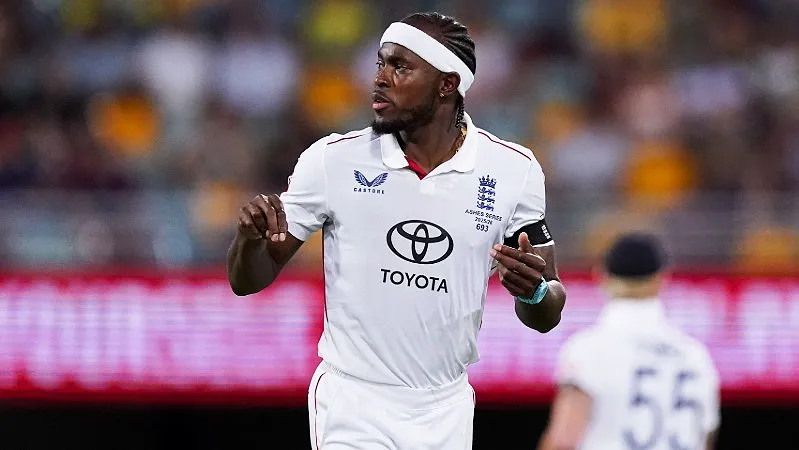

When England named their squad for the first Test against New Zealand at Lord’s on June 4, 2026, Rob Key used one specific word to describe Jofra Archer’s status: unavailable. Not rested. Not dropped. Not choosing the IPL. Every pundit who followed treated Archer as the agent making a personal choice. The structural reality runs in the opposite direction; the decision, the framework containing it, and every risk attached to any alternative were shaped by the ECB, not by Archer.
One Word: Unavailable
Key’s statement to the ECB’s official website declared Archer unavailable, explaining the priority was “building him up for red-ball cricket” after six months on the road. That phrase is workload-management language, not the vocabulary of a player making lifestyle choices. Archer had bowled four overs per match across an entire IPL season; T20 loads are structurally inadequate for five days of Test cricket. The ECB’s own medical team determined additional time was required before he could safely make that transition.
Calling him unavailable rather than rested or dropped is the tell. Rested implies discretion. Dropped implies failure. Unavailable is an institutional determination assigned by the organisation, not elected by the player.
The BCCI Rule That Trapped Archer
Since IPL 2025, the BCCI has enforced a rule that any overseas player who registers for the auction, is purchased, then withdraws before the season starts, faces a two-year ban from the IPL and its auction. Harry Brook became the first to trigger it in March 2025, pulling out of Delhi Capitals ahead of IPL 2025. The BCCI formally notified the ECB of his ban, which runs until IPL 2028.
That rule existed, and the ECB knew it. Their response was to agree that English IPL players would receive No-Objection Certificates covering the full season, signing away their right to recall players mid-tournament. This followed England players leaving the 2024 IPL early to face Pakistan in a T20I series. Archer leaving early meant the same two-year ban that ended Brook’s near-term IPL career; the ECB created that risk and built the NOC structure around it. Archer had no safe exit.
Jofra Archer England Test Squad vs New Zealand 2026
The clearest confirmation of where the decision originated came from Rajasthan Royals head coach Kumar Sangakkara, speaking after RR’s win over Mumbai Indians on May 24. Sangakkara described it as a collaborative decision between the ECB and Archer, driven by the workload reality: bowling four overs per T20I match leaves a bowler structurally unprepared for a Test. He said the ECB was “gracious enough to let him stay” once a timeline for building red-ball loads was agreed.
RR assistant coach Trevor Penney confirmed Archer wasn’t troubled by the criticism because the arrangement had institutional backing, leaving early put him “in danger of never playing in the IPL again,” and staying meant accepting the optics. Both coaches described an institutional arrangement, not a player acting unilaterally.
Three Pundits, One Misread
Michael Atherton, who acknowledged the bowling-loads argument, called the situation “incredibly frustrating” and questioned whether a central contract had value if it couldn’t guarantee availability for the first Test of the summer. Michael Vaughan attacked the ECB-BCCI agreement directly, arguing the Test series should start later if England wanted its IPL players available. Simon Doull called it “absolutely ludicrous.”
Each critique aimed at Archer. None engaged with the structural reality: the ECB signed the full-season NOC agreement, the ECB accepted the BCCI’s two-year ban framework having watched it claim Brook the previous year, and the ECB’s own workload management prevented Archer from stepping directly from T20 cricket into a Test. The frustration is legitimate. The target is wrong.
The ECB Won’t Be Hurried
McCullum told the BBC he’d assess Archer for the second Test and, “if not, we’ll look at the third Test”, framing that signals no external pressure will accelerate the timeline. The second Test is at The Oval on June 17; the third at Trent Bridge. Archer was in Barbados following RR’s exit in the IPL Eliminator against GT, making even a second Test return plausible rather than guaranteed.
He finished IPL 2026 as RR’s highest wicket-taker with 24 wickets, the first full campaign his body had held up since his injury-interrupted years. A three-Test Pakistan series follows New Zealand, which means the ECB’s sequencing extends well beyond Lord’s. The Jofra Archer England Test squad vs New Zealand 2026 omission is the opening move in a plan the ECB designed, and the criticism it has generated belongs to the institution that built the structure, not the player inside it.
Does the ECB deserve more scrutiny for the NOC agreement that made this inevitable, or do central contracts need to take back priority? Make your case below.
FAQs
Why is Jofra Archer not in England’s Test squad vs New Zealand?
The ECB declared Archer unavailable, citing the need to build him up for red-ball cricket after bowling four overs per match throughout the IPL. RR head coach Kumar Sangakkara confirmed it was a collaborative decision between Archer and the ECB.
What is the BCCI rule about IPL overseas players pulling out?
Any overseas player who registers for the IPL auction, is purchased, then withdraws before the season, faces a two-year ban from the IPL and its auction. Harry Brook triggered this in March 2025 after pulling out of Delhi Capitals, receiving a ban running until IPL 2028.
When will Jofra Archer return to England’s Test squad?
McCullum said he’d assess Archer for the second Test at The Oval on June 17, with the third Test at Trent Bridge as the fallback target. There is no confirmed return date.
Who replaced Jofra Archer in England’s squad vs New Zealand?
Ollie Robinson returned to the Test squad for the first time since February 2024, while uncapped fast bowler Sonny Baker received his first Test call-up. Neither is a direct replacement for Archer’s pace and movement.