

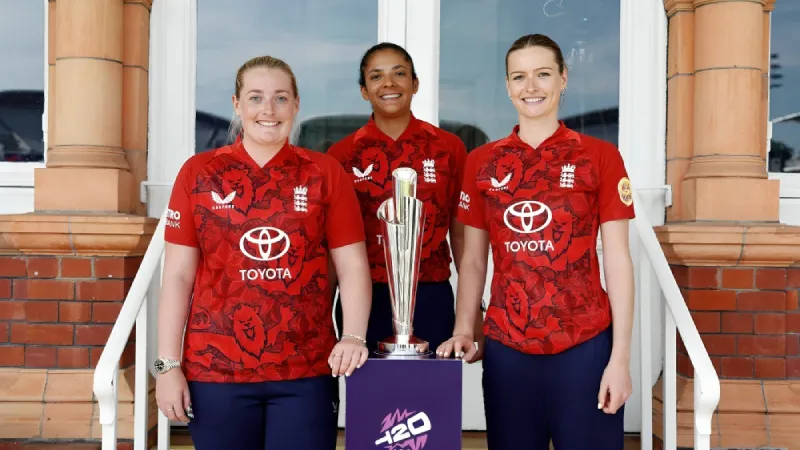

England open the 2026 ICC Women’s T20 World Cup on June 12 against Sri Lanka at Edgbaston, at home in this format for the first time since 2009. The framing writes itself: hosts, ranked second, drawn with New Zealand and the West Indies in Group 2. The problem is what the last six weeks showed. Batting collapses under pressure, the captain has not bowled since April, and form against top-eight opposition was mixed. Home advantage is real. It is not sufficient alone.
England’s T20I Form Before Their Own World Cup
England played six T20Is without Sciver-Brunt, who sustained a calf tear in April. They beat New Zealand 2-1 in May, then beat India 2-1 in a series that looked cleaner than it was. In the opener at Chelmsford, they were bowled out for 150 chasing 189, losing by 38 runs. In the Taunton decider, the batting collapsed to 38 for 3 in the powerplay before Capsey (82 off 43) and Knight (70 not out off 42) built a 137-run fourth-wicket stand. England won by rescuing themselves, which is a different thing from dominating.
What the India Series Loss Actually Revealed
Chelmsford exposed the gap: without Sciver-Brunt, England lacks a batter who can both anchor and accelerate. In the five T20Is before the Taunton decider, Heather Knight scored 19, 25, 18, 21, and 18, never a match-winning contribution. Sciver-Brunt returns in a batting-only capacity; Charlotte Edwards confirmed she will probably not bowl in the early stages. For a team that has relied on her seam bowling in the middle overs for several years, English pitches that offer genuine movement to medium-pace bowlers all day represent a real challenge without that option.
New Zealand and West Indies as Genuine Group 2 Threats
New Zealand enters as defending champions with Kerr in career-defining form: 95-plus T20I wickets, a T20I century on her captaincy debut, and a 4-1 series win over South Africa in March 2026. West Indies, ranked sixth, brings Hayley Matthews as one of the most destructive all-rounders in the format. They lost 0-3 to Australia most recently, but beat Sri Lanka 2-0 in home T20Is in February 2026. England is the only team in Group 2 that cannot use their captain with the ball, the structural disadvantage that matters most in tight matches.
England Women T20 World Cup 2026 Group 2 Home Advantage
England have never lost a home ICC tournament: the 2009 T20 World Cup, the 2017 ODI World Cup, and the 2023 Ashes, all won or unbeaten at key stages. Ground familiarity and crowd support are genuine. But the top-two qualification structure means one unexpected loss could be terminal, and Edgbaston and Old Trafford are not spin-friendly enough to neutralise the pace threats New Zealand and West Indies carry. Only the 2009 hosts, England, have won this title, in the inaugural edition with eight teams. That is a single data point, not a pattern.
Team | Group 2 | Last 5 T20I Results | ICC Ranking | Key Player |
England | Hosts | W W L W W (vs NZ and India) | 2nd | Nat Sciver-Brunt (bat only) |
New Zealand | Defending champs | W W W L W (vs SA) | 4th | Melie Kerr (capt, allrounder) |
West Indies | 2016 champions | L L L (0-3 vs Australia) | 6th | Hayley Matthews (capt) |
Sri Lanka | Qualified by ranking | W W (vs WI T20Is 2-0) | 7th | Chamari Athapaththu |
Ireland | Qualified via the qualifier | Won 2026 Qualifier | 9th | Gaby Lewis |
Scotland | Qualified via the qualifier | 3rd in 2026 Qualifier SFs | Unranked (top 20) | Kathryn Bryce |
Why Home Advantage Is Not Enough on Current Form
The squad is not weak. Sophie Ecclestone and Lauren Bell offer world-class bowling options, and Capsey has established herself as an impact batter capable of changing a match in a short period. But England have not won this title in 17 years, and three batting collapses across the India series, combined with a captain unavailable with the ball, mean the home favourite tag deserves scrutiny rather than assumption. The England Women’s T20 World Cup 2026 Group 2 home advantage is a real factor; the evidence of the last six weeks suggests it is not a wide enough margin to ignore what the bilateral series exposed.
Is England’s home advantage enough to carry them through, or does Sciver-Brunt’s absence from bowling change everything? Drop your take in the comments.
FAQs
What group is England in at the 2026 tournament?
The hosts are in Group 2 alongside New Zealand, West Indies, Sri Lanka, Ireland, and Scotland. The top two teams from the group advance to the semi-finals.
Who is England Women’s captain at the tournament?
Nat Sciver-Brunt is England’s captain, returning from a calf injury but expected to bat only and probably not bowl in the early stages. She sustained the injury in April while playing for The Blaze.
Has England won this title before?
Yes, the 2009 ICC Women’s T20 World Cup was won by England, defeating New Zealand in the final at Lord’s. They have not won the title since.
When is the opening match?
June 12 against Sri Lanka at Edgbaston in Birmingham, the first match of the entire 2026 tournament.
Who are England’s biggest threats in Group 2?
New Zealand, the defending champions led by Melie Kerr, and West Indies, captained by Hayley Matthews, are the most credible threats to England’s place in the top two. New Zealand won 4-1 against South Africa in March 2026 and arrived in strong form.
Disclaimer: This blog post reflects the author’s personal insights and analysis. Readers are encouraged to consider the perspectives shared and draw their own conclusions.