

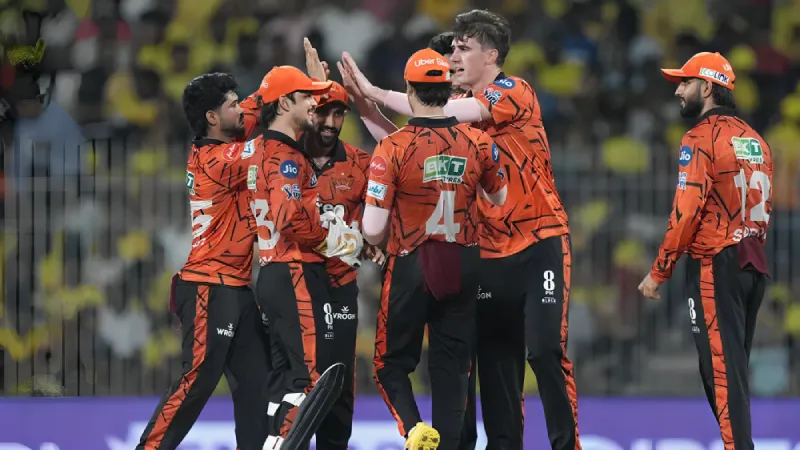

SRH’s batting philosophy delivers results in the league stage and falls apart in the knockouts. Nine wins from 14 matches in IPL 2026, four batters crossing 560 runs each, third place, and then a 47-run Eliminator defeat to Rajasthan Royals. The pattern stretches across four seasons: 10th in 2023, runners-up in 2024, sixth in 2025, and Eliminator exit in 2026. The batting brand is not the problem. The bowling budget that gets left behind once the top four take their share is the problem, and it shows every time a knockout match arrives.
The Eliminator Exposed What the League Stage Hid
In the Eliminator on May 27, Sooryavanshi hit 97 off 29 balls, the highest individual score in an IPL knockout match, as RR posted 243/8. Jofra Archer removed Abhishek Sharma, Ishan Kishan, and Travis Head cheaply in reply. SRH were 81/5 before the innings had shape, and bowled out for 196 in 19.2 overs. The 47-run margin was flattering.
The league stage had hidden the problem. SRH’s first four games saw their pace unit leak at 11.47 economy, the worst in the tournament, and average 45.36. They lost three of four. Debut caps for Praful Hinge and Sakib Hussain in Match 5 changed things: Hinge became the first bowler in IPL history to take three wickets in an opening over. SRH won 8 of their next 10. Uncapped debutants papered over a structural flaw. The Eliminator tore it off.
SRH Bowling Weakness IPL 2026 Salary Cap, Four Seasons of Evidence
SRH spent ₹119.55 crore of their ₹125 crore purse in the IPL 2026 auction. Their top four batting slots consumed ₹64 crore: Klaasen ₹23 crore, Head ₹14 crore, Abhishek Sharma ₹14 crore, and Livingstone ₹13 crore. Pat Cummins at ₹18 crore is counted as bowling spend, but he’s the captain and bowls four overs per game maximum. Outside Cummins, the entire bowling budget was ₹2.6 crore, split across Unadkat, Malinga, and Ansari.
Season | SRH Finish | Economy Rank | Bowling Spend |
2023 | 10th | 7th–10th | ~₹12 cr |
2024 | Runners-up | 6th–8th | ~₹22 cr |
2025 | 6th | 7th–9th | ~₹20 cr |
2026 | Eliminator | 6th–7th | ~₹20.6 cr |
The pattern across four seasons is consistent: mid-table bowling economy, top-heavy batting spend, and a ceiling that appears every time a knockout match arrives.
What Tom Moody Said and Why It Matters
Tom Moody coached SRH to their only IPL title in 2016. His post-Eliminator assessment was direct:
“You’re pouring a lot of money into the way you play as a batting unit. You’re left short with the finances to be able to build a strong bowling unit.”
That’s not speculation from an outsider, it’s an indictment of franchise policy from the man who built the only SRH squad that won it all.
Cummins remains one of the best fast bowlers in the world. The problem isn’t his quality; it’s that he’s the only quality bowling name in the budget. The revival after Match 4 relied on uncapped debutants at the base price.
The RCB Blueprint SRH Ignored
Compare SRH’s bowling investment with RCB’s in IPL 2026. Royal Challengers Bengaluru spent ₹12.50 crore on Josh Hazlewood and ₹10.75 crore on Bhuvneshwar Kumar, two frontline bowlers with genuine credentials, alongside ₹6 crore on Rasikh Salam and ₹5.20 crore on Mangesh Yadav. RCB’s league-stage bowling economy was 9.39, fifth best in the tournament, and their attack wasn’t dependent on one name.
SRH’s economy of 9.9 was respectable but built on debutants rather than depth, in the survivable league stage. In a knockout, it isn’t. RCB’s approach proves the model works: two frontline bowlers with double-digit contract value, a supporting cast with credentials, and an attack that doesn’t collapse when one bowler has a bad night.
Until the Auction Room Changes, the Exits Won’t
SRH’s brand is worth keeping. The Orange Army, the 220-scorers, the powerplay identity, that’s franchise culture that fills stadiums. But a brand without a bowling spine keeps losing in knockouts, and the evidence is four seasons deep. Pouring ₹64 crore into the top four batting slots and fewer than ₹3 crore into specialist bowling outside the captain delivers league-stage spectacle and playoff exits on a reliable schedule.
The SRH bowling weakness IPL 2026 salary cap decisions exposed aren’t fixable with better selections from the same budget. It requires a fundamental reallocation at the next auction, a second frontline bowler commanding real money, not a debutant on base price. Until that changes, SRH’s knockout record won’t.
Should SRH break their batting-first identity at the next auction and sign a second ₹15 crore bowler? Tell us what you’d do in the comments.
FAQs
Why did SRH lose the IPL 2026 Eliminator?
SRH lost to RR by 47 runs after Sooryavanshi’s 97 off 29 balls powered RR to 243/8. Archer took SRH’s top three cheaply; they were bowled out for 196.
What did Tom Moody say about SRH’s bowling in IPL 2026?
Moody said SRH pour too much into batting and lack the finances to build a strong bowling unit. He called it a structural franchise problem.
How much did SRH spend on bowling in the IPL 2026 auction?
SRH’s total bowling spend was ₹20.6 crore, ₹18 crore on Cummins, and ₹2.6 crore on all others. Their top four batters cost ₹64 crore by comparison.
How did SRH’s bowling improve after their first four IPL 2026 games?
Praful Hinge’s debut in Match 5 transformed the attack; he took three wickets in his opening over, an IPL first. SRH won 8 of their next 10.
Disclaimer: This blog post reflects the author’s personal insights and analysis. Readers are encouraged to consider the perspectives shared and draw their own conclusions.