

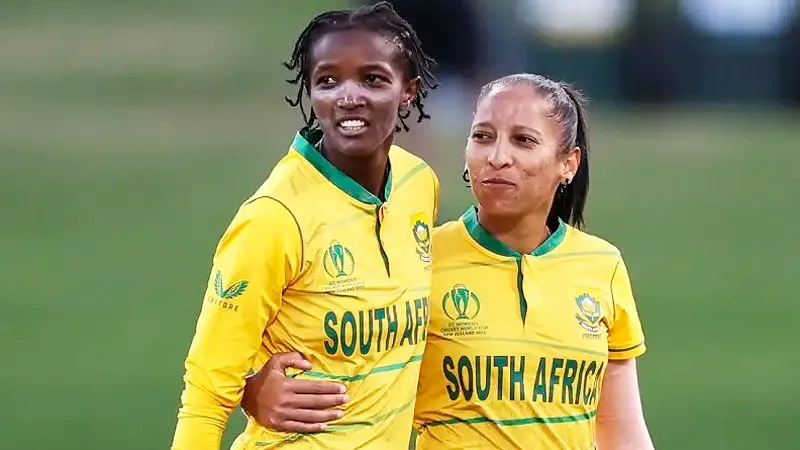

South Africa’s opening bowlers dismissed two Australians inside the powerplay and had the game exactly where they wanted it. Marizanne Kapp and Shabnim Ismail had done their jobs. Then Wolvaardt kept Ismail on for a third over against a batter who had already targeted her, and Phoebe Litchfield hit 29 of her 51 runs off it. That single decision, not the lengthy batting collapse that followed in the chase, is precisely where this match was lost.
Litchfield’s 23-Ball Fifty
Australia won the toss and batted. Marizanne Kapp removed Georgia Voll in the first over. Ismail dismissed Beth Mooney shortly after. Then Litchfield came to the crease at No.3, having missed both Australian warm-up games in Cardiff with a quad strain, and refused to rebuild.
She scored 51 off 24 deliveries, nine fours and a six, raising her half-century off 23 balls. Twenty-nine of those runs came off Ismail from just 11 balls, despite Ismail having dismissed Litchfield four times in WBBL meetings. Litchfield pulled Ismail for six, scooped Khaka off the deck, and was out the very next delivery after her fifty, leaving Australia at 61/3. The powerplay rescue was complete.
Australia vs South Africa Women’s T20WC 2026 Wolvaardt Captaincy
Ismail should not have bowled a third over, but Wolvaardt persisted after Ismail took a wicket in her second over, because of the reputation she carries. Wolvaardt read reputation, not momentum. Litchfield had already identified Ismail as a target, was set at the crease, and had no intention of stopping.
Bowler | Overs | Runs | Wkts | Economy |
Shabnim Ismail | 3 (incomplete) | 33 | 1 | 11.00 |
Marizanne Kapp | 4 | 31 | 1 | 7.75 |
Ayabonga Khaka | 4 | 34 | 2 | 8.50 |
Nonkululeko Mlaba | 4 | 22 | 2 | 5.50 |
Nadine de Klerk | 4 | 37 | 2 | 9.25 |
Mlaba went at 5.50. Ismail went at 11.00. The numbers show what was available. Rotating Ismail out after two overs and bringing in a spinner to disrupt Litchfield’s momentum would have changed the powerplay conclusion materially.
The Finger Injury and Its Full Cost
Ismail came out of retirement at 37 for this tournament, having retired after the 2023 Women’s T20 World Cup final against Australia. She took 4/39 at Arundel the previous week and was Wolvaardt’s identified powerplay option. The third over carried a risk beyond the runs: if anything went wrong physically, South Africa would lose their most dangerous bowler at the worst moment.
That is precisely what happened. Ismail developed a finger niggle and was off the field for much of the remainder of Australia’s innings, unable to complete her four-over allocation. The dual cost was exact: 33 runs conceded in the third over and South Africa’s primary pace threat unavailable during the rebuilding phase between powerplay and middle overs. She batted later in the chase when the result was already beyond reach.
South Africa’s Batting Collapse
Australia finished 172/8. South Africa, chasing 173, were bowled out for 107 in 16.4 overs. Wolvaardt made 44 off 39 before her dismissal triggered the collapse: the last five wickets added just 11 runs. Wareham took 3/13 and scored 32 off 22 to win Player of the Match. Molineux and King took two wickets each. Eight wickets fell to spin.
The collapse reflected a team managing both innings reactively rather than proactively. South Africa had the bowling to restrict Australia and the batting to chase 173. The decision-making in the first innings made both tasks significantly harder than they needed to be.
What Must Change Before the India Match
South Africa is in Group 1 alongside Australia, India, Pakistan, Bangladesh, and the Netherlands. Only two teams advance to the semi-finals at The Oval. With Australia already a game ahead, the India fixture is effectively a must-win.
Wolvaardt scored 330 runs in a 4-1 T20I series win over India in April 2026, confirming she understands this opposition. The question now is whether she manages her bowling resources more carefully, keeping Ismail’s overs for specific moments of damage rather than persisting past the point when momentum has shifted against her. The Australia vs South Africa Women’s T20WC 2026 Wolvaardt captaincy call at the third over is the one decision that needs to change.
Was Wolvaardt right to persist with Ismail after that second-over wicket, or should she have rotated immediately? Tell us in the comments.
FAQs
What happened in the Australia vs South Africa match?
Australia beat South Africa by 65 runs at Old Trafford on June 13, 2026, posting 172/8 before bowling South Africa out for 107 in 16.4 overs. Wareham won Player of the Match with 3/13 and 32 off 22 balls.
How many runs did Phoebe Litchfield score against South Africa?
Phoebe Litchfield scored 51 off 24 deliveries, nine fours and a six, reaching her half-century off 23 balls. Twenty-nine of her runs came off Ismail across 11 balls.
Is Shabnim Ismail injured at the 2026 Women’s T20 World Cup?
Ismail developed a finger niggle during Australia’s innings on June 13, preventing her from completing her four-over allocation after just three overs. She batted later in South Africa’s chase when the result was already settled.
What is Laura Wolvaardt’s record in ICC finals?
Wolvaardt has reached three consecutive ICC finals without a title: lost to Australia by 19 in 2023, New Zealand by 32 in 2024, and India by 52 in 2025. Old Trafford is her fourth consecutive ICC event without winning.
Can South Africa still qualify for the semi-finals?
Yes, but only two teams advance from Group 1, and South Africa trails Australia. They must win the remaining matches, including the India fixture, with net run rate likely to matter.