

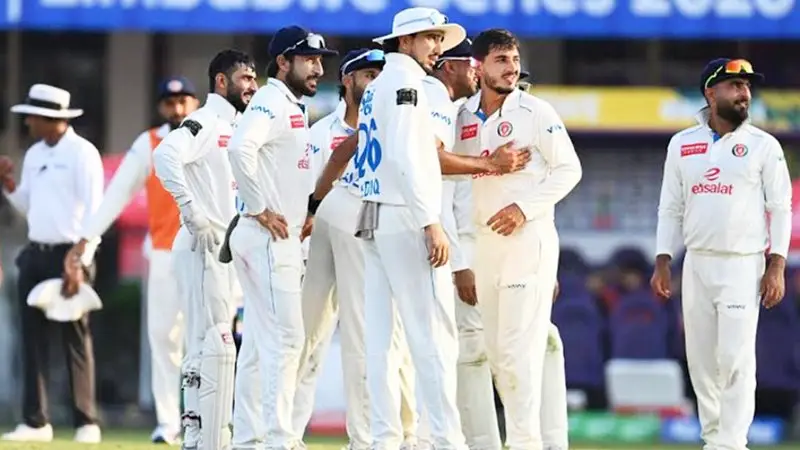

Three centuries gave Afghanistan 514 at Sharjah, and it still was not enough to win. Zimbabwe crossed 500 in both innings and left with a draw on a pitch that offered bowlers little. The surface took some of the blame, but the way Afghanistan spread its overs deserves more. One spinner carried the workload, a fifth bowling option stayed in the dressing room, and the attack ran dry on a final day that Zimbabwe batted through without a scare. They had the runs to control it and not the bowling.
Runs Came Easily on a Flat Deck
Winning the toss on 5 November, Zimbabwe compiled 504 in 134.3 overs, led by Brendan Taylor with 131 and Brian Bennett with 128. Afghanistan replied with 514, a lead of only 10, built on 173 from Rahmat Shah, a debut century from Rahmanullah (113) and 105 from Sediqullah Atal. Three hundreds still bought them no real advantage, and the pitch gave them none either.
Zimbabwe then batted out the entire last day and finished on 523/5. Craig Ervine remained unbeaten on 206, and Wessly Madhevere reached exactly 100, with the pair putting on 208 without being separated. Over the whole Test, Zimbabwe made 1,027 runs and lost only 15 wickets, which is the cleanest summary of how little the bowlers achieved.
Afghanistan vs Zimbabwe Test bowling attack
Four frontline bowlers shared the 256.4 overs Afghanistan delivered. Zimbabwe’s scoring rate was 3.74 in their first innings, rising to 4.28 in the second, and 4.00 overall. The table shows where those overs went.
Bowler | Overs | Runs Conceded | Wickets | Economy |
|---|---|---|---|---|
Zia-ur-Rehman | 96 | 343 | 4 | 3.57 |
Qais Ahmad | 32 | 152 | 3 | 4.75 |
Mohammad Saleem | 43.3 | 144 | 4 | 3.31 |
Ziaur Rahman | 34 | 120 | 1 | 3.53 |
Hashmatullah Shahidi | 24 | 95 | 1 | 3.96 |
Shahidullah | 12 | 68 | 0 | 5.67 |
Abdul Malik | 11.1 | 65 | 1 | 5.82 |
Sediqullah Atal | 4 | 27 | 0 | 6.75 |
Saleem was the tightest of the group at 3.31, and all four specialists stayed under five an over. The cracks showed once the part-timers came on. Shahidullah conceded 5.67 an over, Malik 5.82 and Atal 6.75, and between them they produced a single wicket, Malik’s.
Zia-ur-Rehman Carried a Heavy Load
Zia-ur-Rehman, the left-arm spinner, delivered 96 of those 256.4 overs, a 37% share, and finished with four wickets for 343 runs. That works out at 85.75 per wicket. Split across the two Zimbabwe innings, his work came to 46 overs and then 50. Few spinners are asked to carry that much, and the figures show the strain.
Economy was never the complaint, because 3.57 an over is decent. Workload was. The next busiest bowler, Saleem, got through 43.3 overs, less than half the spinner’s share. Qais Ahmad picked up three wickets early in the match and then received only five overs when Zimbabwe batted again, so the best wicket-taker barely saw the ball once the pitch settled.
Selection Left the Bowlers Short
Rashid Khan was absent, rested from Test cricket. On the 2024-25 tour of Zimbabwe, nobody took more wickets than his 11, and Afghanistan’s most recent win over this opponent, by 72 runs at Bulawayo in January 2025, came when Zimbabwe were dismissed for 243 and 205. At this venue, the team picked debutant Rahmanullah for his batting, a middle-order extra, which meant Yamin Ahmadzai and the leg-spinner Khalil Gurbaz, both named among the 15, missed the XI.
The extra batter paid off with a hundred. The price was a fifth bowler, and the attack felt it. Zimbabwe had gaps of their own, with Richard Ngarava nursing a back problem and Sikandar Raza absent, and they still topped 500 in both innings.
Fixes Needed Before the Second Test
Match two begins on 13 November at this venue again. Those part-timers combined for 39.1 overs and 187 runs, a workload that a fifth specialist would remove. Zia-ur-Rehman needs a break, and the early wickets from Qais Ahmad make the case for longer spells. Saleem, at 3.31 an over, deserves more support too.
The new ball lacks sting too. Ziaur Rahman announced himself with 7/97 in Harare in October 2025, yet he returned 1/120 here. If the Afghanistan vs Zimbabwe Test bowling attack stays as stretched as it was in Sharjah, a series level at two wins each with two draws from six Tests could tilt the wrong way.
Should Afghanistan drop a batter for a fifth bowler in the next Test, or trust the spinners to hold? Share your pick in the comments.
Frequently Asked Questions (FAQs)
Did either side win the opening Sharjah Test?
No, the match finished as a draw on 9 November. Zimbabwe closed their second innings on 523/5 after batting through the entire final day, so Afghanistan never had a real chance.
Which batter made the highest score in the Sharjah Test?
Craig Ervine top-scored with an unbeaten 206. Over the full match, Brendan Taylor collected more runs in total, 131 first up and 82 later, for 213.
Is Rashid Khan part of this Test series?
No, Afghanistan have rested him from Test cricket. Both match squads of 15 leave him out, though his 11 wickets led all bowlers when the sides last met in Zimbabwe.
When does the second Test start in Sharjah?
It begins on 13 November. The five days end on 17 November, again at Sharjah Cricket Stadium, the same ground that hosted the draw, so conditions should be familiar to both sides.
What kept the Sharjah Test from producing a result?
A flat pitch gave bowlers very little help. Afghanistan led by only 10 runs after their 514, and Zimbabwe then batted out the whole final day without losing control.