

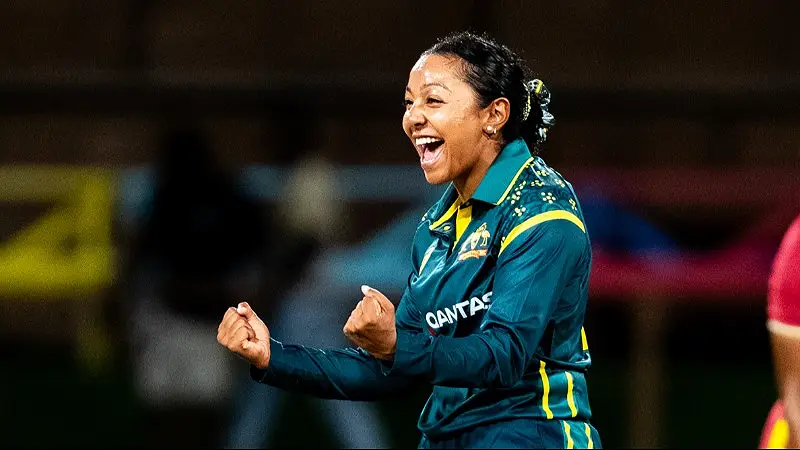

Australia’s spin selection for the Women’s T20WC is not a settled conversation, and Alana King is the reason it stays open. Sophie Molineux bowls left arm and contributes with the bat. Georgia Wareham takes wickets and provides batting depth. King takes wickets and does little else. In a format where all-round value increasingly drives squad decisions, a specialist leg spinner who produces a 3/14 against West Indies forces selectors to ask a question they would rather not: do they pick the most dangerous spin option or the most complete one?
What 3/14 Against West Indies Proved
King’s return spell of 3 wickets for 14 runs confirmed two things the selectors needed to see first: that the extended absence from T20I cricket had not eroded her ability to take wickets in high-pressure situations. Second, that her control under match conditions, not training conditions, had genuinely improved. Three wickets at 14 runs in T20 cricket means she dismissed batters while conceding at under five runs per over, which is the combination that changes match momentum rather than simply maintaining it. That performance put her name back into the selection conversation in a way that consistent domestic form alone could not have achieved.
Molineux and Wareham Make It Harder
The internal competition within Australia’s spin pool is what makes King’s selection uncertain despite his performance. Sophie Molineux brings left-arm variety that right-hand batting lineups find more uncomfortable to assess against King’s leg spin, and her batting at seven or eight adds a genuine run-scoring option that does not exist with King in the XI. Georgia Wareham covers a similar profile, wicket-taking spin paired with lower-order batting that extends the innings.
T20 World Cup 2026 Pitches Change Everything
The conditions for the T20 World Cup 2026 in England and Wales introduce a specific variable that makes Australia’s spin selection more tactical than form-based. English surfaces in T20 cricket typically assist seam movement in the powerplay, which reduces the influence of spin in the phase where game momentum is most decisive. However, as tournament matches progress onto worn surfaces, particularly in knockout rounds where the same venues host multiple fixtures, leg spin that generates bounce and turn becomes significantly more dangerous than it is on a fresh pitch.
Why Batting Depth Works Against Her
Alana King’s primary limitation in Australia’s squad context is not her bowling. It is everything surrounding it. When a team selects a specialist who contributes to only one department, that specialist must be so significantly superior in their discipline that the trade-off is worth the batting or bowling depth it costs. King is a high-quality leg spinner. She is not so far ahead of Molineux or Wareham in wicket-taking quality that the comparison is obvious. On the days when her leg spin does not grip and the conditions flatten out, she contributes nothing beyond her four overs, whereas both of her competitors would still contribute with the bat.
Where Her Selection Argument Actually Stands
King’s best case for selection is as the specialist who wins Australia a match in the semifinal or final when surfaces grip, and opposition batting lineups face leg spin they have not prepared for adequately. Her worst-case scenario is as the specialist who costs Australia a group-stage match when English conditions help seam bowlers, and her four overs produce one wicket at 38. Both scenarios are realistic. Selectors who pick her are backing the knockout round version. Selectors who leave her out are managing the group stage risk. The honest answer is that neither decision is wrong, and that is exactly why this remains Australia’s toughest spin call heading into the tournament.
- Should Australia back Alana King’s wicket-taking leg spin for the knockouts or does batting depth make Molineux and Wareham the safer T20WC picks? Drop your take in the comments and follow for Women’s T20WC 2026 updates.
FAQs
What are Alana King’s chances for the T20WC 2026 selection?
She is in strong contention but not guaranteed due to intense competition within Australia’s spin options.
Why is Alana King important for Australian Women?
Her leg-spin provides a wicket-taking option that can shift momentum in the middle overs.
How will England’s conditions affect team selection?
Seam-friendly conditions may reduce spin options early, but slower pitches later could increase their importance.
Which players are competing with Alana King for selection?
Sophie Molineux and Georgia Wareham are the primary competitors due to their all-around abilities.
Can Australia include multiple spinners in the squad?
Yes, but it will depend on pitch conditions and the overall balance that the team management wants to maintain.