

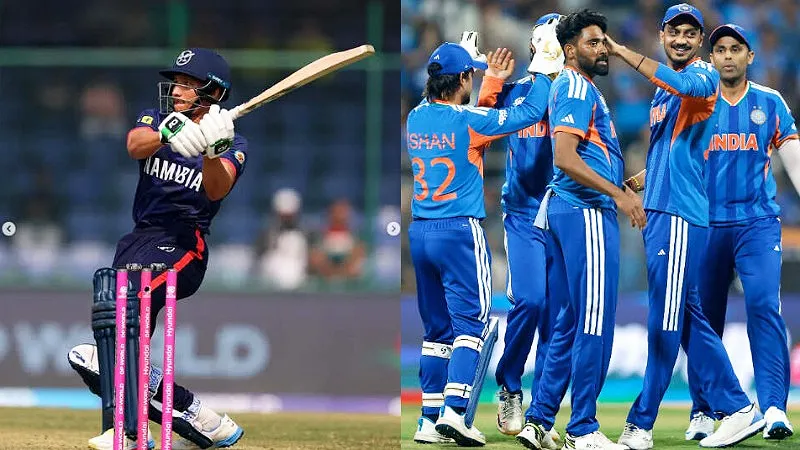

India vs Namibia T20WC match could be far more competitive than expected because Namibia’s key players vs India bring specific tactical threats, especially through left-arm pace and spin. With India’s vulnerability against left-arm pacers already exposed in recent matches, players like Jan Frylinck, Ruben Trumpelmann vs India, and Bernard Scholtz’s bowling record become central to the contest. Add to that the ongoing associate nations’ growth in global tournaments, and this group-stage clash is not just about rankings; it’s about matchups, conditions, and execution in Delhi.
Jan Frylinck’s Top-Order Evolution
The transformation in Jan Frylinck stats T20I over the last year reflects a shift in role and impact. Promoted up the order, Frylinck has improved his strike rotation and boundary conversion, making him more than just a utility all-rounder.
Tactically, Delhi’s shorter square boundaries suit his ability to clear the infield early. If India attacks him with hard lengths, he can use pace-on deliveries to access mid-wicket and long-on. However, his record against high-quality pace remains a test area.
Ruben Trumpelmann vs India Matchup
Among associate pacers, Ruben Trumpelmann stands out because of the angle and seam presentation. The left-arm over-the-wicket angle naturally shapes into right-handers an area where India’s vulnerability against left-arm pacers has surfaced in phases.
Trumpelmann’s ability to strike in the power play gives Namibia a realistic early breakthrough opportunity. In previous meetings, he has shown confidence against top-tier opposition, including boundary-hitting ability down the order. At the Arun Jaitley Stadium, where new-ball swing can last briefly under lights, his first two overs become decisive. If he removes one of India’s aggressive openers, the tempo shifts instantly.
Bernard Scholtz Bowling Record Impact T20 World Cup 2026
The Bernard Scholtz bowling record highlights consistency rather than raw pace. As a left-arm spinner, he relies on accuracy, trajectory variation, and smart field placement.
Delhi’s surface traditionally rewards disciplined spin in middle overs, especially when batters look to accelerate after powerplay consolidation. Scholtz’s economic control allows Namibia to build dot-ball pressure.
India struggled against similar spin matchups in recent matches, particularly when the ball was gripped into the surface rather than floated. In India vs Namibia T20 World Cup 2026, Scholtz’s role is not just containment; it is the disruption of rhythm.
Associate Growth and Tactical Confidence
The gap between Full Members and Associates has narrowed significantly. The narrative of associate nations’ growth is supported by improved domestic structures and franchise exposure. Namibia now enters global tournaments tactically prepared, not just competitively hopeful. Their bowling combinations target matchup weaknesses rather than relying on defensive cricket. India remain favorites, but structured associate strategies, especially with left-arm variation, create pressure phases that were rare a decade ago.
Upset Patterns in T20 History
Past T20 World Cups have repeatedly shown that associate teams thrive when conditions compress scoring. The Netherlands upsetting major sides and Scotland pushing elite teams deep into matches are clear examples.
Analysts often point out that short-format volatility rewards disciplined bowling units. When powerplay wickets fall, even strong batting line-ups can stall.
In tournaments like 2021 and 2022, teams that controlled the middle overs consistently disrupted the favorites. Namibia’s blueprint mirrors that model: early swing, middle-overs spin squeeze, and calculated lower-order hitting.
The real story of India vs Namibia T20WC 2026 is not whether India is stronger on paper; it’s whether Namibia can exploit specific tactical windows. With Jan Frylinck providing top-order acceleration, Ruben Trumpelmann attacking India’s known discomfort against left-arm pace, and Bernard Scholtz controlling the middle overs, Namibia possesses structured threat points.
Key Takeaway
Namibia’s left-arm pace-spin combination gives them a tactical pathway to challenge India if they strike early and control the middle overs.
FAQs
Why are left-arm pacers effective against India in T20s?
The angle across right-hand batters and early swing can create edge opportunities in the power play.
How strong are Jan Frylinck’s stats in T20I compared to previous seasons?
His recent performances show improved strike rate and consistency after promotion up the order.
Which Namibia bowler has the best control in the middle overs?
Bernard Scholtz is known for economic control and disciplined left-arm spin.
Can associate nations realistically upset top teams in T20 World Cups?
Yes. Short formats reduce margin for error, and disciplined bowling attacks have caused major upsets before.