

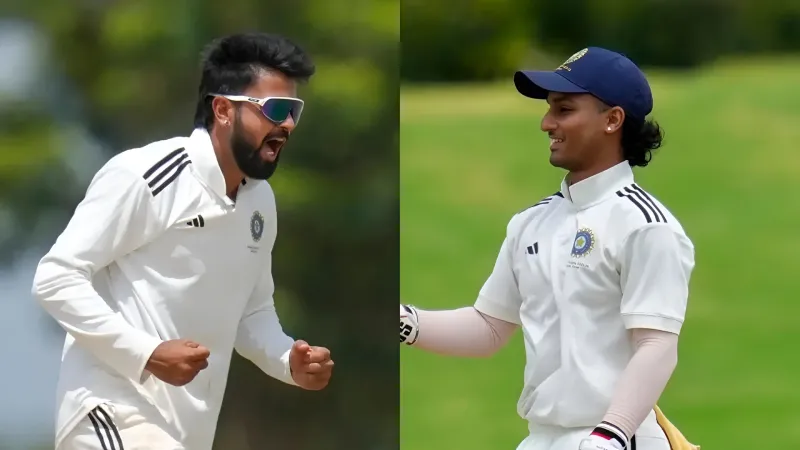

Jain’s thirteen-wicket match carries more weight. Badoni’s unbeaten 210 was the bigger spectacle, yet rain reduced it to a draw worth one point, while Jain’s match haul carried Madhya Pradesh to an innings victory and seven points. Both feats arrived in a round that batters dominated, so the performance that actually changed a result deserves extra weight. Delhi were rescued by a brilliant innings in Ranchi, but Bihar were dismantled in Indore by a bowler who refused to let the contest drift.
Jain’s Match-Winning Haul at Indore
Indore hosted a lopsided contest. Madhya Pradesh batted first and declared at 407 for 8, with Saksham Purohit contributing 132 and Rajat Patidar 109. Saransh Jain then dismantled Bihar twice: seven wickets for 40 runs in their 99 all out, and six for 49 when they could only reach 134 second time around.
His match return of 13 for 89 left Bihar 174 runs short even after batting twice. That margin brought Madhya Pradesh seven points and moved their season tally to 13. Bihar never recovered from the first-innings collapse, and their second effort only confirmed the gap. Very few spells in the round shifted a points table so directly.
Player | Team | Performance | Result | Impact |
Saransh Jain | Madhya Pradesh | 13 for 89 | Won by innings and 174 runs | Seven points |
Ayush Badoni | Delhi | 210* off 228 balls | Drawn, rain-hit | One point |
Priyanshu Moliya | Baroda | 321* | Drawn, first-innings lead | Three points |
Ranji Trophy 2026 round 3 Ayush Badoni and Delhi’s Rescue
Jharkhand had Delhi in trouble at 181 for 5 in Ranchi when Badoni walked out. He remained unbeaten on 210 from 228 balls, including 19 fours and three sixes, and Sumit Mathur, who stayed on 150, joined him in a 334-run sixth-wicket stand. That stand let Delhi declare at 515 for 5, the kind of rescue that turns a nervous start into a commanding position.
His previous outing was 217 at Palam’s Air Force Ground, where Gujarat were the opponents, off 233 balls, which is his best first-class score. Two double hundreds in a row place him beside Gautam Gambhir and Virat Kohli in Delhi’s record books. Then the weather intervened. Days three and four were lost to rain, Jharkhand closed on 131 for 4, and Delhi took one point, leaving them sixth in Group C with four.
A Slate Tilted Toward Batters
Scoring was heavy everywhere. Across the 18 matches, 35 first innings were completed, and they averaged roughly 315 runs per innings, while the median sat at 281; four unfinished innings sit outside those numbers. Chandigarh’s 685 led the way, ahead of Baroda on 616, Meghalaya on 562 and Delhi on 515, so four sides cleared 500.
Within Baroda’s 616 against Jammu and Kashmir came Priyanshu Moliya’s unbeaten 321, the biggest individual score that club has ever recorded. In that setting, Bihar’s 99 was the lowest first-innings total anywhere, and Jain was the reason. When runs flow so freely, a bowler who collects wickets in bulk stands apart.
Selector Thinking on Both Players
India’s Test and ODI parties for New Zealand do not include either player, and the India A group leaves both out too. No selector has said anything about either one, so the case rests on numbers alone. That gap in recognition is part of what makes the comparison interesting.
Volume supports Badoni: 2,426 first-class runs from 27 matches at roughly 60, with six hundreds. Rarity supports Jain, since nothing else this round matched 13 wickets in one game. Selectors tend to notice what is hard to repeat.
Wickets Win the Argument
Look at what each innings changed. Badoni lifted Delhi out of 181 for 5, yet the match fizzled into a draw with a single point. Jain bowled Bihar out for 99 and then 134, while the typical first innings elsewhere reached 315, and that earned seven points. Context matters as much as numbers in a round like this.
Back-to-back doubles prove Badoni is consistent, and his claim is strong. But settle the Ranji Trophy 2026 round 3 Ayush Badoni question by asking which feat decided the result, and the answer is Jain’s 13 wickets, with the 210 only softening a draw. Consistency earns respect, but impact earns results, and the points table records only the second.
Which feat would you pick as the round’s best, Jain’s 13 wickets or Badoni’s second straight double? Tell us in the comments.
Frequently Asked Questions (FAQs)
Who scored double centuries in Ranji Trophy round 3?
Four batters passed 200 in the round: Badoni made 210 not out, Nehal Pajni 222, Ajay Duhan 239, and Priyanshu Moliya 321 not out. Moliya’s score for Baroda is the highest in that side’s history.
What were Saransh Jain’s figures against Bihar?
Jain took 13 wickets in the match for 89 runs. He claimed 7 for 40 in Bihar’s first innings of 99 and 6 for 49 in their second innings of 134.
Who has the highest score of the Ranji Trophy season?
Chinmay Sutar of Mizoram holds the highest individual score of the season, an unbeaten 400. He added another 125 runs in round 3, so his tally keeps growing.
What is Badoni’s best first-class score so far?
His best is 217, scored in the Palam fixture versus Gujarat. He faced 233 balls for it, and the 210 not out against Jharkhand followed straight after.
Which team leads the Ranji Trophy points table?
No single side, because the competition is split into groups. Mumbai lead Group D on 21, Vidarbha top Group A on 19, Bengal head Group C on 18, and Hyderabad sit first in Group B on 16.
Disclaimer: This blog post reflects the author’s personal insights and analysis. Readers are encouraged to consider the perspectives shared and draw their own conclusions.