

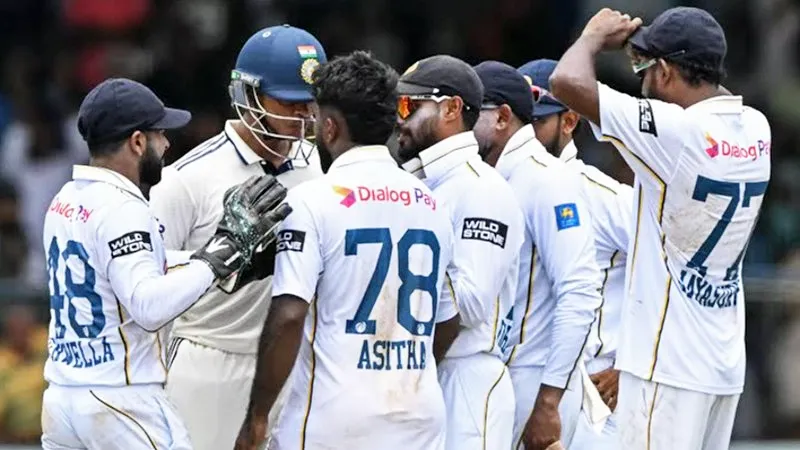

Article 2.12 is the ICC’s physical-contact clause, and it rarely leaves the code book. Yashasvi Jaiswal and Asitha Fernando were fined and given a demerit point after their heads made contact following Jaiswal’s dismissal in Colombo, and the article used against them separates this from a routine send-off, since it demands actual physical touch rather than words or gestures. That distinction is why officials reached for a clause used only a handful of times in international cricket, and why the punishment matters more than its modest size suggests.
Inside the Colombo Head-to-Head Incident
Fernando dismissed Jaiswal for 45 off 53 balls in the 17th over of India’s first innings, with the score at 66 for two. As Jaiswal turned back toward the pavilion, he changed course toward Sri Lanka’s celebrating huddle after something came from Fernando’s direction. Words followed, then Fernando moved his head toward Jaiswal.
Jaiswal leant his helmeted head forward in response, and the two made contact. Match referee Andy Pycroft of the Emirates ICC Elite Panel proposed the sanctions afterward. Both players admitted the offence immediately, which meant no formal hearing was needed. The passage of play lasted only a few seconds, but it was enough to draw the match referee’s full attention.
Jaiswal-Fernando SL vs IND 2026 sanction
Both players were fined 25 percent of their match fees and given one demerit point apiece. The charge fell under Article 2.12 of the ICC Code of Conduct, which covers inappropriate physical contact with a player, support staff, umpire, match referee, or anyone else during an international match.
That makes it a Level 1 breach, carrying a minimum reprimand and a maximum of half a match fee plus two demerit points. Neither Jaiswal nor Fernando carried any demerit points into the incident, so this counted as a first offence for both of them under the sport’s 24 month disciplinary window.
The Weight Behind a Level 1 Breach
Most flashpoints after a dismissal never reach Article 2.12. Send-offs, exaggerated celebrations, and verbal sparring usually fall under Article 2.5, which covers language or gestures that could provoke an aggressive reaction, or Article 2.6, which covers deliberately distracting a fielder.
Article 2.12 sits on a different tier entirely, reserved for cases where bodies actually touch. In Colombo, the heads made contact, and that physical detail is what pushed the incident past a standard send-off charge. Match officials do not reach for 2.12 unless they have seen contact that goes beyond words.
Past Article 2.12 Cases Compared
Shannon Gabriel has been charged under this article twice. He picked up a 50 percent fine and three demerit points for deliberate contact with Sarfraz Ahmed in April 2017, then a 30 percent fine and two demerit points for shoulder-barging Imrul Kayes in November 2018, a breach that triggered a one-Test ban once his points accumulated.
Player(s) | Incident | Punishment | Result |
|---|---|---|---|
Shannon Gabriel | Contact with Sarfraz Ahmed, April 2017 | 50% fine, 3 demerit points | No ban, points added |
Shannon Gabriel | Shoulder barge on Imrul Kayes, November 2018 | 30% fine, 2 demerit points | One-Test ban |
Virat Kohli | Shoulder contact with Hendricks, 2019 | Reprimand, 1 demerit point | No ban |
Shaheen Afridi | Stepped into Breetzke’s path, 2025 | 25% fine, 1 demerit point | No ban |
Jaiswal and Fernando | Head-to-head contact, August 2026 | 25% fine, 1 demerit point each | No ban |
Gabriel’s second charge shows how a routine Level 1 breach can turn into a ban once points pile up over time. A single Article 2.12 charge rarely means much on its own, but the category itself signals something the ICC treats as physically serious rather than merely verbal.
Neither Player Is Anywhere Near a Ban
Neither player is close to a ban. Under ICC rules, a player needs four or more demerit points inside a rolling 24-month window before those convert into suspension points. Jaiswal and Fernando both sit three points short of that line, and both played out the rest of the Colombo Test without any restriction.
The Jaiswal-Fernando SL vs IND 2026 sanction lands in the same disciplinary category as Gabriel’s 2018 shoulder-barge, which only became serious once his history caught up with him. Neither Jaiswal nor Fernando carries that baggage yet, but the specific article used here marks head-to-head contact as a line the ICC enforces, no matter who moved first.
Should the ICC hand out harsher first-offence penalties for head-to-head contact, or was a demerit point enough here? Share your take in the comments.
Frequently Asked Questions (FAQs)
What punishment did Yashasvi Jaiswal receive from the ICC?
Jaiswal was fined 25 percent of his match fee and given one demerit point. The sanction came under Article 2.12 of the ICC Code of Conduct after his head-to-head contact with Asitha Fernando in Colombo.
What is Article 2.12 of the ICC Code of Conduct?
Article 2.12 covers inappropriate physical contact with a player, official, or match personnel. It is a Level 1 breach carrying a minimum reprimand and a maximum of a 50 percent fine plus two demerit points.
How many demerit points can lead to a Test ban?
A player needs four or more demerit points within a rolling 24-month period before a ban applies. Four points convert into two suspension points, costing a player one Test or two white-ball internationals.
Did Jaiswal or Fernando get suspended after the Colombo incident?
No, both players received only a fine and one demerit point each. Since neither carried prior demerit points in the previous 24 months, the incident counted as a first offence for both of them.
What caused the confrontation between Jaiswal and Fernando in Colombo?
Jaiswal walked toward Fernando after being dismissed, and the pair exchanged words before their heads made contact. It happened in the 17th over of the second Test at the SSC on August 23, 2026.