

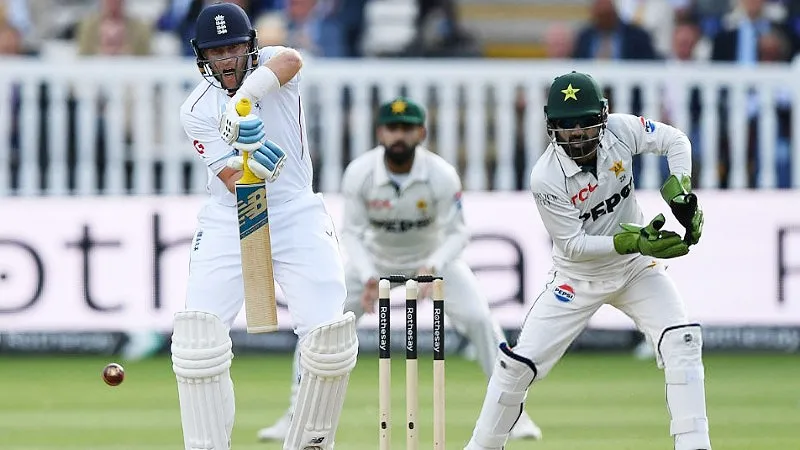

It means England’s seam-friendly pitches wasn’t only shaped by conditions, but potentially by the ball manufacturer too. Root was dismissed lbw in all three of his innings against Pakistan, and he believes a firmer, heavily lacquered seam is behind it, denting pitches and holding shape longer than in previous years. He isn’t alone: Ben Duckett and Jamie Smith were beaten by the same class of delivery. Root’s own numbers are extreme, but the wider pattern suggests conditions, not just technique, are driving it.
Root Points The Finger At The Ball Itself
England sealed a 2-0 series win over Pakistan at Lord’s on August 30, and Root left with an unwanted record: lbw in all three innings. Mohammad Abbas removed him at Headingley for 66 and again at Lord’s for 4, before Mohammad Ali got him for 24 in the second innings.
Root’s exclamation points at the ball rather than his technique. He believes the current batch of Dukes balls carries a heavier lacquer on the seam, keeping it firmer for longer than in past summers. He noted four of his seven lbw dismissals this summer were umpire’s call, meaning marginal enough to have gone either way.
A Firmer Seam Changes Ball Behaviour
Lacquer is sprayed onto the leather to protect it and improve swing aerodynamics. Applied more heavily to the seam, it keeps the stitching harder for longer, and Root’s theory is that this dents pitches and generates extra movement off the surface. Cricviz data backs the wider narrative: the Lord’s pitch for the second Test produced the second-highest false-shot percentage, 32.7 percent, in over 800 matches tracked since 2006.
England’s own attack cashed in too. Ollie Robinson finished the Lord’s Test with match figures of 8 for 35 in 27 overs. Neither Dukes nor the ECB had publicly responded to Root’s lacquer claim by the close of the match.
England vs Pakistan Test series 2026 LBW dismissals
Root’s case is extreme, but he isn’t the only batter troubled by the same mode of dismissal this series.
Batter | Innings | LBW Dismissals | Series Runs | Series Average |
|---|---|---|---|---|
Jordan Cox | 3 | 0 | 139 | 46.33 |
Dan Lawrence | 3 | 0 | 118 | 39.33 |
Jamie Smith | 2 | 0 | 77 | 38.50 |
Harry Brook | 3 | 1 | 95 | 31.66 |
Joe Root | 3 | 1 | 94 | 31.33 |
Emilio Gay | 3 | 1 | 39 | 13.00 |
Ben Duckett | 3 | 1 | 33 | 11.00 |
Ben Duckett was pinned lbw by Abbas in both his dismissed innings, at Headingley for 15 and in the Lord’s first innings for 17. Jamie Smith fell to an Ali nip-backer for 61 in that same innings. Root’s rate stands out on paper, but Duckett and Smith show this reaches beyond one batter.
Not Just A Root Problem Across The Order
The common thread isn’t technique so much as trajectory. Pakistan’s seamers, like England’s own, have bowled full and straight with a ball moving late and hitting the stumps. Duckett has been beaten by balls swinging into his pads more than once, and Smith fell to the same class of delivery that twice threatened Root.
Harry Brook, bowled by an Ali delivery angled across off stump, and Dan Lawrence, run out in the first innings, have largely avoided the lbw trap. Even so, neither has looked entirely comfortable against the sustained seam movement on show, and the false-shot numbers suggest the conditions carry a share of the blame regardless of who is at the crease.
Abbas And Ali Exploit The Conditions
Mohammad Abbas was the standout threat, taking 9 wickets across the Lord’s Test, including a five-for in England’s second innings, and 10 in the series overall. His method is classical: full length, hitting the top of off stump, and moving late into the right-hander. Mohammad Ali added 3 wickets in that same first innings with sharp nip-backers, the same delivery type that troubled Smith and Root twice over.
Both bowlers exploited a firmer ball that held its seam and cut off the pitch, especially under overcast London skies. England won 2-0, but their own batting fragility, needing 173.5 overs across Pakistan’s four innings, was not one-sided: Root’s side was also outbowled by Abbas in spells. Whatever the England vs Pakistan Test series 2026 LBW dismissals data proves about the ball, Pakistan’s seamers found the same weakness that England’s bowlers exploited right back.
Is this really a story about a firmer Dukes ball, or just classical seam bowling doing what it has always done? Share your read in the comments.
Frequently Asked Questions (FAQs)
Why is Joe Root getting out lbw so often this year?
He has been dismissed lbw seven times in nine innings this English summer. Root attributes it to a firmer Dukes ball producing more lateral movement, though four of those decisions were umpire’s call.
What changed with the Dukes ball this season?
Root believes the current batch carries a heavier lacquer on the seam. He says this keeps the seam firmer for longer, denting pitches and creating more movement off the surface than in previous summers.
How many times was Root dismissed lbw against Pakistan?
He was out lbw in all three of his innings across the two-Test series. Mohammad Abbas got him twice, at Headingley and Lord’s, while Mohammad Ali dismissed him lbw in the second innings at Lord’s.
Have other England batters struggled with lbw dismissals too?
Yes, Ben Duckett and Jamie Smith were both dismissed by similar deliveries. Duckett was pinned lbw by Abbas in both his dismissed innings, while Smith fell to an Ali nip-backer at Lord’s.
What does an umpire’s call mean in a DRS LBW review?
It means ball-tracking showed the delivery only marginally hitting the stumps. In that case, the original on-field decision stands, and Root pointed to four such calls among his own dismissals this summer.